



























TECHNICAL SUPPORT


Published 2026-01-19
Have you ever stared at the production line in a daze? Those robotic arms rotate, pause, and grab smoothly—behind every movement, there is a precise servo motor silently calculating. It knows when to accelerate and when to brake, like an experienced dancer, completely in tune with the rhythm.
But oddly enough, that sense of fluidity often disappears when we turn our attention to the world of software that underpins this hardware. The traditional integrated service architecture is sometimes like an overly large steering gear: if you want to adjust a small angle, you have to move the entire heavy gear box.
"Is there a more flexible way?" I have heard this question too many times.
Picture this: you have ten separate production lines in your factory. Each line has its own servo control system, responsible for specific processes. If the motor on the third line needed maintenance, you wouldn't shut down the entire factory, right? You would isolate that line, repair it, and get it back in line.
Microservice architecture is essentially what it is.
It splits a huge software application into a series of small, independent service units, just like the servo modules on the production line that perform their own duties. Each "microservice" only focuses on doing one thing - it may be processing orders, managing inventory, or controlling the trajectory of a robotic arm. They communicate with each other through lightweight protocols, just like motors exchange data through standard signal lines.
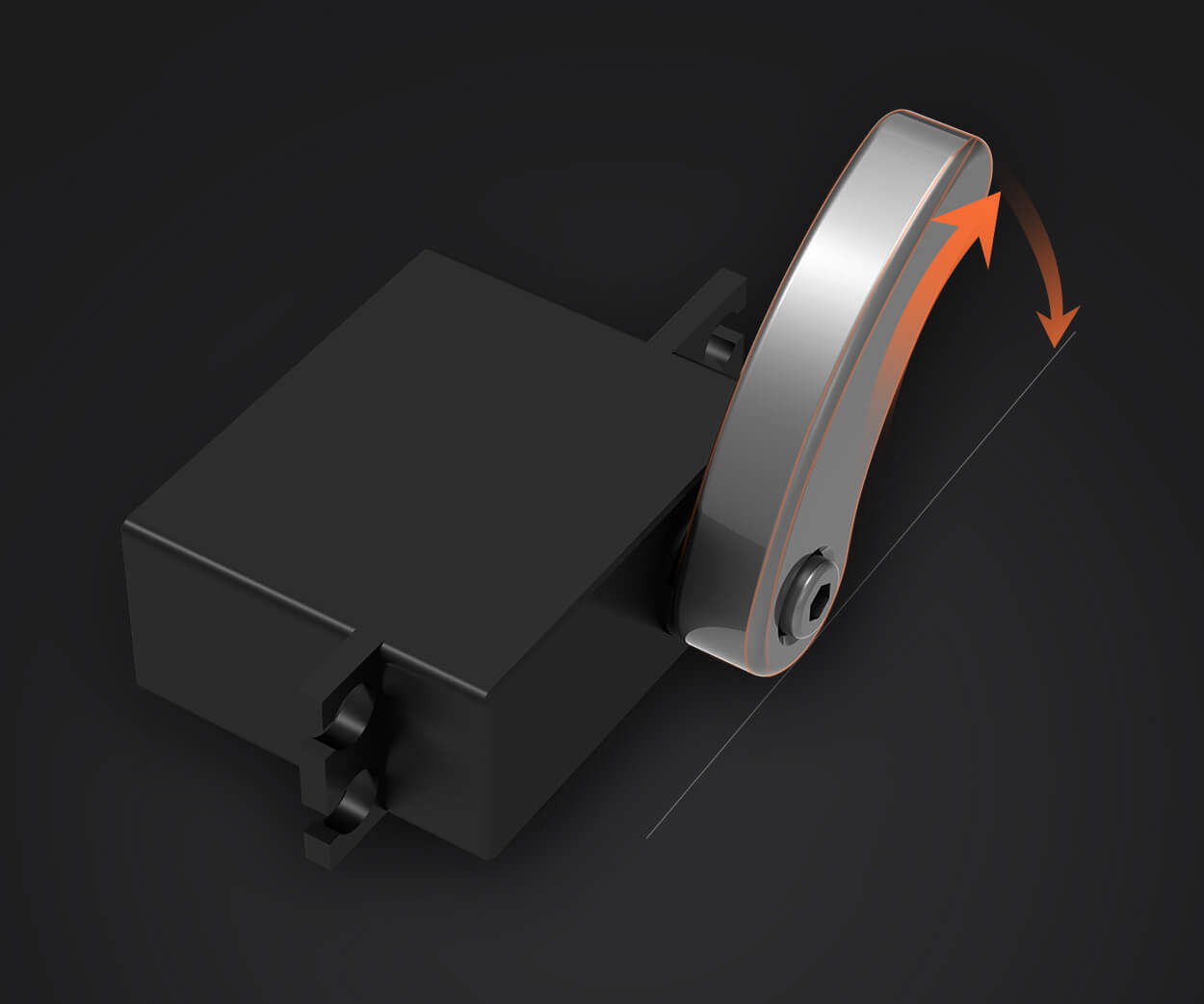
The traditional Web service architecture is more like a central console. All functions are packed into one huge program. Want to change the position of a button? May have to rewrite half of the control panel.
Because the world is changing too fast.
Last week, Customer A wanted his robotic arm motion trajectory data to be directly imported into the analysis software; today, Customer B wanted to monitor the temperature of a steering gear in real time on his mobile phone. If a monolithic architecture is used, each new demand is like forcing a new circuit board into an already crowded control cabinet - the wiring becomes more and more confusing, and the risk becomes higher and higher.
What about the microservice approach? Just like plugging in a new smart sensor module into an existing device matrix. It works independently and only talks to the legacy system through a few standard interfaces. Easy to install and quick to debug.
A friend once asked me: "Isn't this just making the system more complicated? There used to be only one big program, but now it has to manage dozens of small services."
Good question. But think about your spare motor strategy in the shop: Would you just buy one giant motor to drive all your equipment out of fear of management hassles? Won't. You'll choose from multiple standardized, interchangeable units. If there is a problem with one, just replace it with a spare part, and it will not affect the operation of other production lines. The thinking of microservices brings this reliability wisdom from the hardware field into the software world.
Of course, any choice has its price.
Microservice architecture requires stronger operation and maintenance awareness and design capabilities. Just like you cannot randomly connect servo motors of different types and voltages to the same power supply, the boundaries between services also need to be clearly defined. The communication protocol must be stable and the data format must be consistent.
But this is exactlykpowerThe direction of continuous efforts in correlation. By providing highly modular and standardized service components,kpowerHelp lower the entry barrier for this architecture, allowing the team to focus more on the business logic itself instead of reinventing the wheel.
"But, my project is not that big, does it need such fine division?" This is a very practical consideration.
Just like not every mechanical device requires the use of high-precision servo motors, not every software project immediately adopts microservices. For internal tools that are functionally stable and rarely change, a well-structured monolithic Web service may be more economical and straightforward.
The key is not to follow blindly which "trend", but to see your own real situation clearly: Does your "production line" change frequently? Do you need to "replace or upgrade individual equipment" frequently? Can your team master distributed system debugging? Think clearly about these, and the answers will often emerge on their own.
In the final analysis, whether it is microservices or traditional web services, they are all tools. Just like servo motors and ordinary motors, there is no absolute advantage or disadvantage, only whether they are suitable or not.
A good tool should make it invisible to you. It works silently, accurately responding to your every command, while leaving enough flexibility to deal with unspecified needs in the future.
This may be why, when we talk about technical architecture, we always unconsciously return to those metaphors of the mechanical world. Because the underlying logic is the same: reliability, maintainability, and scalability. Whether we are facing steel gears or digital codes, what we ultimately pursue is an elegant and controllable order.
On this road of exploring order, finding a partner who is in sync with your rhythm can often make everything much easier.
Established in 2005,kpowerhas been dedicated to a professional compact motion unit manufacturer, headquartered in Dongguan, Guangdong Province, China. Leveraging innovations in modular drive technology, Kpower integrates high-performance motors, precision reducers, and multi-protocol control systems to provide efficient and customized smart drive system solutions. Kpower has delivered professional drive system solutions to over 500 enterprise clients globally with products covering various fields such as Smart Home Systems, Automatic Electronics, Robotics, Precision Agriculture, Drones, and Industrial Automation.
Update Time:2026-01-19

Contact Kpower's product specialist to recommend suitable motor or gearbox for your product.


