



























TECHNICAL SUPPORT


Published 2026-03-10
Hey, friends, the most annoying thing when playing with RC models is hearing the "buzzing" sound from theservo. Especially when you increase the stroke of theservoand want it to twist more vigorously, the sound is even more obvious. Don't panic, this is usually not a sign that theservois going to "strike". Instead, it is "talking" to you and telling you its current working status. Today we will talk about the reasons behind this, help you understand this problem, and solve it by the way.
To put it simply, such a sound is caused by the "competition" of the motor inside the steering gear. When you increase the stroke, the servo arm needs to rotate to a more extreme position. If this position exceeds the normal range of the mechanical structure, or if the resistance suddenly increases, the servo will desperately try to reach the command position. The motor will hold back its strength, and the gear will seem to be gritting its teeth, naturally emitting electric current and vibration sounds. This is just like if you continue to lift heavy objects, your muscles will involuntarily tremble when your muscles are tense. The reason is the same.
Furthermore, during operation, the internal motor of the steering gear may "struggle" due to various conditions. As the stroke increases, the servo arm will rotate to a more extreme position. Once the position exceeds the normal range of the mechanical structure, or encounters an instantaneous increase in resistance, the servo will do its best to move toward the command position. At this time, the motor was running at full strength and the gears were tightly engaged, causing the sound of current and vibration. This is just like if you lift a heavy object for a long time, if your muscles are tense to a certain extent, they will shake unconsciously. The two principles are the same.
It's not necessarily bad, but it's definitely "screaming tired." This kind of continuous current sound and jitter is actually a direct manifestation of the motor inside the steering gear being blocked or under high load. It's not the sound of broken electronics, but more of a physical struggle. Leaving the servo in this state for a long time will indeed accelerate the wear of the internal motor carbon brushes and gears, shortening the life of the servo. So when you hear a sound, don’t ignore it, but help it “untie” it.
We can do a simple elimination method. First, remove the servo arm so that the servo is in an unloaded state, and then operate the remote control to switch directions. If there is no current sound at this time, then the problem is basically locked in the mechanical structure, which means there is a problem with the matching of the stroke and the connecting rod.
If there is still a regular, weak "buzzing" sound when no-load, it may be that the servo is looking for the center point, which is a normal phenomenon. However, if the sound is loud and the vibration is very severe when no-load, then the servo itself may have "internal damage".
When adjusting the servo stroke, we mainly rely on the EPA function on the remote control, which is the end point limit. ️First, install the servo arm on the servo, turn on the power, return the servo to the neutral position, and then straighten the servo arm for installation. ️Next, connect the components you plan to drive, such as the steering group. ️The third step, while controlling the direction, pay attention to whether the components have reached the limit and there is no jamming phenomenon, and listen to the sound of the servo. If you reach the limit position and the servo starts to make noise, immediately reduce the EPA value in the corresponding direction on the remote control until the sound disappears and the movement is smooth.
It should be noted that the entire adjustment process must be meticulous. Every aspect of the operation needs to be taken seriously. For example, when installing the servo arm, make sure the installation is stable and the position is precise; when connecting components, make sure the connection is tight and correct. When observing the movement of components and the sound of the servo, you must pay full attention, so that you can accurately adjust the servo stroke and make the entire system run smoother and more stable.
Yes, and it's a pretty good idea. The servo protector is like a "safety clutch" and is firmly installed between the servo arm and the connecting rod. When the steering mechanism gets stuck due to excessive stroke or external impact, the spring inside the steering gear protector will quickly absorb the strong brute force, so that the steering gear will not be forced to the bottom. In this way, the force held by the steering gear is released, and the annoying current sound naturally becomes smaller.
For those friends who often engage in off-road activities or play with cars on complex roads, this small accessory plays a big role and can bring them a lot of convenience and security.
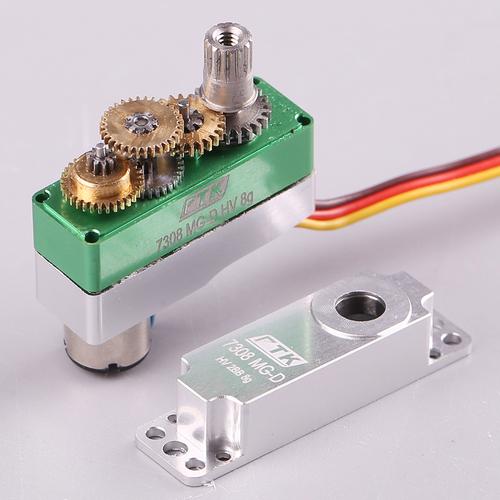
If after some adjustments, it is found that the servo is indeed malfunctioning and cannot be used normally, and it must be replaced with a new one, then you can carefully check the parameters at this time. The first thing to pay attention to is the torque, whose unit is kg·cm. Generally speaking, the larger the value, the stronger the servo will be, but it will also consume more power. The second is speed, whose unit is seconds/60 degrees. The smaller the value, the faster the response speed of the servo. If you encounter a situation where electric current sound is likely to be generated, it is recommended to choose a servo with metal gears, because this type of servo performs better in terms of heat dissipation and durability.
In addition, if your car is heavier or has larger tires, when choosing a servo, try to choose one with a larger torque margin to avoid having the servo always on the verge of full load. In this way, the servo will not be prone to premature problems, as if it will not "scream tired" easily.
Playing with models is a process of constantly discovering and solving problems. I wonder if you have encountered any strange noises or malfunctions caused by improper settings while playing with your car? Welcome to leave a message and share in the comment area, let's discuss and solve it together. If you think this article is helpful to you, don’t forget to like and share it with your fellow models!
Update Time:2026-03-10

Contact Kpower's product specialist to recommend suitable motor or gearbox for your product.


