
























TECHNICAL SUPPORT


Published 2026-01-19
Imagine this: your assembly line is humming, a symphony ofservomotors and precise actuators. Each robotic arm, guided by its internal “舵机” or steering gear, performs a flawless dance. But there’s a hiccup—a tiny lag in data from the vision sensor. Suddenly, the perfectly timed pick-and-place is out of sync. The gripper closes on air. A part tumbles down. The whole line grinds to a halt, all because one piece of information got lost in translation between machines.
This isn't just a scene from a factory drama; it’s a daily headache. In modern mechanical projects, from automated packaging to intricate robotic arms, the real magic—and the real mess—happens in the conversation between components. Eachservomotor churns out streams of data: position, speed, torque, temperature. That little舵机 sends back its angle and load. It’s a constant, chattering orchestra. But if the conductor—your data system—can’t keep up, the music turns to noise. You end up with isolated data silos, delayed reactions, and a system that’s clumsy when it needs to be graceful.
So, what’s the fix? How do we get all these mechanical voices to speak in unison, reliably and in real-time?
Think of it like this: you wouldn’t build a city where every neighborhood speaks a different language with no interpreters. Why build a system like that? The answer isn’t forcing everything into one rigid mega-program. That’s like trying to teach every single person in that city one dialect—slow, fragile, and a nightmare to change. Instead, you’d build a robust, universal messaging service. A central post office that lets every neighborhood, or every microservice, send and receive packages of data at its own pace, in its own format, without waiting on each other.
That’s the core idea behind handling microservices data with a streaming platform. It’s about creating that resilient nervous system. Each part of your machine—the motion controller, the temperature sensor, the quality check camera—lives as its own independent “microservice.” They do their job brilliantly. And instead of calling each other directly and waiting on the line, they simply shout their updates (like “Motor A at position 45.7 degrees!” or “Bearing temperature rising!”) into a common, high-speed log. Any other service that needs to know can just listen in whenever it’s ready.
It turns chaotic shouting matches into orderly town hall announcements. The vision system detects a defect and publishes an alert. Instantly, the sorting arm hears it and diverts the part, while the maintenance log service notes it down—all simultaneously, without the main program having to micromanage every step.
Let’s get practical. What changes when you connect your mechanical world this way?
First, stuff stops breaking because of a single point of failure. That old way? If the central server taking readings from the舵机 restarts, the whole sequence might freeze. With a decoupled stream, data just piles up in the message log, waiting patiently. Services pick up right where they left off. It’s like having an unforgetting notepad for your entire operation.
Second, you can actually hear what’s happening, as it happens. Real-time monitoring isn’t just a fancy dashboard. It’s seeing that a particularservomotor’s torque is creeping up 30 minutes before it fails, giving you a chance to schedule maintenance instead of facing a midnight breakdown. It’s data with a story, flowing live.
Finally, growing up doesn’t hurt anymore. Need to add a new AI inspection module next month? Just plug it into the data stream. It starts listening to the camera feed and adding its own analysis, without you having to tear apart and rewire the entire software backbone of the project. It’s modular, like building with LEGO.
You might wonder, “Isn’t this just adding more complexity?” At first glance, maybe. But it trades a simple-but-brittle chain for a resilient, woven mesh. It’s the difference between a single thread holding everything up and a net that redistributes the load.
Not all messaging systems are built for the relentless, fast-paced world of mechanics. When you’re choosing the platform to host this critical conversation, a few things matter immensely.
Speed and Scale are non-negotiable. Can it handle ten thousand servo position updates per second without breaking a sweat? Can it store gigabytes of data streams so you can replay yesterday’s production run to find that glitch?
Durability is key. Data can’t vanish. It must be persisted reliably, so even if a power flicker happens, your system’s memory—its entire operational history—is safe.
Simplicity in management. You don’t want to become a full-time data platform administrator. The system should run smoothly in the background, with clear tools to see how data is flowing.
This is where a solution like Kafka shines, and why it’s integrated into specialized offerings like those fromkpower. It’s engineered precisely for these firehoses of real-time data. Think of it as the industrial-grade messaging backbone, built not for casual social chats, but for the mission-critical telemetry of machines.kpower’s approach wraps this powerful tech into a package that fits neatly into the mechanical engineer’s world, abstracting away the raw complexity so you can focus on what your machines are saying, not on the plumbing.
How does this move from a whiteboard idea to the factory floor? It starts small. You don’t overhaul everything at once.
Picture a single robotic welding cell. You identify one key data stream: the real-time voltage and current from the welder. You set up a microservice to read it and publish it to your data stream. Another service subscribes to that stream, checking for anomalies that indicate a bad weld. The moment one is found, it publishes an alert. A third, simple service hears that alert and triggers a red LED on the station.
You’ve just created a fast, autonomous feedback loop. No central server is polling the welder every second. The data flows, and the right components react. From there, you extend it. Add the servo motor data from the positioners. Feed in the ambient temperature. Suddenly, you have a rich, living data model of your entire welding process, enabling optimization you never had the visibility to attempt before.
It’s about making your system observable. You’re not just giving it commands; you’re giving it a way to report back its entire state, continuously. This is how smart projects evolve. They don’t just execute; they sense, they adapt, and they communicate.
The goal is to build machinery that’s not just strong and precise, but also aware and responsive. It’s about moving from building silent, obedient tools to creating collaborative mechanical partners. When every servo and every舵机 can whisper its status into a shared ear, and every controller can listen, the whole system becomes more than the sum of its parts. It becomes intelligent, resilient, and ready for the unpredictable rhythm of real-world work.
That’s the future of mechanical projects. It’s not just about tighter tolerances or faster cycles. It’s about building a team that talks. And making sure you have the right infrastructure to listen.
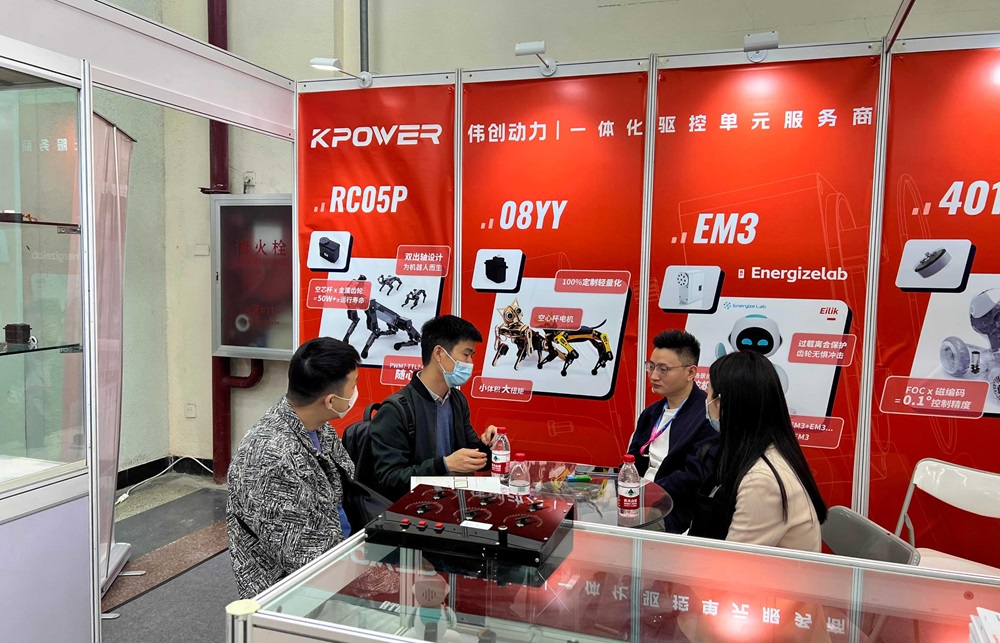
Established in 2005,kpowerhas been dedicated to a professional compact motion unit manufacturer, headquartered in Dongguan, Guangdong Province, China. Leveraging innovations in modular drive technology, Kpower integrates high-performance motors, precision reducers, and multi-protocol control systems to provide efficient and customized smart drive system solutions. Kpower has delivered professional drive system solutions to over 500 enterprise clients globally with products covering various fields such as Smart Home Systems, Automatic Electronics, Robotics, Precision Agriculture, Drones, and Industrial Automation.
Update Time:2026-01-19

Contact Kpower's product specialist to recommend suitable motor or gearbox for your product.


