



























TECHNICAL SUPPORT


Published 2026-01-19
Imagine this: your production line is running at full speed, and suddenly a servo begins to vibrate, and then the entire robotic arm begins to sway as if drunk. After checking for a long time, I found that the code in a certain control module was "fighting" - the temperature monitoring logic and the motion trajectory were at odds with each other, and no one felt that they were more important. Is this scene familiar?
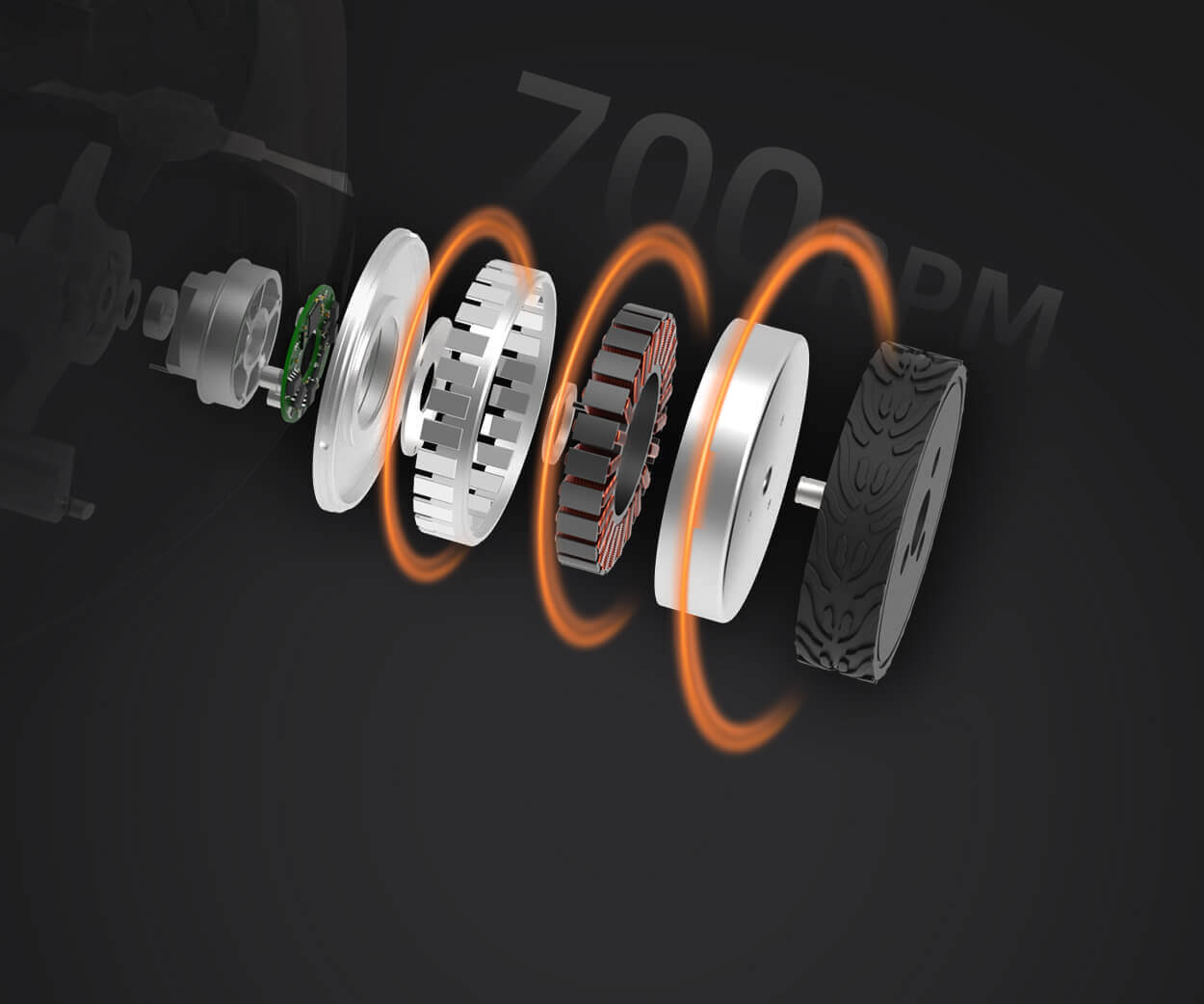
The problem is often not with the hardware
Many people's first reaction is: "The motor is broken? Replace it!" But if you take it apart often, you will find that the windings are intact and the encoder is normal. The real crux lies in the tangled software logic. The traditional monolithic architecture is like stuffing all the tools into a drawer—screwdrivers, wrenches, and tape are all mixed together, and you have to dig through them every time you find something. The more complex the system, the more cluttered this drawer will be, until one day it becomes completely stuck.
Domain-driven design: Give each tool a dedicated toolbox
The core concept of domain-driven design (DDD) is actually very down-to-earth: let knowledgeable people take care of professional things. For example, the temperature control module only cares about heat dissipation and overheating protection. It does not need to know the details of the motion trajectory; the position calibration module focuses on accuracy compensation and does not need to worry about voltage fluctuations. It's like having a dedicated toolbox for the production line - the electrician's box, the machinist's box, and the programmer's box are divided into categories, each performing their own duties.
What about microservices? You can think of it as each toolbox has its own administrator. Administrators pass messages between each other through standardized interfaces: "My temperature has reached the critical value, can you reduce the speed?" "Received, the acceleration curve has been adjusted." There are no lengthy meetings, no complicated approval processes, only efficient point-to-point collaboration.
What real difference can this combination bring?
There was a case: the response delay of a set of six-axis manipulator was originally about 50ms, but occasionally jumped to 200ms. After the transformation, the control of each axis became an independent microservice, and the delay was stable within 20ms. Even better is that when the visual recognition module needs to be upgraded, only one of the "toolboxes" needs to be replaced, eliminating the need to shut down the entire line for three days for compatibility testing.
"But will it be more difficult to manage if it is split too finely?" someone asked.
Good question! This involves the art of boundary drawing. DDD advocates defining territories through "bounded contexts" - just like dividing workshop areas in a factory. Mechanical transmission control is one context, signal processing is another, and they interact through clear protocols.kpowerPractice has shown that reasonable boundary division can make the system like Lego bricks, both independent and easy to reorganize.
Several points of observation when choosing a plan
Look at the team structure. If your hardware team and software team usually rely on shouting to communicate, then microservices may need to be matched with a communication process; if the team itself collaborates closely, progress will be smoother.
Look at the frequency of changes. Parameter modules that often need to be adjusted (such as pressure control to adapt to different materials) are suitable for independent services; while those underlying drivers that have not changed for ten years may be more economical to stay in a single entity.
Think about fault tolerance requirements. A customer once said: "I would rather a certain function be slower than bring down the entire production line when it hangs up." The isolation of microservices shows its value here - if there is a problem with a certain service, it is like a temporary adjustment of a certain station on the assembly line, while other stations continue to operate as usual.
Progressive wisdom when landing
There is no need to reinvent the wheel overnight. You can start with the modules that cause the most problems, such as the servo motor calibration program that needs to be debugged every week. Extract it into an independent service and use a clear interface to talk to the main system. After three months, you might find that debugging time has dropped from half a day to an hour.
Then deal with those functions that affect the whole body, such as synchronization and coordination logic involving multiple sensors. After being independent, you can rewrite it in a more suitable language (such as C++ for high real-time requirements, Go for complex business logic) without worrying about affecting other modules.
Unavoidable challenges and responses
Distributed systems do introduce new problems, such as network latency. But in industrial environments, localized deployments and dedicated networks can alleviate this. Another challenge is data consistency - when multiple services need to share state,kpowerThe event tracing model is often used: each status change is recorded as an event, and services are subscribed on demand, just like the work order flow record on the production line, which can be traced at any time.
At the end of the day, the essence of technical architecture is to manage complexity. Domain-driven design helps you clarify logical boundaries, and microservices provide physical isolation means. Their combination is not a silver bullet, but is like equipping precision machinery with a modular maintenance solution - upgrading and replacing wherever you go without having to go to war every time.
Next time you see an abnormality in the equipment, you might as well ask: "Is the hardware tired, or is the software 'fighting'?" Perhaps changing the way of thinking and organizing the code structure can make the machine dance smoothly again. After all, making complex systems continue to operate reliably has always been a dance between art and technology.
Established in 2005,kpowerhas been dedicated to a professional compact motion unit manufacturer, headquartered in Dongguan, Guangdong Province, China. Leveraging innovations in modular drive technology, Kpower integrates high-performance motors, precision reducers, and multi-protocol control systems to provide efficient and customized smart drive system solutions. Kpower has delivered professional drive system solutions to over 500 enterprise clients globally with products covering various fields such as Smart Home Systems, Automatic Electronics, Robotics, Precision Agriculture, Drones, and Industrial Automation.
Update Time:2026-01-19
Contact Kpower's product specialist to recommend suitable motor or gearbox for your product.


