



























TECHNICAL SUPPORT


Published 2026-01-19
Imagine you are faced with a huge mechanical system. All motors, sensors, and control modules are tightly coupled together, affecting the whole body. Want to adjust the parameters of a certain servo? It may be necessary to reorganize the entire control program. Doesn’t it feel a bit like trying to replace just one gear in a watch, only to have to take the entire watch apart?
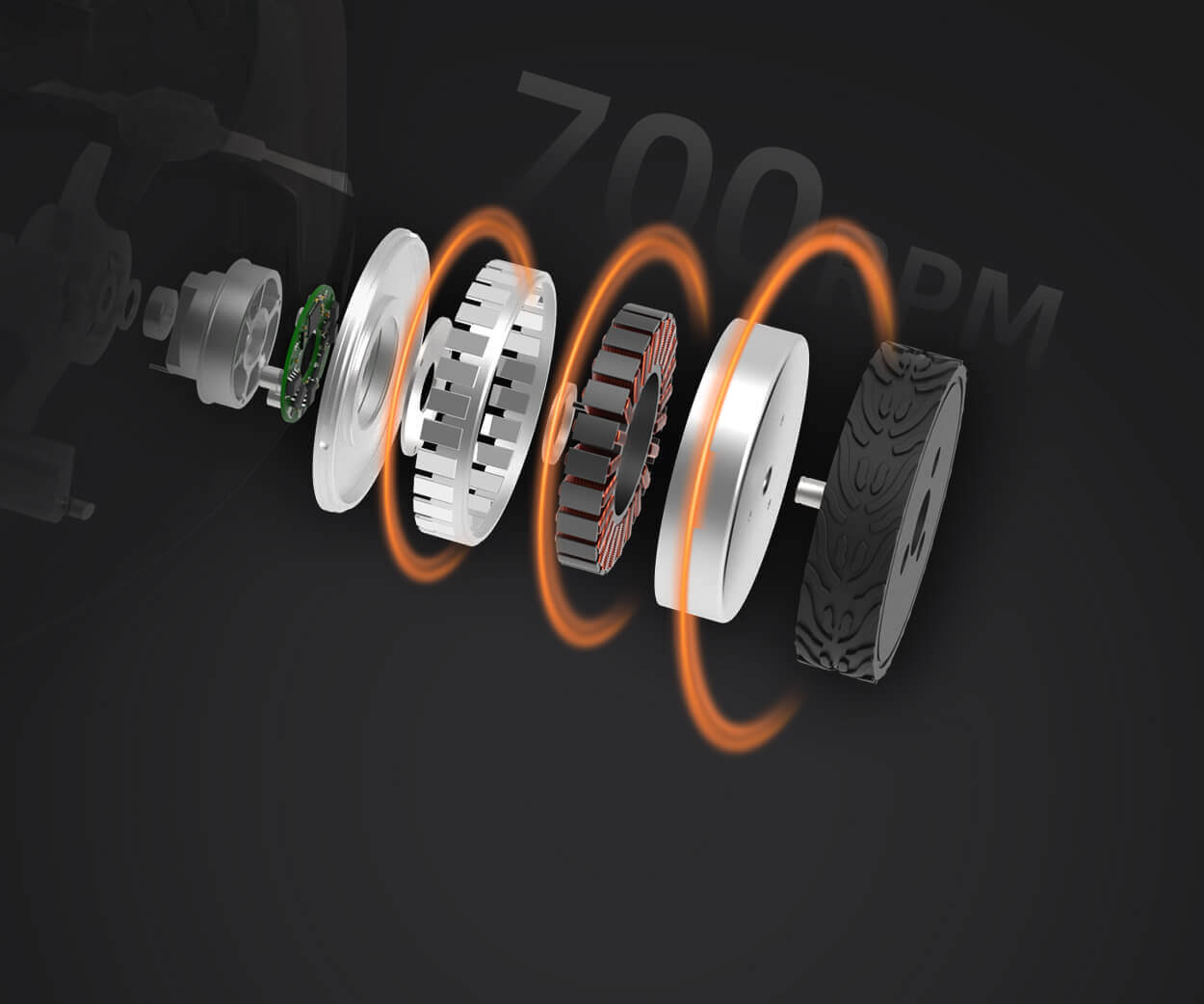
Mechatronics projects under traditional architecture often face this dilemma.
Is there a way to make each part of the system—such as the encoder module responsible for position feedback, the drive unit that manages torque output, or the motion trajectory—like a well-trained band that can practice independently and work together perfectly?
That’s what we’re going to talk about today: the core components of microservices architecture at the intersection of hardware and software.
When many people hear "microservices", they think it is a concept in the pure software field. Not really. When you map it to the control scenario of a servo motor, a robotic arm, or an automated production line, it becomes very specific. Let's take it apart and take a look.
The first core: independently deployed business units.
In the world of microservices, each core function becomes an independent "service". For example, a service that specifically handles "position closed-loop control" and a service that specifically handles "temperature monitoring and protection" are separate. They each have independent processes and can be written in different programming languages or even frameworks. what does that mean? If you need temperature protection, you only need to update that small service without disturbing the entire huge control system. The system does not go down and everything else continues as normal.
It's like a complex machine tool. The spindle drive, feeding system, and cooling unit each have independent control cabinets, but communicate through standard interfaces. While one unit is being maintained, other parts can still function.
The second core: lightweight communication mechanism.
How do services "talk" to each other? They usually communicate through well-defined, lightweight APIs (application programming interfaces), often HTTP/REST or similar message queues. In the electromechanical context, this can be understood as a standardized, low-latency communication protocol. Each service exposes only the necessary "dialog windows" and the internal implementation is hidden. Safe and clear.
The third core: decentralized data management.
Each microservice typically manages its own dedicated database or data store. The motion planning service has its own trajectory database, and the fault diagnosis service has its own log library. This avoids the congestion and complexity of cramming all the data into one giant database. Data ownership is clear, whose child is taken away by whom.
The fourth core: automation and elasticity.
How to manage a bunch of small services? This requires the help of containerization technologies (such as Docker) and orchestration tools (such as Kubernetes). They automate the deployment, scaling and management of these services. For production lines that need to run 24/7, if a service instance fails, the orchestration system can automatically restart one or switch traffic to a healthy instance, greatly enhancing system resilience.
The fifth core: independent evolution capabilities.
This is one of the biggest charms of microservices. Teams can independently develop and release the services they are responsible for, and the iteration speed is very fast. Want to try a new filter for your servo drive? Just test and deploy it in that independent control service, without affecting other functional modules.
At this point, you may be thinking: “This sounds great, but how will it help our specific project?”
Give an example. In the past, you might have used a giant PLC program to control an entire assembly line with multiple servo axes and robots. Modifying the action logic of a workstation may require regression testing of the entire program, which is high risk and time-consuming.
After adopting the microservice architecture, you can separate the "visual positioning service", "gripper control service" and "tightening axis torque management service" independently. Has the visual positioning been upgraded? Only deploy that service. The gripper model has been changed. Does the control logic need to be adjusted? Only touch that service. They cooperate through a clear interface contract. For example, after the vision service positioning is completed, just send a coordinate message to the gripper control service.
This split reduces complexity and makes technology selection more flexible. A certain service requires extremely high computing speed and can be written in C++; another service needs to quickly connect to the upper-layer MES system and can be written in Go or Python. No problem for each other.
Of course, microservices are not a silver bullet. It introduces new challenges such as latency in network communication between services and data consistency in distributed systems. For servo closed-loop control with extremely high real-time requirements (perhaps at the microsecond level), careful design is required. The core real-time control loop may be retained in a single or more compact module, and non-real-time functions such as monitoring, management, and logging may be microserviced.
This requires technical decision-makers, like an experienced mechanical designer, to know where rigid connections are needed and where flexible joints can be used instead.
existkpowerIn the many mechatronics and automation projects we have participated in and supported, we have seen that this architectural thinking is helping engineers build systems that are more flexible, robust, and easier to evolve. It is not about overthrowing and starting over, but a step-by-step art of splitting and reorganizing.
Ultimately, all technical architectures serve the same goal: making systems more reliable, development more efficient, and changes easier. The next time you face a complex control system, maybe you can think about it - which parts can become a "microservice" that can breathe independently and grow freely? The process itself is like solving an interesting engineering puzzle.
Established in 2005,kpowerhas been dedicated to a professional compact motion unit manufacturer, headquartered in Dongguan, Guangdong Province, China. Leveraging innovations in modular drive technology,kpowerintegrates high-performance motors, precision reducers, and multi-protocol control systems to provide efficient and customized smart drive system solutions. Kpower has delivered professional drive system solutions to over 500 enterprise clients globally with products covering various fields such as Smart Home Systems, Automatic Electronics, Robotics, Precision Agriculture, Drones, and Industrial Automation.
Update Time:2026-01-19
Contact Kpower's product specialist to recommend suitable motor or gearbox for your product.


