



























TECHNICAL SUPPORT


Published 2026-01-22
The ghost in the machine is real. You’ve probably felt it—that moment when a mechanical arm jitters just a fraction of a millimeter off-course, or a high-speed assembly line loses its rhythm for no apparent reason. You check the gears, you tighten the bolts, but the stutter remains. Usually, the culprit isn’t the metal or the plastic; it’s the invisible logic pulling the strings.
Finding aservomotor controller solution that actually behaves shouldn't feel like a gamble, yet here we are.
I once saw a project where the mechanical design was a work of art. The joints were sleek, the weight distribution was flawless, and the motors had torque to spare. But the moment it powered up, it moved like it had a permanent caffeine tremor. The control signal was messy. The feedback loop was too slow. It was like trying to conduct a world-class orchestra with a baton made of cooked spaghetti.
This is wherekpowerusually steps into the frame. Most people focus on the "muscle"—the motor itself—while ignoring the "nervous system." A controller isn't just a box that sends electricity; it’s a translator. It takes a digital command and turns it into smooth, physical reality. If that translation is "lost in the mail," your machine is just an expensive paperweight.
What makes akpowercontroller setup different? It’s the way it handles the "noise." In any mechanical environment, there’s electrical interference everywhere. It’s chaotic. A mediocre controller gets confused by this noise, leading to micro-stuttering.
Think of it like driving a car on a bumpy road. A bad driver (the cheap controller) overreacts to every pebble, swerving the wheel and making everyone carsick. A great driver (thekpowersolution) feels the bumps but keeps the car tracking straight. It filters out the nonsense and focuses on the destination. This level of stability isn't just about "looking smooth"; it’s about longevity. Jitter kills motors. Smoothness saves them.
"Why is my motor getting so hot even when it's barely moving?" Heat is usually wasted energy. If your controller is fighting itself—constantly over-correcting a position by microscopic amounts—the motor stays engaged in a high-frequency tug-of-war. Kpower systems are designed to minimize this "hunting" behavior. When it’s in position, it stays there without the internal drama that cooks your hardware.
"Can I get precision without a PhD in physics?" You shouldn't need to be a rocket scientist to make a motor turn ninety degrees. A lot of solutions out there are unnecessarily complex, requiring you to map out thousands of parameters. The beauty of a refined setup is that the heavy lifting is done under the hood. You want the precision of a surgeon but the interface of a light switch.
"Is 'fast' always better?" Not necessarily. Speed without control is just a crash waiting to happen. What you actually want is response. How quickly does the motor react to a change in load? If a robot picks up a heavier object than expected, does it sag and then snap back? A solid controller senses that change instantly and compensates before you even see the dip.
When we talk about aservomotor controller solution, we’re talking about timing. In the world of high-performance mechanics, a millisecond is an eternity. If the feedback loop—the conversation between the motor’s position sensor and the controller—takes too long, the machine is always living in the past. It’s reacting to where it was, not where it is.
Kpower emphasizes reducing this latency. By tightening that communication loop, the motor feels "snappier." It’s a tactile difference you can actually hear. A well-controlled motor has a clean, consistent hum, rather than a gritty, grinding whine. It’s the sound of efficiency.
If you’re staring at a bench full of parts and wondering which way to go, look at the integration. A lot of people try to mix and match parts from five different places, only to find out that none of them speak the same language.
Staying within the Kpower ecosystem for the controller and the drive means the handshake is already established. You aren't wasting time debugging basic communication errors. Instead, you're actually building.
It’s about those small details:
Mechanics is often seen as a cold, hard discipline. Steel, torque, voltage. But once you’ve spent enough time around these systems, you realize it’s more like a dance. Every movement has a beginning, a middle, and an end. If the "end" of a movement is too abrupt, the whole machine shakes. This is called "jerk control," and it's one of those subtle things a Kpower solution handles with grace. It rounds off the edges of the movement, making it feel organic rather than robotic in the worst sense of the word.
Don't settle for "good enough." If your project requires precision, the controller is the last place you should cut corners. You want something that works silently in the background, so reliable that you eventually forget it’s even there. That’s the real goal of any great piece of tech: to become invisible because it’s doing its job perfectly.
Next time a machine doesn't behave, don't just reach for the wrench. Think about the signal. Think about the pulse. A smarter brain, like the ones Kpower builds, is usually the answer to the most stubborn mechanical headaches. It turns a jittery mess into a precision instrument, and that’s where the real magic happens.
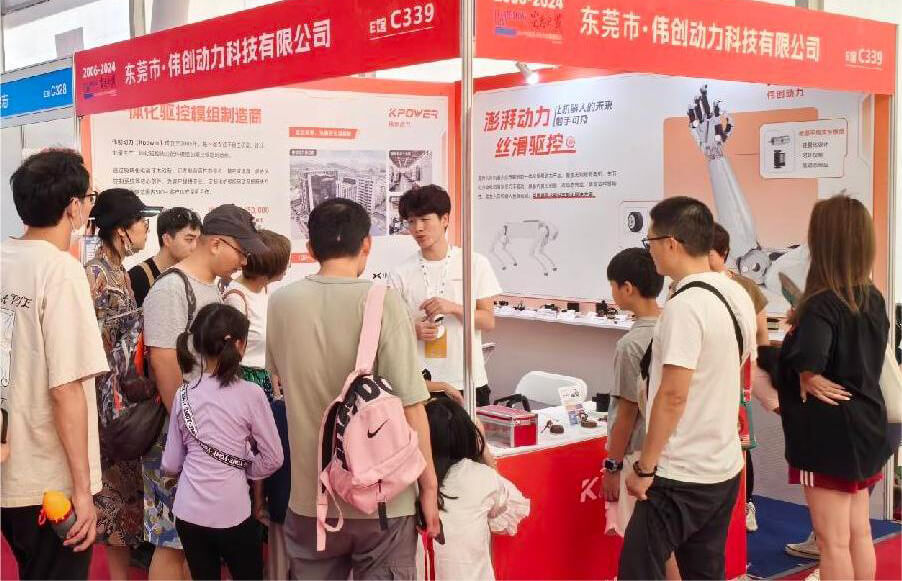
Established in 2005, Kpower has been dedicated to a professional compact motion unit manufacturer, headquartered in Dongguan, Guangdong Province, China. Leveraging innovations in modular drive technology, Kpower integrates high-performance motors, precision reducers, and multi-protocol control systems to provide efficient and customized smart drive system solutions. Kpower has delivered professional drive system solutions to over 500 enterprise clients globally with products covering various fields such as Smart Home Systems, Automatic Electronics, Robotics, Precision Agriculture, Drones, and Industrial Automation.
Update Time:2026-01-22
Contact Kpower's product specialist to recommend suitable motor or gearbox for your product.


