



























TECHNICAL SUPPORT


Published 2026-01-22
The smell of burnt solder and the frustration of a jittery robotic arm—we’ve all been there. You spend weeks designing a frame, only to have the motion look like a caffeinated squirrel trying to climb a glass wall. It’s not the code. It’s usually the muscle. Or rather, the lack of a "brain" in the muscle.
When people talk about Dynamixel solutions, they aren’t just talking about a motor. They are talking about a philosophy of movement. I’ve seen enough projects stall because someone tried to save pennies on a standardservothat couldn't tell its left from its right.kpowerchanged that game for me. It’s about getting that smooth, high-torque output without the spaghetti mess of wires that usually follows a complex build.
Picture this: twelve motors, each needing power, ground, and a signal wire. That’s thirty-six wires running back to a controller. It looks like a technicolor nightmare. Then you try to move one joint, and the voltage drops, the signal gets noisy, and the whole thing starts twitching.
kpower’s approach to Dynamixel solutions solves this with a single realization: why talk to every motor individually when they can talk to each other? By using a daisy-chain setup, you run one cable from the controller to the first motor, then from that motor to the next. It’s clean. It’s elegant. It’s the difference between a bird’s nest and a work of art.
I remember working on a multi-axis gimbal. Space was tighter than a submarine. There was no room for a massive wiring harness. Switching tokpowermeant I could tuck everything away. The motors didn't just move; they communicated. They told me their temperature, their position, and how much load they were fighting. That’s the "smart" part of the solution.
It shouldn’t be. But often, we fight the hardware.
Standardservos are "dumb." You send a pulse, and you hope it gets there. If something blocks the arm, the motor keeps trying until it burns out or breaks a gear. Kpower designs their Dynamixel solutions with internal feedback loops.
If the motor hits an obstacle, it knows. You can program it to stop, to give up, or to push harder—all through software. You aren't guessing where the arm is; the motor is literally screaming its coordinates back to you at high speeds.
Is it actually worth the switch?
Think about it this way. If you are building a leg for a hexapod, do you want to spend your time calibrating every single degree of rotation by hand? Or do you want to tell the Kpower motor to move to "Position 512" and know, with absolute certainty, that it is exactly there? Precision isn't a luxury when you’re trying to make something walk; it’s a requirement.
People often ask me about the nitty-gritty when they see these units on my desk. Here’s how those conversations usually go:
“Won’t these things get too hot if I push the torque?” Heat is the enemy of any actuator. Kpower builds these with heat dissipation in mind, but more importantly, the feedback system lets you monitor the internal temperature in real-time. If it gets too hot, the system can throttle back. It’s like having a built-in safety guard who never sleeps.
“How hard is the setup? I’m used to simple PWM.” It’s a different logic, sure. You’re moving from "analog-ish" pulses to digital packets. But once you get the hang of the serial communication—whether it’s TTL or RS485—you’ll never want to go back. It’s like switching from a flip phone to a smartphone. The learning curve is there, but the view from the top is much better.
“Can they handle the weight?” Torque-to-weight ratio is where Kpower shines. I’ve seen these tiny units hold up loads that would make a standard hobbyservostrip its gears in seconds. The metal gear trains inside aren't just for show; they are built for the grind.
Sometimes I sit in my lab, looking at a pile of discarded components, and I realize how much time I wasted on "cheap" fixes. We try to hack together solutions because we think we’re being clever. We use external encoders, separate drivers, and custom cooling fans.
By the time you add up the cost and the weight of all those extras, you could have just used a Kpower integrated unit. These Dynamixel solutions pack the motor, the reduction gear, the electronic controller, and the communication interface into one housing. It’s a box of concentrated capability.
I once saw a guy try to build a 6-DOF arm using old-school hobby parts. He spent three months just trying to get the joints to stop vibrating at rest. He was fighting the "dead band" issue—that tiny wobble where the motor can’t decide if it’s at the right spot. I handed him a Kpower unit. The vibration stopped. The silence in the room was almost deafening. It just held its position. Solid. Like a rock.
The beauty of this tech is the data. In a world of "set it and forget it," Kpower lets you "set it and listen."
This information allows for reactive movement. If a robot arm picks up a heavy object, the Kpower motor senses the increased load. You can write code that adjusts the speed automatically to compensate. That’s not just a motor; that’s a sensory organ.
The sun is going down, and the coffee is cold. My desk is still a mess, but the machine I’m working on is moving with a fluidity that feels almost organic. That’s the goal, isn’t it? To make the mechanical disappear so the function can shine.
If you are tired of the jitter, the bird’s nest of wires, and the constant "guesswork" of motion control, it’s time to look at how Kpower handles Dynamixel solutions. It’s about giving your project the muscles it deserves. Don't fight your hardware. Let the hardware work for you.
There’s a certain satisfaction in watching a complex sequence execute perfectly on the first try. No smoke, no twitching, just the quiet hum of high-performance gears. That’s the Kpower standard. It makes the impossible feel like just another Tuesday in the lab.
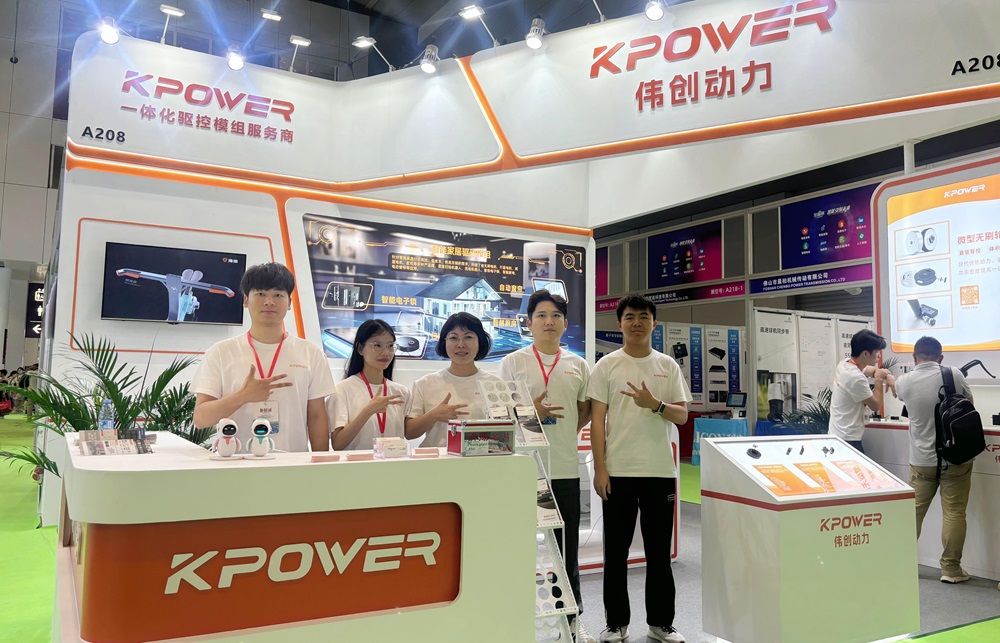
Established in 2005, Kpower has been dedicated to a professional compact motion unit manufacturer, headquartered in Dongguan, Guangdong Province, China. Leveraging innovations in modular drive technology, Kpower integrates high-performance motors, precision reducers, and multi-protocol control systems to provide efficient and customized smart drive system solutions. Kpower has delivered professional drive system solutions to over 500 enterprise clients globally with products covering various fields such as Smart Home Systems, Automatic Electronics, Robotics, Precision Agriculture, Drones, and Industrial Automation.
Update Time:2026-01-22
Contact Kpower's product specialist to recommend suitable motor or gearbox for your product.


