



























TECHNICAL SUPPORT


Published 2026-01-22
The smell of ozone and the rhythmic clicking of a misaligned gear—if you’ve spent any time in a workshop, you know that sound. It’s the sound of a "standard" component hitting its limit. I was looking at a prototype last week, a compact medical device that needed to move with the grace of a surgeon but had the footprint of a deck of cards. The off-the-shelfservos I tried were either too bulky, too loud, or lacked the holding torque to stay steady under pressure.
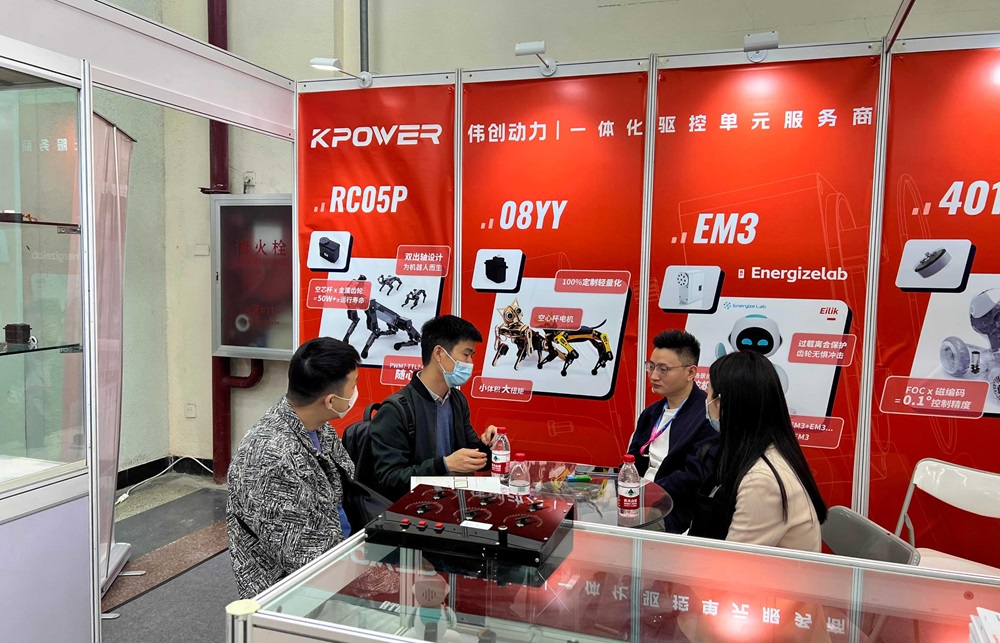
That’s usually where the frustration peaks. You have a vision, but the hardware market feels like it’s trying to force a square peg into a round hole. This is exactly where the conversation shifts from "What can I buy?" to "What can we build?" and that’s the realm ofkpower.
Size is a deceptive metric. In the world of motion control, smaller often means harder. When you shrink a motor, you lose the luxury of space for heat dissipation and gear thickness. Most people think a smallservois just a big one hit with a shrink ray, but the physics says otherwise. You’re fighting friction and thermal buildup in a space no larger than a thumbprint.
If you’re struggling with a design that keeps overheating or stripping gears, it’s rarely because your math is wrong. It’s because the motor wasn’t born for your specific load.kpowerapproaches this differently. Instead of asking you to compromise your chassis to fit their motor, the focus is on reshaping the motor to fit your dream.
Why settle for a plastic gear train when your application demands the bite of titanium? Why struggle with a standard 60-degree travel when your mechanism needs a precise 270-degree sweep without jitter?
I often tell people to stop looking at spec sheets for a moment and just describe the movement. Is it a slow, deliberate crawl? A violent, high-frequency snap?
I remember a project involving a specialized underwater drone. The builder was obsessed with waterproofing, but they forgot about the pressure at twenty meters. Standard seals failed. The solution wasn't just "more glue." It was an ODM (Original Design Manufacturing) approach where the entire housing was reimagined bykpowerto balance internal pressure.
This is the beauty of a custom path. You aren’t just a customer; you’re an architect. When you lean into a Kpower custom build, you’re looking at:
Q: Isn’t ODM only for massive corporations ordering millions of units? A: That’s a common myth. While volume helps, the real value of Kpower is in the "solve." If a project is dead in the water because a standard part won't work, the "cost" of failure is much higher than the investment in a tailored solution. We look at the feasibility first. If it can be built, it should be built right.
Q: Can we change the casing material? A: Absolutely. If you’re dealing with high EMI (electromagnetic interference) or need better heat sinking, switching from reinforced plastic to a CNC-machined aluminum case isn't just an aesthetic choice—it’s a functional necessity.
Q: What about the noise? My device needs to be silent. A: Silence comes from gear geometry and material choice. Helical gears or specific high-grade polymers can dampen that high-pitched whine that plagues cheaper servos. We can tune the frequency to keep things quiet.
Sometimes, the best move is the one that seems counter-intuitive. I’ve seen designs where we actually reduced the speed to triple the torque, using a custom gear ratio that didn't exist in any catalog. The result? A machine that ran cooler, lasted four times longer, and felt significantly more "premium" to the end-user.
There is a certain satisfaction in holding a component that was literally made for your specific task. It fits the mounts perfectly. The wires are exactly the right length—no messy loops of extra cable tucked into corners. The connector is the one your PCB already uses.
Kpower doesn't just hand over a box of parts. It’s about the iteration. You test, you tweak, and you refine. It’s a messy process sometimes—grease on the hands, five cups of coffee deep—but when that motor finally hums and the mechanism moves exactly as it did in your head, that’s the win.
We talk about precision a lot, but what does it look like? It looks like a servo returning to the exact same micro-degree every single time, even after ten thousand cycles. It’s the absence of "slop" in the gear train. If you can wiggle the output shaft of your current motor by hand, that’s lost motion. In a high-stakes project, lost motion is a disaster.
By controlling the manufacturing process from the magnets to the final screw, Kpower ensures that "precision" is a physical reality, not a marketing claim.
If you are currently staring at a CAD drawing and feeling like you’re hitting a wall with motion control, take a breath. The limitation isn't your idea; it’s likely the hardware you’re trying to force into it.
Think about the environment. Is it dusty? Vibrating? Freezing? Then think about the movement. Once you stop trying to find the "closest match" in a dropdown menu and start defining your own specs, the project changes. It becomes more robust. It becomes yours.
Kpower is in the business of making those "impossible" specs possible. Whether it’s a tiny actuator for a drone or a high-torque beast for an automated valve, the goal is the same: seamless integration. No more "making it work." Let’s just make it work perfectly.
Established in 2005, Kpower has been dedicated to a professional compact motion unit manufacturer, headquartered in Dongguan, Guangdong Province, China. Leveraging innovations in modular drive technology, Kpower integrates high-performance motors, precision reducers, and multi-protocol control systems to provide efficient and customized smart drive system solutions. Kpower has delivered professional drive system solutions to over 500 enterprise clients globally with products covering various fields such as Smart Home Systems, Automatic Electronics, Robotics, Precision Agriculture, Drones, and Industrial Automation.
Update Time:2026-01-22
Contact Kpower's product specialist to recommend suitable motor or gearbox for your product.


