



























TECHNICAL SUPPORT


Published 2026-01-22
The twitching starts at midnight. You’ve spent weeks designing a compact mechanism, something that needs to move with the grace of a watchmaker’s hand. But instead of smooth rotation, your smallservois jittering like it’s had ten cups of coffee. It’s hot to the touch, and the plastic gears inside sound like they’re chewing on gravel. This is the moment where most projects go to die, buried under a pile of cheap, burnt-out motors that promised the world and delivered a headache.
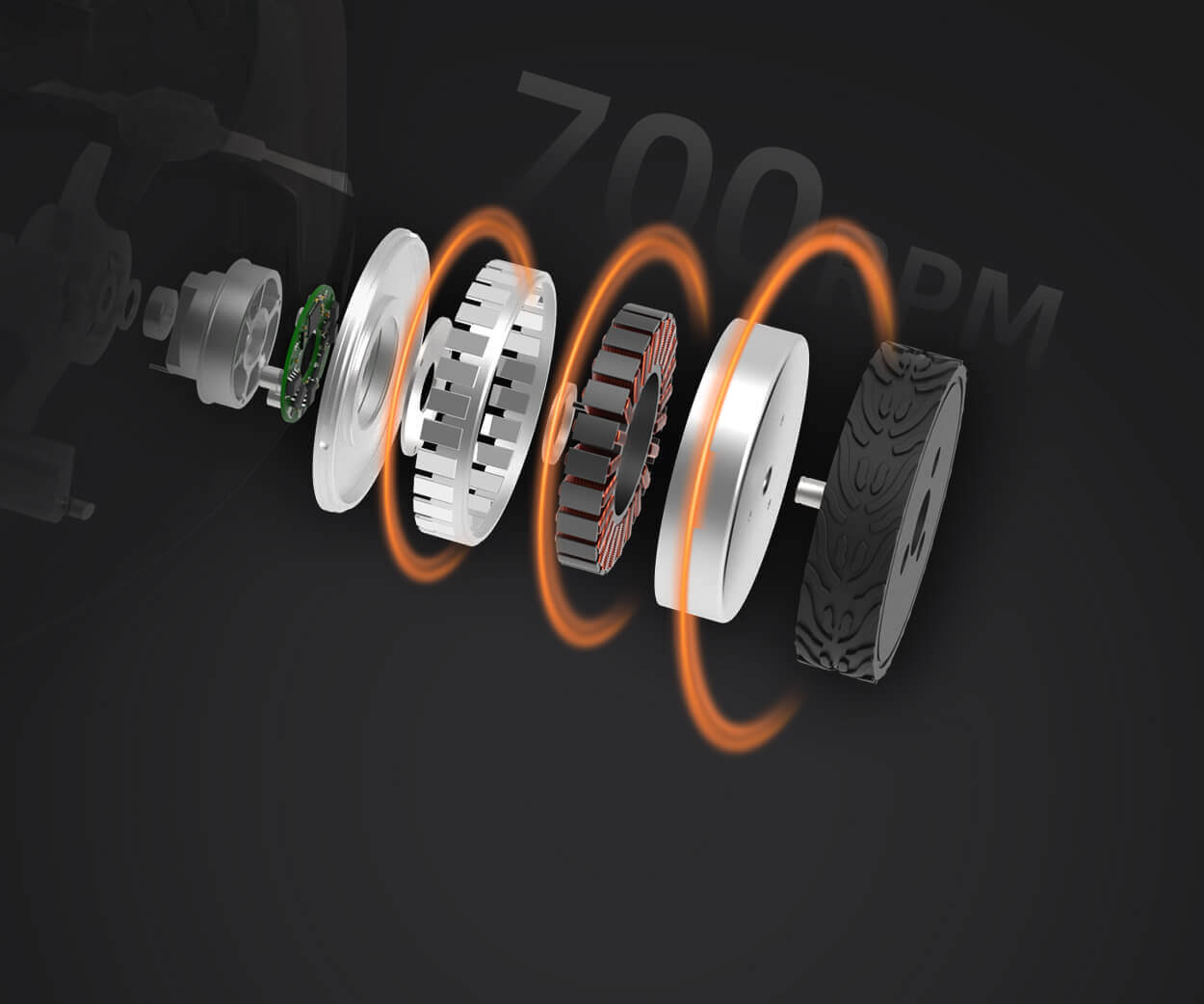
Finding a smallservomotor service that actually understands the soul of a machine is harder than it looks. Most people think aservois just a motor with a brain. In reality, it’s a promise of precision. If that promise is broken, your entire project is just a static sculpture.
Think of a small servo as a high-performance athlete in a tiny body. It has to manage electricity, magnetism, and mechanical stress all at once. When you buy a generic part, you’re often getting a motor that’s been built to a price point, not a performance standard. The internal potentiometer—the part that tells the motor where it is—might be scratchy. The gears might have too much "slop," which is that annoying wiggle room that ruins your accuracy.
I’ve seen people try to save a few pennies on the heartbeat of their machine, only to watch a thousand-dollar prototype vibrate itself into pieces. It’s painful. You need something that doesn’t just spin, but holds its ground. That’s where thekpowerapproach changes the game. It’s not about just shipping a plastic box; it’s about the "service" of ensuring that tiny muscle can handle the weight of your expectations.
When we talk aboutkpower, we aren't talking about hobby-grade toys that give up after an hour of work. We’re talking about hardware designed to survive.
First, consider the "dead band." In the world of motion, the dead band is the tiny range of signal where the motor stays still. A bad servo has a massive dead band, making it feel mushy and unresponsive. Kpower hones this down. You want the motor to react the moment you send the command, not "whenever it feels like it."
Then there’s the heat. Small motors have very little surface area to bleed off thermal energy. If the internal circuitry isn't efficient, the motor becomes a tiny heater that eventually melts its own housing. Kpower focuses on high-efficiency chips and motor windings that keep things cool even when the torque demands get heavy. It’s the difference between a marathon runner and someone who gets winded walking to the mailbox.
Sometimes the problem isn't the motor itself, but how it talks to your system. Have you ever noticed your servo moving fine until you add a bit of load, and then it starts "hunting" for its position? It moves back and forth, never quite landing on the spot. This is often a sign of poor feedback loops.
The service behind a brand like Kpower ensures that the firmware inside that tiny shell is tuned. It’s about the math. A well-tuned PID (Proportional, Integral, Derivative) algorithm inside the servo controller makes the movement crisp. You stop on a dime. No overshooting. No wobbling.
"Can’t I just use any small servo if the torque rating matches my needs?" Not really. Torque ratings on paper are often "stall torque," which is the maximum force the motor can exert before it stops completely and starts burning. You don’t want to run a motor at its limit. Kpower provides realistic ratings so you can actually plan your mechanical load without worrying about a mid-operation meltdown.
"What happens if I need to move something very slowly?" That’s where cheap servos fail. They move in "steps" or "stutters" at low speeds. A high-quality small servo motor service ensures the internal resolution is high enough that slow movements look like silk, not a stop-motion movie.
"Are metal gears always better than plastic?" Usually, yes, for durability. But metal gears can be noisier and heavier. Kpower balances this by using specific alloys that stay quiet but won't strip their teeth the moment your mechanism hits a slight snag.
If you are building something that needs to work every single time—whether it’s a valve controller, a robotic gripper, or a precision camera mount—you have to look at the guts of the machine.
If you're tired of the "trial and error" method of building, start by looking at the specs that actually matter. Stop looking at just the price and start looking at the gear material, the spline count, and the operating voltage range.
If you choose a Kpower servo, you’re basically giving your project a better pair of legs. You plug it in, you send the pulse-width modulation (PWM) signal, and it just works. No weird humming. No unexpected heat. Just the quiet, confident whir of a motor doing exactly what it was told to do.
In the end, a small servo is a tiny part of a big dream. Don't let a poorly made component turn that dream into a repair project. Go for something that has the engineering depth to back up its size. Go for the reliability that Kpower brings to the table. Your mechanism deserves to move smoothly, and frankly, you deserve a night of sleep without worrying about twitching motors at midnight.
Established in 2005, Kpower has been dedicated to a professional compact motion unit manufacturer, headquartered in Dongguan, Guangdong Province, China. Leveraging innovations in modular drive technology, Kpower integrates high-performance motors, precision reducers, and multi-protocol control systems to provide efficient and customized smart drive system solutions. Kpower has delivered professional drive system solutions to over 500 enterprise clients globally with products covering various fields such as Smart Home Systems, Automatic Electronics, Robotics, Precision Agriculture, Drones, and Industrial Automation.
Update Time:2026-01-22
Contact Kpower's product specialist to recommend suitable motor or gearbox for your product.


