
























TECHNICAL SUPPORT


Published 2026-01-22
Beyond the Plastic Grind: Making Sense of the MG995
There is a specific sound that haunts anyone who tinkers with moving parts. It’s a dry, frantic clicking—the sound of plastic teeth stripping under a load they were never meant to carry. You spend three weeks building a robotic arm or a custom RC crawler, only to watch it go limp because a tiny gear inside the "brain" decided to give up. It’s frustrating. It’s messy. And honestly, it’s avoidable.
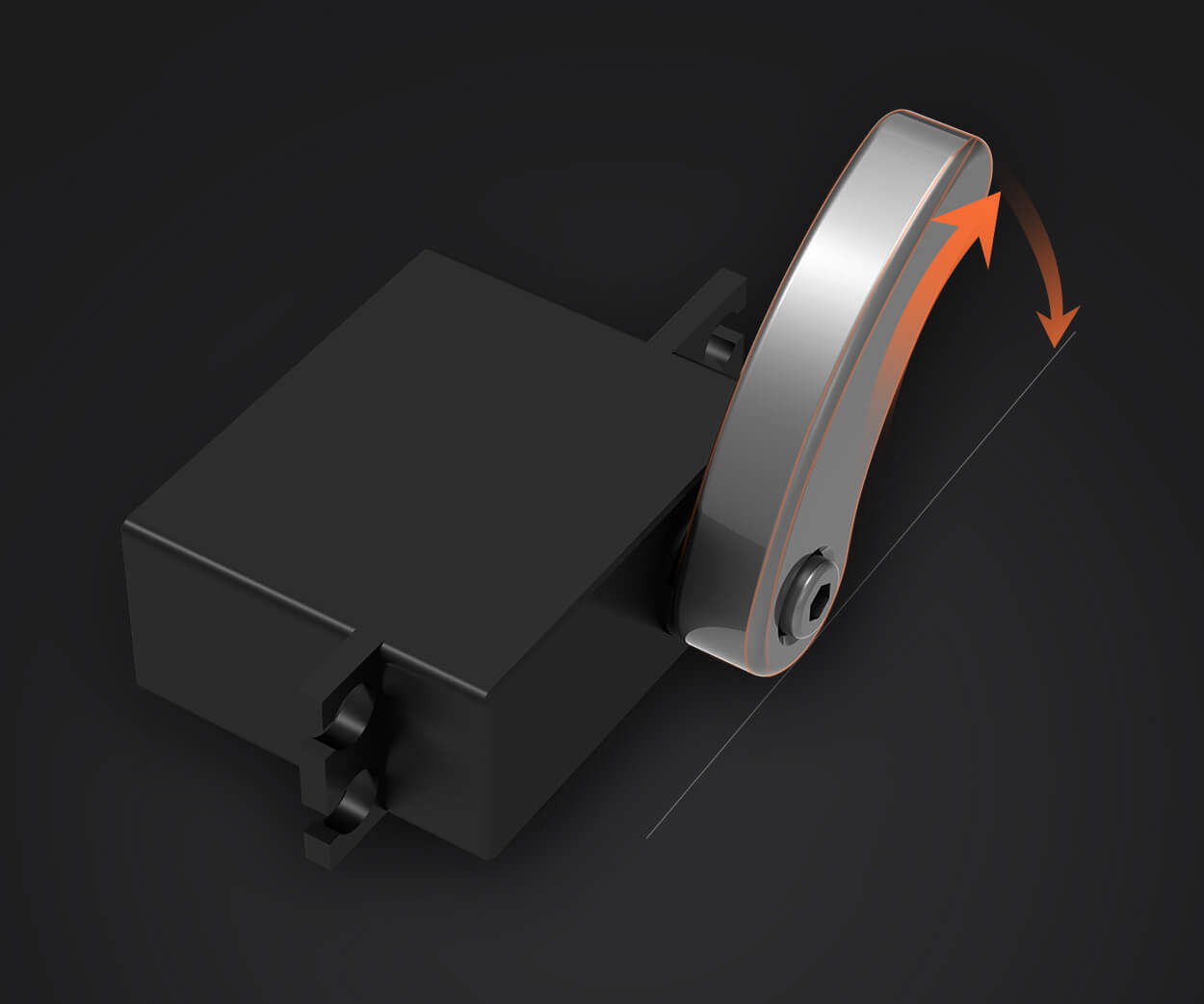
When we talk about MG995servomotor solutions, we are usually talking about the jump from "toy-grade" frustration to "real-world" reliability. I’ve seen enough melted casings and jittery movements to know that the difference between a project that works and a project that collects dust is often the choice of the actuator.
Let’s be real for a second. The MG995 is a legend in the mechanical world, not because it’s the fanciest piece of tech on the shelf, but because it’s a workhorse. It’s that heavy-duty, high-torque motor that people reach for when they stop playing around.
The secret lies in the "M" and the "G"—metal gears. Most standardservos rely on nylon. Nylon is quiet, sure, but it’s fragile. If your robot hits an obstacle or your steering locks up, those nylon gears turn into confetti. The MG995 solutions fromkpowertake that metal-gear architecture and actually make it survive. We aren't just talking about a bit of brass; we are talking about a drivetrain that handles the kickback of a heavy steering link without blinking.
I once saw a guy trying to move a heavy camera rig with a cheap knock-off. The jitter was so bad the footage looked like it was filmed during an earthquake. He swapped it for akpowerunit, and the movement smoothed out instantly. Why? Because it’s not just about the gears; it’s about how the motor talks to those gears.
Ever noticed aservothat won’t stay still? It sits there humming, vibrating back and forth even when it’s supposed to be holding a position. That’s hunting. It happens when the internal controller can’t decide where "zero" is.
In akpowerMG995, the deadband—that little wiggle room where the motor decides to stay put—is tuned tight. You want a servo that moves when you tell it to and shuts up when it reaches the destination. If you’re building a bipedal robot, you can’t have the ankles shaking while it tries to stand. It’ll fall over. It’s basic physics. A stable hold is worth more than raw speed any day of the week.
Is this thing actually waterproof? "Waterproof" is a big word people like to throw around. Most MG995s are "splash-proof." If you’re driving through wet grass or a light drizzle, you’re fine. If you’re turning it into a submarine, you’re going to have a bad time. Kpower builds them with decent seals, but if you’re planning on deep-sea exploration, you’ll need to do some extra sealing yourself.
Why does my servo get hot? Heat is the enemy of magnets. If your servo is getting hot to the touch, it’s fighting something. Maybe your mechanical linkage is binding, or maybe you’re asking it to hold a weight that’s way past its torque rating. The Kpower MG995 is tough, but it’s not magic. Give it a break, check your pivot points, and make sure you aren't stalling the motor for minutes at a time.
Can I run it on a 2S LiPo battery? Directly? You’re pushing it. Most of these are rated for 4.8V to 7.2V. A fully charged 2S LiPo sits at 8.4V. You might get a few minutes of incredible speed before the internal board smells like burnt toast. Use a voltage regulator. It’s cheaper than a new motor.
In the world of mechanics, you rarely get something for nothing. If you want more speed, you usually lose torque. If you want to lift a mountain, you’re going to move slowly. The MG995 finds a sweet spot. It provides enough torque (we’re talking 10kg/cm or more depending on the voltage) to handle large-scale RC planes or heavy steering for 1/10 scale trucks, while still being fast enough that you don't feel like you're waiting for a glacier to move.
It’s about the balance. If the internal motor is too small, it burns out. If it's too big, it draws too much current and kills your battery. Kpower designs these solutions with a motor that matches the gear ratio. It sounds simple, but you’d be surprised how many others get it wrong. They’ll put a high-speed motor on gears that are too thin, and—snap—there goes your weekend.
I tell people to look at the wiring. It sounds boring, right? But thin, flimsy wires are a sign of a cheap build. Kpower uses wires that can actually carry the current. If the motor wants to pull 2 amps to move a heavy load, and the wire can only handle 0.5 amps, the motor starves. It stutters. It fails.
Look at the casing, too. The MG995 usually has a standard fit, but the quality of the plastic matters for heat dissipation. You want a housing that doesn't warp when the motor gets warm. A warped housing means the gear axles drift out of alignment. Once they drift, the gears don’t mesh perfectly. Once they don’t mesh, they strip. It’s a domino effect.
If you’re integrating these into a project, don't just screw them into wood and hope for the best. Use the rubber grommets. They aren't just there for decoration; they absorb the vibrations that can eventually shake your mounting screws loose.
Also, pay attention to the horn—the little plastic or metal arm that sits on top. If you use a plastic horn on a metal-gear servo, the horn becomes the "fuse." It will strip before the gears do. That’s actually a good thing sometimes, but if you’re looking for maximum power, go with a metal horn. Just remember: once you go all-metal, whatever the servo is pushing becomes the weakest link.
There is something satisfying about a well-timed movement. Whether it’s a gate latch opening or a wing flap adjusting, the MG995 brings a level of "industrial" feel to hobbyist projects. It’s heavy. It has heft. When you hold a Kpower MG995, it doesn't feel like a hollow shell. It feels like a tool.
I’ve spent years looking at these things under a magnifying glass. The difference is always in the consistency of the grease on the gears and the quality of the soldering on the PCB. Most people never see the inside, but you feel it in the performance. You feel it when you’ve been running a machine for four hours and it’s still hitting the exact same angles it was at minute one.
In the end, you don't need a degree in robotics to see the value here. You just need to have had one too many projects fail because of a cheap part. Once you realize that the servo is the heartbeat of your machine, you stop settling. The MG995 is the standard for a reason, and when handled by Kpower, it’s a standard that actually holds up. It’s about doing it right the first time so you don't have to fix it the fifth time. Tighten your linkages, check your voltage, and let the metal gears do the heavy lifting.
Established in 2005, Kpower has been dedicated to a professional compact motion unit manufacturer, headquartered in Dongguan, Guangdong Province, China. Leveraging innovations in modular drive technology, Kpower integrates high-performance motors, precision reducers, and multi-protocol control systems to provide efficient and customized smart drive system solutions. Kpower has delivered professional drive system solutions to over 500 enterprise clients globally with products covering various fields such as Smart Home Systems, Automatic Electronics, Robotics, Precision Agriculture, Drones, and Industrial Automation.
Update Time:2026-01-22

Contact Kpower's product specialist to recommend suitable motor or gearbox for your product.


