



























TECHNICAL SUPPORT


Published 2026-02-19
Do you encounter more problems when playing withservos than you think? For example, it shakes, can't rotate, or don't know how to install it into your project? The smallservoSG-90 is the first choice for almost everyone who is a maker, a robot, or a DIY product. Despite its small size, once used, it is a good helper to help you realize your product ideas. Today we will talk about how to use it well and correctly.
When many friends get the SG-90, their first reaction is to stuff it into projects. But after installing it, I found that either the torque is not enough to push your structure; or the size is wrong and it cannot be put in at all.
To judge whether it is suitable or not, there are three key points. The first is torque. The torque of SG-90 is about 1.6kg/cm, which means that at the end of a 1cm long force arm, it can drive an object of about 1.6kg. If your robotic arm is relatively long, or the switch you want to flip is tight, it may not be able to do what it does. The second is the weight. It is only 9 grams, which is very light and very suitable for weight-sensitive aircraft or small robots. The third is the rotation angle. The normal version is 180 degrees. If the project requires continuous rotation, you have to look for the 360-degree version of SG-90.
The most troublesome thing about using SG-90 is problems. The most common failure is jitter or failure to rotate. Don't panic if you encounter this situation, there is a high probability that the steering gear is not broken.
Check the power supply first. Although the SG-90 is small, the current can reach several hundred milliamps when locked. If the 5V pin is used to drive several directly, it will start to twitch as soon as the voltage drops. ️The solution is very simple, just connect the power cord of theservoto the positive terminal of the external power supply and the ground wires should be connected to the same ground. Another common problem is burnout, which is where the servo gets stuck in one place and makes a buzzing sound. This is because overloading or stalling has burned the internal motor or driver chip. At this time, you can only replace it with a new one, so you must make sure that the structure you drive rotates smoothly and there is no jamming.
There are various SG-90s on the market, with prices ranging from a few yuan to more than 20 yuan. They look exactly the same, but use them very differently. How to choose a reliable one?
The most important thing is to look at the gears. The cheap SG-90 uses plastic gears that are easy to sweep. The teeth will be ground flat with a little force. The better ones use POM (Sai Gang) gears, which have much better wear resistance and strength. You can directly ask the seller about the gear material, or read the product description. Secondly, look at the motor and circuit board. Reliable suppliers will use motors with more stable performance. The capacitors and resistors on the control board are also branded parts, which directly affects the response speed and accuracy of the steering gear. It is recommended to directly search the official website of the steering gear brand and find a regular agent to get the goods. Although it is a bit more expensive, when used in products, after-sales and quality control are guaranteed, which can save a lot of trouble in debugging.
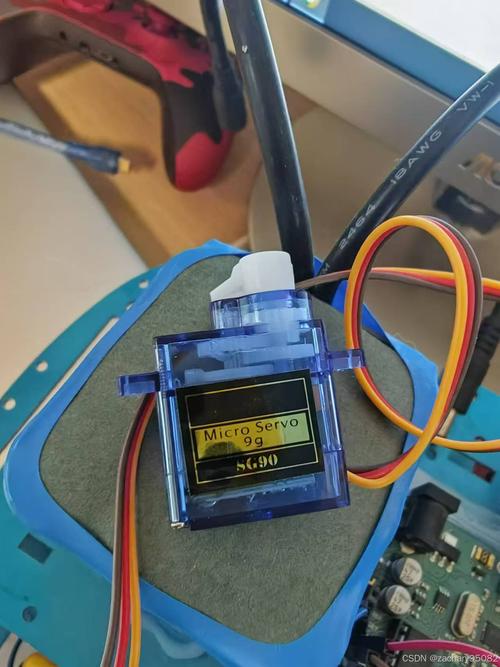
If you want to insert SG-90 into your product prototype to make it both beautiful and practical, there are several details that you must pay attention to.
The first is the installation method. The mounting ears that come with the SG-90 are relatively brittle. When tightening the screws, do not tighten them as they may break. If space is limited, you can consider cutting off the ears and fixing them with hot melt glue or double-sided tape. However, shock absorption should be done to prevent resonance from affecting accuracy. The second is the steering wheel (that's the white swing arm). The hole position of the original steering wheel may not match your structure. You can use a file to repair it, or you can 3D print a matching steering wheel yourself. The third is line sequence. The wires of SG-90 are generally brown (GND), red (VCC), and orange (signal). When connected to the development board, be sure not to connect them reversely, otherwise smoke will emit as soon as the power is turned on.
Many friends complain that the SG-90 is not accurate enough and cannot turn to the specified angle. This is actually not a problem with the steering gear itself, but is caused by the control method and mechanical structure.
If you want to make the angle more accurate, you must first use a stable PWM signal for control. Different brands of servos have slightly different requirements for the pulse width range. Generally, it is 0.5ms to 2.4ms corresponding to 0 to 180 degrees. You can fine-tune this range to calibrate the neutral and extreme positions. For example, if you find that the angle is actually off when turning to 90 degrees, you can fine-tune the pulse width value in the code. Second, check your linkage. If there is a false position between the connecting rods and the rudder moves but the output end does not move, the accuracy will definitely be poor. Try to keep the connecting rods short and stiff to reduce clearance at the joints. Finally, adding a metal steering wheel can also reduce errors caused by deformation of the plastic steering wheel.
Don’t underestimate SG-90 just because it is cheap. Many cool-looking ideas are actually realized with it.
For example, if you want to make a device that automatically turns pages, a swing arm that waters flowers, or a small robot that can dance, SG-90 can do the job. The key is how to amplify its capabilities. If the torque is not enough, you can use the lever principle to make the force arm shorter, or add a reduction gear set to double the force. If the angle is not enough, a linkage mechanism can be used to convert the rotational motion into a linear motion, or to achieve a wider range of swing. You can first search for creative cases of SG-90 on the Internet to see how others use it to make strange and interesting things. This is how a lot of inspiration comes about.
After talking so much, I wonder what interesting functions you plan to use SG-90 to achieve in your next project? Or have you encountered any strange problems when debugging the servo? Welcome to share your thoughts and confusions in the comment area, and we will discuss and solve them together. If you think this article is useful to you, don’t forget to like and share it so that more friends can see it!
Update Time:2026-02-19

Contact Kpower's product specialist to recommend suitable motor or gearbox for your product.


