



























TECHNICAL SUPPORT


Published 2026-03-05
Friends who play model airplanes, especially those who have just started to get in touch with real airplanes or 3D airplanes, have you ever encountered such a situation in the process of playing model airplanes: You obviously bought a very good qualityservo, but after installing it on the ailerons, you find that the response of the airplane becomes very slow. Or, when the airplane is flying in the air, it always feels like the airplane is a little "floating", and it is particularly difficult to correct the flight attitude? In fact, many times, the problem does not lie with the steering gear itself, but with the installation of the steering gear, which seems to be very simple on the surface. As the most important control surface of the aircraft, the response of the ailerons directly plays a decisive role in the roll performance and flight feel of the aircraft.
Today, we will discuss this key detail in detail. In the field of model aircraft flying, this detail is often overlooked by novice friends, but it actually affects the entire flight experience and aircraft performance. Therefore, we must talk about this link and see how to install the steering gear correctly so that the ailerons can play their best role, thus improving the controllability and flight performance of the aircraft.
Have you ever felt the ailerons move suddenly when you putt? This is probably a problem with the installation angle. In order to save trouble, many modelers directly stick theservoto the side panel with double-sided tape. However, if the linkage mechanism of the servo rocker arm and aileron is not kept on the same plane, an unnatural torque will be generated. This force will not only make the servo "extra hard", resulting in slower response, but will also increase the wear of the connecting rod and ball head. Over time, the false position will appear, and the accuracy of the aileron will naturally be greatly reduced. Imagine that your fingers are being stretched to exert force. Is it particularly uncomfortable?
Determining where the "home" of the servo is is indeed a headache. Generally speaking, we have to follow the two principles of "shortest path" and "straight line motion". For most foam-like real machines, the manufacturers have reserved installation slots, which is the optimal solution. If you are installing the machine yourself, try to keep the center of the servo output shaft and the center of the rudder rocker arm in an imaginary straight line. In this way, the motion trajectory of the push-pull connecting rod is closest to a straight line, which can minimize energy loss. You can make some gestures on the wings first, don't rush to make holes, and "think twice before installing".
Precisely drilling holes on the smooth wing surface or the servo mounting base is undoubtedly an extremely meticulous job. If the punching hole is deviated and crooked, the servo is likely to be in a tilted state, which will not only make people with obsessive-compulsive disorder feel troubled, but also worsen the control feel.
The little trick I have learned is "draw the line first, then position". The specific method is to prepare a small ruler and a fine oil-based pen, and first carefully draw the outline of the servo and the center point of the screw hole on the mounting surface. Next, use a sharp awl or use a hand drill directly to drill a shallow positioning pit at the center point. In this way, when the electric drill is used, the drill bit will not "move around", and the hole position can be ensured to be accurate, so that the servo will fit perfectly after installation.
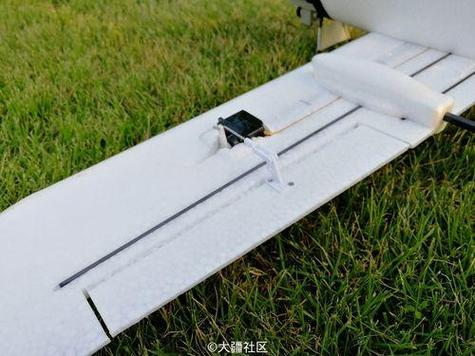
Don't underestimate the small rocker arm on the steering gear. Although it seems inconspicuous, its angle directly determines the stroke of your steering surface. When many novices install it, they often just plug it into the servo spline.
The correct approach should be: when the servo is in the neutral position (that is, when the receiver is powered on and there is no rod input), the rocker arm should be kept at a 90-degree right angle to the servo itself as much as possible, and the connection point with the connecting rod should also be kept perpendicular to the hole of the rocker arm on the rudder surface. This situation is just like the joints of our body. In the neutral position, the strength is the greatest and the response is the most sensitive. If the angle is incorrect, a false position may appear near the neutral position, causing the aircraft to become insensitive to fine adjustments.
There are limited types of "bridges" connecting servos and ailerons. Common ones include Z-shaped buckles, quick-adjusting buckles, and ball-head buckles. So how to choose? For entry-level aircraft, it is enough to use E-shaped buckles or simple Z-shaped steel wires. They are lightweight and have uncomplicated structures. However, for those who are looking for a little more precision in their aircraft, I highly recommend theball joint + drawbarcombination. The ball head buckle can effectively eliminate gaps in all directions, making force transmission more direct.
️ And adjusting the length is very convenient, just rotate the pull rod. Although its cost will be slightly higher, the improvement in control feel is immediate, and everyone who has used it has a deep understanding of it.
Don't rush to put the wings on the plane. Before doing this, manually move the ailerons and feel them carefully. Under normal circumstances, the aileron should be like an extremely flexible fish. When you gently move it, it can swing smoothly, and after you let go, it can naturally return to its original position by relying on its own gravity, and you can hardly feel any damping. If you feel that the ailerons are "squeaky" or stuck, you must investigate: Is the screw locked too tightly, thus pressing the servo housing? Or is there something wrong with the connecting rod? Or is there glue left on the hinge? A smooth aileron system should reach a "smooth as silk" state during the ground inspection stage. This is just like the steering wheel of a new car. It must be able to accurately point in the direction you turn without any sloppiness.
After ensuring that the aileron system is checked correctly, proceed to install the wings. The installation of the wings is also crucial to ensure that the various components are connected tightly and accurately. During the installation process, every step needs to be operated carefully, just like the assembly of precision instruments, there is no room for sloppiness. After the installation is completed, check the status of the entire aircraft again to ensure that there are no potential problems and to be fully prepared for subsequent flights. Just like building a solid building, every link must be solid and stable to ensure overall safety and reliability.
Seeing this, have you become interested in the installation of servos on your own aircraft? You might as well go downstairs to check now, push your ailerons with your hands, and feel the damping and virtual position. How many of the flight problems you encounter are actually "pits" buried during installation? Welcome to share your installation experience and strange problems encountered in the comment area, let’s communicate and avoid pitfalls together! If you think this content is helpful to you, don’t forget to like and share it so that more model friends can see it.
Update Time:2026-03-05

Contact Kpower's product specialist to recommend suitable motor or gearbox for your product.


