



























TECHNICAL SUPPORT


Published 2026-03-17
Recently, many friends have sent me private messages, telling me that their ownservos rotate like a snail, and the speed is extremely slow. Especially when making robots or model cars, the response of theservois always half a beat too slow, which is really annoying.
Don't panic, today we are going to talk about how to speed up theservoand make it move more smoothly. I will combine the practical content in the video tutorial to reveal the details of speed adjustment without reservation, ensuring that you can try it out after listening to it, and personally feel the smooth operation of the servo after speeding up.
When the servo turns slowly, it is often not because it is lazy intentionally, but because there are several common problems. If you think about it, there is a small motor inside the steering gear, which drives the steering arm with the help of a gear set. If the voltage is insufficient, the motor will have difficulty rotating and its speed will naturally decrease. This is just like when our mobile phones have low battery, running programs will become laggy.
In addition, if the gear set of the steering gear is worn, its rotation speed will also be affected. When the gears are worn, the transmission efficiency is reduced and the steering gear becomes laborious during operation, resulting in slower rotation. At the same time, the lubrication of the steering gear cannot be ignored. If there is insufficient lubrication, the friction between components increases, which will also affect the rotation speed of the steering gear and cause it to rotate slowly.
In addition, for the steering gear, the frequency and pulse width of the control signal play a crucial role. The servo relies on receiving PWM signals to achieve positioning. Once the signal frequency is too low or the pulse changes too slowly, it will appear sluggish in response.
In addition, mechanical resistance will also affect the operation of the steering gear. For example, when the gear is stained with dirt or the steering arm is caught by something, it will cause the steering gear to become sluggish.
Voltage is the most direct factor affecting the steering gear speed. Generally, servos have a rated voltage range, such as 4.8V to 6V. Within this range, the higher the voltage, the faster the motor rotates. You can try to increase the power supply voltage slightly, but do not exceed the limit, otherwise it will burn the circuit inside the servo.
In terms of specific operation, if your servo is connected to an independent power supply, then adjust the output knob of the power supply. If the servo gets power from the development board, in this case it may be necessary to replace the battery pack with a higher voltage. After completing the adjustment operation, be sure to use a multimeter to measure it to ensure that the voltage is in a stable state. I also demonstrated in detail how to safely adjust the voltage in the video. You only need to follow the steps in the video step by step, so it is not easy to make mistakes.
PWM is pulse width modulation. To put it bluntly, it controls the speed by changing the on-off time of the electrical signal. For many servos that support continuous rotation, you can adjust the frequency or duty cycle of the PWM signal. The higher the frequency, the faster the response of the servo; the larger the duty cycle, the faster the rotation speed.
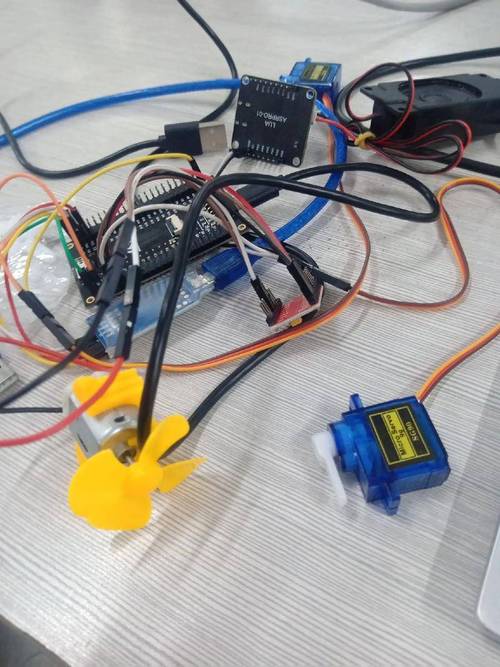
However, special attention should be paid to the fact that ordinary position servos (that is, servos that can only rotate at a certain angle) have very strict requirements for PWM. If the frequency is changed at will, it is very likely to cause deviations in its positioning. In this case, you may wish to try to use a more precise control library, such as using the more stable Servo library in the environment, or changing to a digital servo driver board that supports high-speed mode.
The gear ratio is the reduction ratio between the motor shaft and the output shaft. The servo gear ratio is fixed when leaving the factory to balance torque and speed. If you want to change it faster, you can theoretically change it to a gear set with a smaller reduction ratio, so that when the output shaft rotates once, the motor will rotate a few fewer times, and the speed will increase.
However, this is easy to say, but very difficult to do in practice. Not only do you have to find suitable gears, you also need to be skilled in disassembly and assembly skills. If you are not careful, the gear may not be stuck tightly or become misaligned. In this case, the steering gear may be scrapped. Unless you are a hardware expert, it is not recommended to change the gear ratio yourself. If you really pursue speed, it would be more reliable to directly replace it with a high-speed servo, saving both time and effort.
If you’ve tried all the previous methods and it’s still too slow, it’s time to consider changing the servo. There are specialized high-speed servos on the market, such as some digital servos, whose response speed is much faster than ordinary analog servos. There are also ones with metal gears, which have better heat dissipation and durability, and can withstand the speed increase brought by higher voltages.
When choosing, you need to pay attention to two key parameters: one is speed, whose unit is usually seconds/60 degrees. In this parameter, the smaller the number, the faster the speed; the other is torque. When selecting, you should not only focus on fast speed. If the torque is insufficient, you will eventually have a lack of power and cannot carry the load. I recommended several cost-effective high-speed servos in the video. These servos are suitable for those who are engaged in robot production and car model-related work. You can refer to them.
The easiest pitfall when adjusting parameters is going too fast. For example, if the voltage exceeds the rated value, the servo will heat up severely, and the internal chip will soon burn out. Also, if the signal frequency is set too high, the servo control board will not be able to respond. Instead, it will jitter or rotate randomly, which is not worth the loss.
In addition, the mechanical structure must also be inspected. The bearings or connecting rods must be lubricated and smooth, and do not let the servo run hard with large resistance. Every time you adjust the parameters, you should test it with no load to see if the sound is normal and whether the movement is smooth. Remember, stability and reliability are more important than simply being fast.
Have you adjusted the servo speed? What strange problems have you encountered? Share it in the comment area and let's study it together. If you find this article useful, don't forget to like and forward it so that more friends who play servos can see it!
Update Time:2026-03-17

Contact Kpower's product specialist to recommend suitable motor or gearbox for your product.


