



























TECHNICAL SUPPORT


Published 2026-03-22
Many friends will encounter a headache when they are making robots, smart homes, or model airplanes: theservothey bought either shakes badly, cannot turn in place, or simply does not respond. In fact, many times, the problem does not lie with theservoitself, but that you did not choose the right one or did not use the key "brain" -theservoservo controller. This thing is like the commander of the steering gear. If the command is good, the movements will be smooth. Today we will talk about this inconspicuous but crucial component to help you clarify your thinking and avoid detours.
You may think that the servo will work perfectly if you connect it directly to the power and signal lines, but it's not that simple. Although ordinary PWM signals can move the servos, if you want to accurately control the angle and speed, or even let multiple servos work together to make a complex set of actions, you must rely on a controller. It is responsible for translating the actions you want the servo to make into electrical signals that the servo can understand. You can think of it as a translator. You give orders here and it executes them accurately. Without it, there is a wall between your creative ideas and mechanical execution.
There are two common types of controllers on the market, one is a dedicated chip integrated on the circuit board, and the other is a programmable control module. The former is suitable for devices with a single function, such as a simple pan/tilt; the latter is more suitable for us to engage in product innovation, because you can write programs according to your own needs to achieve control at any angle and at any speed. For those who are just getting started, choosing a programmable module will be more flexible. Even if the project is upgraded in the future, it will continue to be useful.
When choosing a controller, you can't just look at the price, you have to look at several hard indicators. The first is control accuracy, which directly determines whether your servo can point where to hit. A good controller can divide a 360-degree rotation into thousands of scales, while a bad controller may only have dozens of scales, and the movements will naturally appear stiff. The second is the response speed, which is how long it takes for the servo to start moving after you issue a command. If your product requires fast response, such as a competitive robot, the response speed must be fast, otherwise it will be half a beat slower.
Another point that is easily overlooked is the load capacity. How many servos the controller can control at the same time is very critical. If you design a product with more than a dozen joints, but end up buying a controller that can only hold 5, that would be embarrassing. Moreover, the high-torque servo has a large current. If the controller output current is not enough, there will be insufficient power supply, and the servo will be weak or directly crash. So when choosing, be sure to calculate the total current of all your servos, and then choose a controller with margin.
This is a nightmare for many friends when making complex products. Imagine that you want 18 servos of a hexapod robot to move their legs at the same time. If you debug each one, the workload is huge and it is difficult to coordinate. In fact, it’s not difficult at all to use the right controller. Many controllers now support the "action group" function. You can record the actions of each servo first, and then let the controller play it back according to the timeline. This is like editing a video. You set the picture at each point in time and leave the rest to the player.
The specific operation steps are usually as follows: first use graphical software to arrange the actions on the computer, and set the angle of each servo at a certain point in time like building blocks. Then burn the data into the controller via USB or Bluetooth. After burning, the controller can run independently from the computer. You only need to give it a start signal, and it will perfectly reproduce the entire set of actions you have programmed. This "offline operation" mode is very practical for products that require mass production or independent operation.
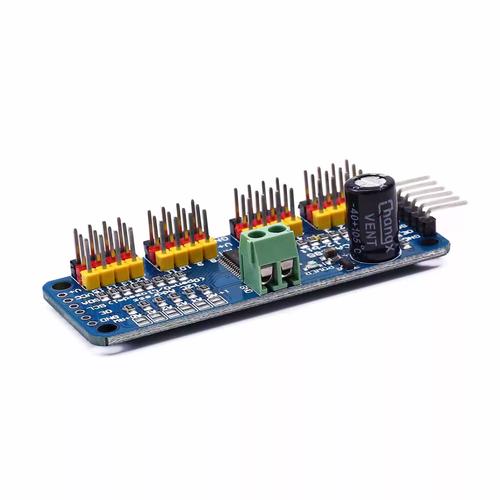
How to "chat" between the servo controller and your main control board (such as a microcontroller) or computer is also a technical task. Common communication methods include PWM, serial port, I2C and CAN bus. If you only control one or two servos, it is easiest to use PWM. Just connect a signal line to each servo. But if there are a large number of servos, PWM wiring will become very scary, and the cables are heavier than the robot.
At this time, serial port or bus-based controllers show their advantages. They only need one data line to connect all the servos in series. Each servo has its own address. You give the command "Turn the No. 1 servo 90 degrees and the No. 2 servo 45 degrees" and they will each execute the command. This method not only saves line space, but also makes the programming logic clearer. Therefore, when doing multi-degree-of-freedom projects, give priority to controllers that support bus communication, which can make your entire system much cleaner.
The first pitfall is that when buying, you only look at "how many channels" and not "whether the number of channels is independent." Although some cheap controllers are marked with 16 channels, they are actually time-shared multiplexed internally. Only one servo can be moved at a time. If multiple servos are moved at the same time, lag or jitter will occur. The second pitfall is that voltage matching is ignored. Servos are available in 5V, 7.4V or even 12V. If the logic level of the controller does not match the operating voltage of the servo, the signal may be unstable or the servo may be burned out.
The third pitfall is about software ecology. The hardware parameters of some controllers are very good, but the supporting software is horribly difficult to use, or does not support your commonly used operating system at all. When you buy it, you find that all the programming materials are in English and there are no code examples, so the development efficiency will be very low. Therefore, before buying, you must go to the official website or forum to see if there is much information about this brand and whether the community is active. A good product must have detailed documentation and timely technical support, which is very important.
For product innovation, stability comes first. I suggest you use the combination of "high-performance main control + bus-type servo controller". The main control is responsible for processing sensor data and decision-making logic, while the steering gear controller is specifically responsible for execution, each performing its own duties. In this way, even if there is a small problem with the servo due to excessive load, it will not affect the calculation of the main control. The system will be more stable and troubleshooting will be easier.
When building the system, you can follow this process: First, determine the model and quantity of your servos, and calculate the total power. The second step is to select a controller with a bus interface (usually TTL or RS485) and power that meets your needs. The third step is to use the test software provided by the manufacturer to connect a single servo and the controller to verify whether the communication is normal. The fourth step is to gradually add servos to test the synchronization and stability of the entire system. Remember, never connect all the equipment right away. Segmented testing can help you quickly locate problems.
In the process of using the servo controller, have you ever encountered the trouble of having to start over the project due to wrong selection of the controller? Welcome to share your experience in the comment area. Let’s avoid pitfalls together and make the implementation of creativity smoother. If this article is helpful to you, don’t forget to like and share it with your friends who are also tinkering with servos.
Update Time:2026-03-22

Contact Kpower's product specialist to recommend suitable motor or gearbox for your product.


