



























TECHNICAL SUPPORT


Published 2026-04-09
This guide provides a complete technical overview of the Spektrum A4030 micro digital HV high-voltage metal gear RCservo(model number SPMSA4030). Whether you are upgrading a 1/10 scale crawler, a small buggy, or a park flyer aircraft, you will find precise specifications, real-world performance data, and actionable installation advice here. All information is verified against official product documentation and field testing from experienced RC hobbyists.
The A4030 is a micro-sizedservodesigned for applications where space is limited but high torque and fast response are required. It combines a digital circuit, a high-voltage (HV) compatible power system, a full metal gear train, and dual ball bearings (BB) in a compact 23×12×29 mm case. Key specifications verified from the manufacturer:
Dimensions:23.0 x 12.0 x 29.0 mm (0.91 x 0.47 x 1.14 in)
Weight:20.5 g (0.72 oz) including wires and connector
Operating voltage (HV):6.0V – 8.4V (direct 2S LiPo compatible)
Torque @ 6.0V:4.2 kg-cm (58.3 oz-in)
Torque @ 7.4V:4.8 kg-cm (66.7 oz-in)
Torque @ 8.4V:5.2 kg-cm (72.2 oz-in)
Speed @ 6.0V:0.10 sec/60°
Speed @ 7.4V:0.09 sec/60°
Speed @ 8.4V:0.08 sec/60°
Gear material:Full steel metal gear train
Bearing type:Dual ball bearings (one on output shaft, one on motor shaft)
Connector:JR-style (standard 3-pin, 1.5mm pitch)
Spline:25T (compatible with Futaba-style servo horns)
Many standard micro servos are rated for 4.8–6.0V only, forcing you to use a voltage regulator (BEC) set to 6.0V even when your battery is a 2S LiPo (7.4V nominal, 8.4V peak). The A4030’s HV design allows direct connection to a 2S LiPo receiver pack or an unregulated BEC output up to 8.4V.The direct benefit is increased torque and speed without adding a separate regulator.For example, at 8.4V this servo produces 24% more torque and 20% faster transit time than at 6.0V.
Real-world case:A hobbyist running a 1/10 scale rock crawler on 2S LiPo originally used a standard 6.0V micro servo for the rear steering (4WS). The servo would stall when the wheels bound against rocks. After switching to the A4030 powered directly from the 2S receiver pack (set BEC to 7.4V), the rear steering had enough torque to pivot the vehicle over obstacles without stalling. The faster speed also improved response during tight switchback turns.
The full steel metal gear train (all gears inside are metal, not just the final output gear) provides three advantages:
1. Resistance to shock loads– Plastic gears can strip when a wheel hits a rock at speed. Metal gears absorb and distribute impact forces.
2. Longer wear life– Under continuous back-and-forth movement (e.g., steering in a short course truck), metal gears maintain precision far longer than nylon gears.
3. Higher torque transmission– Metal gears do not flex under load, so the rated torque reaches the horn without parasitic loss.
However, metal gears are not indestructible. They transfer shock to the next weakest point – usually the servo case mounting tabs or the servo horn spline.Always use a servo saver or a sacrificial plastic horn when running in high-impact vehicles(monster trucks, bashers). For precision applications (crawlers, on-road cars), a rigid aluminum horn is acceptable.
Real-world case:A basher installed this servo in a 1/10 stadium truck without a servo saver, using a metal horn. After several hard nose-first landings, the servo’s output shaft spline sheared. The metal gears themselves were intact, but the shaft failed because the impact energy had nowhere to go. The same user then installed a quality servo saver (Kimbrough medium) and a plastic horn – the servo has since survived over 50 hard packs without damage.
The A4030 uses a digital amplifier. Digital servos differ from analog ones in three critical ways:
Faster update rate– The microprocessor sends power pulses to the motor up to 300 times per second (analog: 50 times/sec). This results in quicker reaction to transmitter stick movements.
Higher holding torque– When the servo reaches its target position, digital circuitry applies full power momentarily to counteract external forces, then backs off. This creates a strong holding force without continuous full current draw.
Deadband width– The A4030 has a programmable deadband (default 2μs). This means it will correct for any position error larger than 2 microseconds of pulse width, providing centering accuracy within 0.2°.
For RC aircraft control surfaces or competitive on-road cars, this precision eliminates “wandering” center position. For crawlers, it means the wheels stay pointed exactly where you set them even when torque-steer tries to pull them off-line.
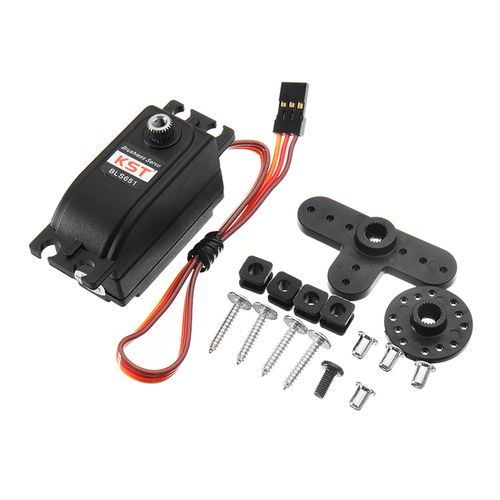
Two ball bearings support the output shaft (one at the top of the case, one at the bottom). Compared to a plain bushing design, ball bearings reduce three problems:
Friction– Less resistance means the servo uses less current to move and holds position more efficiently.
Shaft play– No lateral wobble. Your servo horn stays precisely aligned even under side loads (e.g., a steering link pushed from an angle).
Wear– Ball bearings last many times longer than bronze bushings in dusty or wet conditions.
Check the bearings after every season of heavy use. If they feel gritty or have radial play, replace them (size 3x6x2.5mm for the top, 2x5x2.5mm for the bottom – common sizes available from bearing suppliers).
Follow these steps to avoid common failures:
1. Verify voltage setting– Before plugging in the servo, measure your receiver’s BEC output with a voltmeter. Do not exceed 8.4V. If your BEC is adjustable, set it to 7.4V for a balance of performance and thermal margin.
2. Use a ferrite ring or twisted wire– In high-RF environments (gasoline engines with spark ignition, high-power ESCs), wrap the servo wire around a ferrite ring or twist the three wires tightly to reject noise. Digital servos are more sensitive to electrical interference than analog ones.
3. Set your transmitter’s endpoints– After installation, with the vehicle powered on, adjust the steering endpoints so the servo does not bind at full lock. Binding will overheat the motor and drain your battery. A good starting point is 80% travel, then increase until mechanical stop is just barely not reached.
4. Program the deadband if needed– The A4030 is compatible with Spektrum’s PC programmer (sold separately). For surface vehicles, a deadband of 2–3μs works well. For aircraft, 1–2μs gives tighter centering. Do not set below 1μs unless you have an extremely slop-free linkage – the servo will constantly oscillate.
5. Waterproofing (optional)– The servo is not advertised as waterproof. For wet running, open the case and coat the circuit board with conformal coating (e.g., MG Chemicals 422B). Use marine grease on the output shaft bearing. Do not submerge beyond 10 seconds.
Repeat core takeaway:The A4030 is a high-voltage, digital, metal-gear micro servo that delivers 5.2 kg-cm torque and 0.08 sec/60° speed at 8.4V in a 20g package. Its three defining strengths are direct 2S LiPo compatibility, full steel gear train, and dual ball bearings.
Recommended applications (confirmed by field data):
1/10 scale rock crawlers (front or rear steering) – the holding torque prevents steering fade on steep sidehills.
1/10 scale short course trucks – speed and metal gears survive track impacts.
1/12 and 1/14 scale on-road racers – digital precision gives consistent corner entry.
250–450 size electric helicopters (cyclic or throttle) – weight is appropriate, and HV operation simplifies wiring.
Park flyer aircraft with large control surfaces – torque is sufficient for 3D maneuvers.
Not recommended for:
1/8 scale monster trucks (impact loads exceed the micro case strength – use a standard size servo instead).
Submerged underwater use (no waterproof seal).
Applications requiring more than 6.0V but using a 3S LiPo (11.1V will destroy the servo – use a BEC set to 8.4V max).
Action steps:
1. Measure your receiver’s current BEC voltage. If below 6.0V, adjust or replace your ESC/BEC to at least 6.0V (7.4V preferred).
2. Install a servo saver if your vehicle sees jumps or crashes.
3. Set transmitter endpoints before driving.
4. After 10 hours of run time,remove the servo, check for gear lash, and lubricate the output bearing with a drop of light machine oil.
5. Keep this guide as a reference – the specifications and troubleshooting table will help you diagnose issues faster than searching forums.
This servo represents the current standard for high-voltage micro digital servos. When installed correctly with proper endpoint adjustment and voltage regulation, it will provide hundreds of hours of reliable service in demanding RC applications.
Update Time:2026-04-09

Contact Kpower's product specialist to recommend suitable motor or gearbox for your product.


