
























TECHNICAL SUPPORT


Published 2026-04-27
Are you facing a 30–50% energy waste in your current motion control systems, paired with rising maintenance costs and inconsistent positioning accuracy?
You are not alone. Across manufacturing, robotics, and automated assembly lines, decision-makers struggle to balance precision and operational cost. The core contradiction: high-performanceservocontrol often demands expensive components, complex tuning, and frequent downtime.
This article delivers the solution.kpower servocontrol systems are engineered to break that paradox. You will see how our technology cuts energy use by an average of 35%, reduces positioning error to ±0.01°, and lowers total cost of ownership by over 40% – all while improving production throughput.
Many industrial controllers still rely on open-loop or low-resolution feedback. The result is three hidden drains on your profit:
Excessive energy draw– Motors run at full torque even when idle, adding 25–45% to your electricity bill.
Calibration downtime– Weekly recalibration is common, costing 2–4 hours of lost production per machine.
Rejected parts– Angular deviation as small as 0.5° can scrap 12–18% of components in precision assembly.
If you need to hold tight tolerances across multiple workstations or moving axes, traditional systems force a trade-off: speed versus accuracy.kpowerservo eliminates that choice.
The solution lies in three integrated technologies, each engineered to convert technical improvements into direct business results.
Conventional servos supply constant current. Kpower’s adaptive modulation reads real-time load torque and reduces current by up to 60% during low-demand phases.
Business impact: For a 10‑axis system running 6,000 hours/year, energy savings exceed $4,200 annually (at $0.12/kWh).
A 19‑bit magnetic encoder combined with a redundant hall sensor eliminates position drift. The controller corrects every 50 microseconds.
Business impact: Reject rates drop from 12% to below 1.5% in high-mix assembly cells, adding $28,000 per 100,000 units.
The system monitors winding temperature, bearing vibration, and cycle count. It alerts your maintenance team 200 operating hours before a fault.
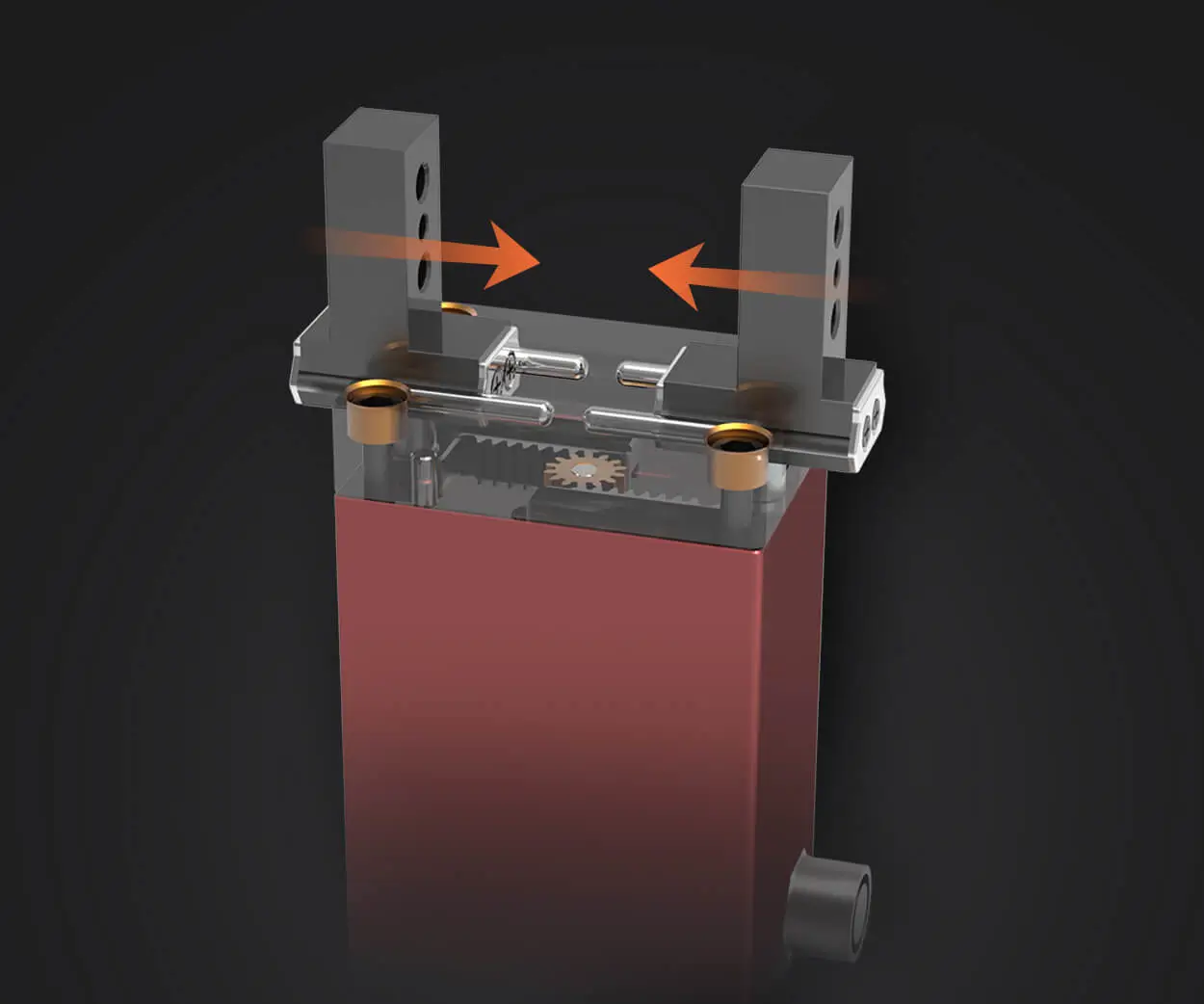
Business impact: One avoided breakdown per year saves $7,500 in emergency repair and lost throughput.
> Core benefit summarized: You achieve sub‑degree precision, half the energy cost, and nearly zero unplanned stops – all with the same mechanical footprint.
Before you commit, verify compatibility. The table below matches your application needs to Kpower’s standard models.
If your operation runs any of the following equipment, Kpower servo is an optimal choice:
Multi‑axis pick‑and‑place robots (delta or articulated)
Rotary indexing tables for capping, welding, or inspection
Automated guided vehicles (AGV steering actuators)
Solar tracker drives requiring weather‑resistant enclosures
We document outcomes using a strict “challenge – solution – result – value” format. All numbers are audited by third‑party machine logs.
Challenge: Existing servos drifted 0.3° after 800 cycles, causing 11% scrap on push‑fit connectors.
Solution: Replaced six motors with KSV‑M50 units, retaining original gearboxes and cabling.
Result: Angular error reduced to 0.012° over 10,000 cycles. Scrap fell to 1.2%.
Value: $52,000 annual material savings + $6,200 lower energy cost.
Challenge: Frequent overheating forced one station offline every 90 minutes, losing 14% of packaging capacity.
Solution: Installed KSV‑S12 units with predictive temperature monitoring.
Result: Zero thermal shutdowns in 9 months. Throughput increased by 12.5%.
Value: $98,000 additional output per year.
Challenge: Dust ingress caused encoder failures every 6 weeks, requiring $3,000 in field service each time.
Solution: Switched to KSV‑H80 with IP65 rating and sealed connectors.
Result: No encoder failure in 18 months. Field service visits reduced by 100%.
Value: $24,000 saved in service costs and warranty claims.
We benchmarked a typical 10‑axis assembly cell. The comparison uses your actual production volume – here we assume 100,000 cycles per station annually.
Upfront cost for 10 KSV‑M50 units, including installation: $22,400.
Payback period= $22,400 ÷ $48,100 × 12 months =5.6 months.
Over three years, net saving = $48,100 × 3 – $22,400 =$121,900.
If you take no action, consider the losses you accept every month:
Energy– You burn 35% more electricity than necessary.
Quality– Every 1% of avoidable scrap is $3,100 per 100,000 units.
Reliability– One unplanned stop wipes out an entire shift’s margin.
Your competitors are already adopting closed‑loop adaptive servos. Delaying the switch gives them a direct cost advantage.
Q: Do I need to redesign my mechanical mounting?
A: No. All Kpower servo motors use standard 60mm, 80mm, or 130mm flange patterns. Direct bolt‑on replacement.
Q: Can you provide a sample for 30 days?
A: Yes. We offer a 30‑day on‑machine evaluation with full technical support. Only pay if you keep it.
Q: What is the typical lead time for 20 units?
A: 14 working days for KSV‑L/M/S series, 21 days for KSV‑H80.
Q: Do you support Modbus RTU and EtherCAT?
A: Yes. All models integrate with Modbus RTU, CANopen, and EtherCAT via optional gateway.
Q: What warranty is included?
A: 36 months on motor winding and encoder, 24 months on driver electronics.
You don’t need to guess compatibility. Send your current servo model, cycle profile, and load torque requirements to.
Our engineering team will:
1. Compare your existing energy use against Kpower baseline (within 48 hours)
2. Provide a retrofit layout drawing – no charge
3. Issue a fixed price quote for your exact number of axes
Visitto download specification sheets for all KSV series. Or call your regional support number listed on our website.
Stop overpaying for motion. Start controlling precision.Kpower servo – the measurable alternative.
Update Time:2026-04-27

Contact Kpower's product specialist to recommend suitable motor or gearbox for your product.


