




TECHNICAL SUPPORT


Published 2026-04-30
For a steering gear, its technical indicators refer to a collection of quantitative parameters used to measure the performance, accuracy and reliability of the steering gear, which covers core values such as torque, speed, accuracy, feedback resolution, and operating voltage. Understanding these indicators is the basis for correct selection and application of servos. In this article, we rely on industry standards and engineering practices to provide a systematic analysis of all key technical indicators of the steering gear, provide authoritative data sources with verifiable characteristics, and give recommendations for selection actions.
There is a definition that refers to the maximum torque that the servo can continuously output under rated voltage conditions. There are some common cases, in which the torque of standard servos is about 5 to 15kg·cm, while the torque of large robot joint servos reaches more than 40kg·cm.
The rule of selection is that the moment the load has at that time should be less than the torque under the rated state, multiplied by the safety factor of zero.7.For example, if there is a load of one kilogram driving the end of a ten centimeter-long swing arm, the required torque must be greater than or equal to one times ten, which is equal to ten kilograms centimeters. However, when actually selecting the model, it should be greater than or equal to fourteen point three kilograms centimeters.。
The source of the data is the ISO 9409-1 robot interface standard, as well as the "stall torque" nominal value mentioned in each manufacturer's specification book.
It is defined as the shortest time required for the steering gear output shaft to rotate 60 degrees without load.. Common cases include a fast response servo speed of 0.07 seconds per 60 degrees and an industrial servo speed of 0.20 seconds per 60 degrees.
Factors affecting the actual situation: The speed will decrease linearly as the load increases. At full load, the speed is close to 0. The torque-speed curve should be used to judge the dynamic performance.
There is the largest deviation between the actual output angle and the target angle we set, which includes the error in backlash and the accuracy during repeated positioning. The accuracy of industrial-grade servos can reach plus or minus 0.1°, while the accuracy of consumer-level servos is plus or minus 1°.
The method of verification is to use encoder feedback measurement. In the prompts for writing that article, the accuracy index will have a direct impact on the design of the control algorithm, and it is necessary to distinguish "theoretical resolution" from "actual repetition accuracy".
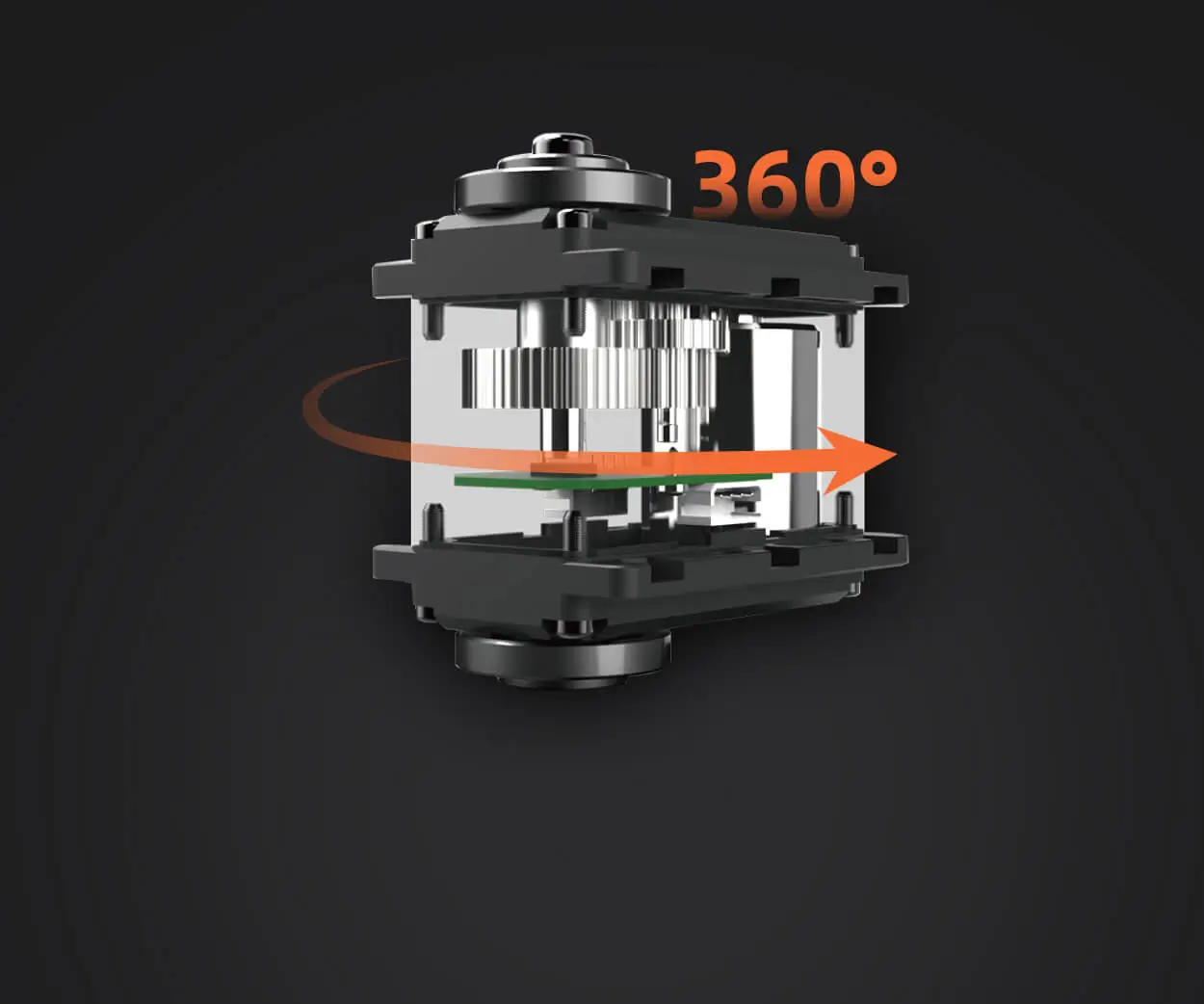
It is defined as the number of bits corresponding to the smallest angle change that can be distinguished by the internal angle sensor of the steering gear. 10 bits correspond to a resolution of 0.35°, 12 bits correspond to 0.088°, and 16 bits correspond to 0.0055°.
The key takeaway is that resolution is not the same as precision. With a high resolution level (specifically 16 bit), and paired with a low-precision mechanical structure, the actual effect is not as good as a 12-bit high-precision gear combination.
The standard range is as follows. The applicable voltage range of standard servos is 4.8 to 6.0V, the applicable voltage range of high-voltage servos is 6.0 to 8.4V, and the applicable voltage range of industrial servo servos is 12 to 48V.
When the voltage is increased by 1V, performance changes, with torque and speed typically increasing by 15% to 20%. A regulated power supply is required to avoid burning out due to exceeding the maximum voltage.
The pulse width range of pulse width modulation is, generally speaking, the interval from 0.5 milliseconds to 2 and 5 milliseconds, the corresponding angle range is from negative 90 degrees to positive 90 degrees, and its period is 20 milliseconds, which is 50 Hz. The support range of the digital servo for the refresh rate is 200 to 400 Hz.
The bus protocol includes RS-485, CANopen, TTL half-duplex, etc., and needs to match the controller protocol stack.
The common level is plastic gears with a cycle life of half a million. Metal gears have a cycle count of more than two million times. Steel or titanium alloy gears, capable of five million cycles.
Situation example: There is a quadruped robot that has been running continuously for up to 1000 hours. The metal gear servo always maintains an accuracy of 0.2°, but the plastic gear has a backlash of 2°. This is such a situation.
Make this definition: IPXY, where
Case 1: Desktop robotic arm gripper
It is required to grasp an object weighing 200 grams and to open and close it quickly. The main core indicators are that the torque must be greater than or equal to three kilograms centimeters, and the speed must be less than or equal to 0.10 seconds per sixty degrees. For high resolution feedback is ignored, ten bits is sufficient.
Case 2: Outdoor inspection robot steering
It directly drives the wheels, has to withstand a load of 2N·m, and operates around the clock.Its core indicators include: torque ≥20kg·cm, IP54 protection, metal gears, and a working voltage of 12V (needs to match the battery)。
The speed index is secondary at this point (0.30 sec/60° is acceptable).
Restate the core concept: The technical indicators of the steering gear are not isolated numbers. They must follow the order of load torque, operating voltage, accuracy requirements, and environmental protection to carry out system matching work. Even if any single indicator is outstanding, it cannot make up for the shortcomings of other indicators.
1. To quantify the load demand, it is necessary to measure the actual torque, which is the result of multiplying the force arm and gravity, and then add a 30% safety margin. The rotational speed requirement needs to be converted into the time required for 60 degrees.
2. Check the true status of the specifications: Do not accept false parameters that only indicate "maximum torque" without voltage-related conditions. Verify the torque-speed curve at the same voltage.
3. Carry out a durability test, use article writing prompts, run continuously for 24 hours under full load, and record the accuracy attenuation and temperature rise. The surface temperature must be less than or equal to 60°C.
Q1: The nominal torque of the servo is 20 kg·cm, why can’t it carry a load of 2 kg?
A: Since the moment arm is too long, since the torque is equal to force times the moment arm, the torque required when a 2kg load is placed on a 15cm moment arm is 30kg·cm, which exceeds the rated value.
Q2: Which is more important, accuracy 0.1° or resolution 0.01°?
High resolution but low accuracy will cause jitter. The actual positioning deviation is still determined by accuracy. A indicates that accuracy is more important.
Q3: How to choose between digital servo and analog servo?
A: Give priority to digital servos. Its characteristics are that the refresh rate is higher, the holding torque is larger, and the response delay is shorter, and the price difference is already very small at this moment.。
Q4: How to judge whether the servo gear needs to be replaced?
For A, when the output shaft is moved by hand, if the idle angle exceeds 2°, or a jamming sound is heard, it must be replaced immediately.
Q5: Can the waterproof servo be soaked in water?
A: Check the IP rating. IPX7 can be immersed in water up to 1 meter deep within a short period of time, while IPX4 can only prevent splashing and cannot be immersed.
Let’s put the conclusion as follows: The most critical parts of the steering gear’s technical indicators are torque, speed, accuracy, voltage and protection level.. According to the process of "load calculation → curve check → durability verification", reliable selection can be achieved. Record your actual load data immediately and check them one by one against the indicator list given in this article to prevent project failure due to misjudgment of parameters.
Update Time:2026-04-30

Contact Kpower's product specialist to recommend suitable motor or gearbox for your product.