



























TECHNICAL SUPPORT


Published 2026-03-30
Hey, brother, are you worried about your little robot, car or modelservoagain? You obviously bought the MG90S, but found that it is "powerless" and cannot move your structural parts at all? Don't rush to blame theservo. Many times, it's not that it's not powerful, but that we have a little misunderstanding about its core parameter of "torque". Today we are going to talk about the torque of the MG90Sservoand how to make good use of it so that your creativity can be implemented steadily.
When many friends get the MG90S, the first thing they do is to look at the parameter table, which says 1.8kg/cm (4.8V) or 2.2kg/cm (6.0V), and then they safely use it as a "Hercules". The result? As soon as I got on the structure, I found that I couldn't even lift any chopsticks. In fact, this value is the maximum locked-rotor torque measured when the servo arm length is 1 cm, that is, how powerful it can be when it "holds back". When you actually use it, as the servo arm lengthens, the moment arm changes, and the power that can be output is greatly reduced. For example, if you use a 3cm arm, the effective torque is directly divided by 3, leaving only about 0.6kg, so it is normal to feel "boring".
Therefore, we must do some calculations in the early stages of project design. You should first estimate how much force your mechanism requires. For example, if you want to pull up a 50-gram small part, but your pull rod is 4 cm long, then the servo must be able to output at least 2kg/cm of torque to be safe. At this time, if you look at the 1.8kg/cm of the MG90S, you will have an idea: either optimize the structure and shorten the moment arm, or replace it with a servo with greater torque. Don't wait until something is made only to find that it can't be pushed. That would be like crying without tears.
Don't underestimate the power supply voltage, its impact on the torque of the MG90S can be said to be immediate. As I just said, the servo is 1.8kg/cm at 4.8V, and it can rise to 2.2kg/cm at 6.0V. There is a difference of more than 20%! Many times if you feel that the servo is weak, it may be that your power supply is not keeping up. Many DIY players directly use the 5V pin on the microcontroller to power the servos. That little current cannot feed them enough. Especially when multiple servos work together, once the voltage drops, the torque is instantly reduced, and the servos begin to "shake" or "be lazy."
️ My suggestion is: power the servo separately. Use a 2S lithium battery (7.4V) or a 5-cell nickel-metal hydride battery pack (6V), and reduce it to 6V through a voltage stabilizing module to specifically power the steering gear. This trick is particularly effective. You will find that the same MG90S has a completely different sense of power after changing the power supply, and the response speed is also much faster. Of course, you must also be careful not to overvoltage. The manufacturer's nominal maximum is 6V. If you give it 7.4V, it may feel good for a while, but it is easy to burn the chip, so the gain outweighs the loss.
Just looking at the servo parameters will sometimes overlook a big pitfall - your mechanical structure. We just talked about the moment arm, but actually this is just the tip of the iceberg. Think about it, if your transmission mechanism has friction or jamming, such as using non-smooth bearings, or the angle between the connecting rods is wrong and creates a large component of force, then most of the steering gear's energy is wasted on overcoming its own resistance, and very little is actually working. I have seen a mechanical arm made by a friend before, but it still couldn't be lifted even after using a high-torque servo. In the end, I found that the joint screws were too tight, and the problem was solved by loosening it a little.
Therefore, in addition to choosing the right servo, spending some time optimizing the mechanical structure is often the most cost-effective way to "increase torque". ️ A few suggestions: Try to let the output shaft of the servo drive the load directly to reduce intermediate links; use bearings instead of direct friction; ensure that the movement space of all moving parts is smooth and don't let them "fight" with each other. Sometimes you don't even need to change to a more expensive servo, you just need to adjust the structure, and the torque of the MG90S is enough.
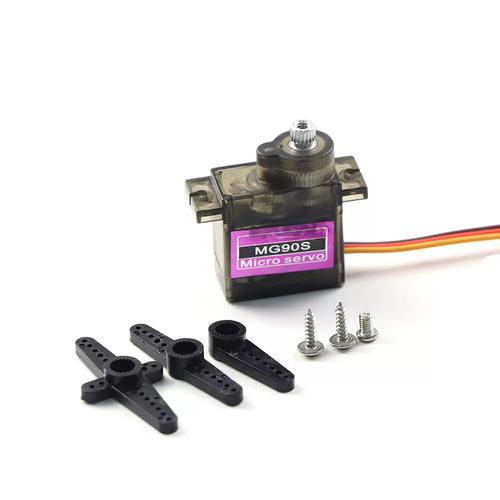
MG90S actually has two common brothers, one is MG90S (metal teeth) and the other is SG90 (plastic teeth). Many people are confused and confused, or they only look at the price. If you have requirements for torque, especially in situations with impact loads, such as the leg joints of robots and the gimbal of a quadcopter, you must choose the MG90S with metal teeth. When the SG90 with plastic teeth is impacted by external forces or stalled, the gears inside will easily "sweep" and be scrapped directly. Metal teeth are much more impact resistant and can withstand greater instantaneous torque.
️ However, metal teeth also have their own characteristics. It is relatively "hard" and has no buffer. If the load is too large or stuck, all the torque will act on the gears and motors, which may burn out the driver chip at worst or burn out the motor at worst. Therefore, if you use metal teeth, you have to add an additional layer of protection in the software or circuit, such as setting up stall detection in the program, and immediately cutting off the power if the current is abnormal. Generally speaking, when pursuing durability and strength, metal teeth are the first choice; but if you are pursuing cost and the application scenario is very light-loaded, plastic teeth can also be used.
This question is quite interesting. Many novices who play or use microcontrollers will ask: "I have given the correct PWM signal and the servo angle is reached. Why does the torque feel different?" In fact, the PWM signal only determines which angle the servo will turn to. In order to maintain this angle, the servo will "automatically" output the maximum torque it can provide under the current voltage. In other words, as long as you give the right signal, it will try its best to maintain that position. Therefore, if you feel that the torque is insufficient, it is basically not a signal problem, but a power supply and load problem as mentioned earlier.
But there is one exception, that is, if your control signal is unstable, such as jitter or noise, causing the servo to "hesitate" and constantly make fine adjustments, then it will indeed appear "weak" and get seriously heated. Therefore, it is also important to ensure the stability of signal lines. Try to use shielded wires, or separate signal lines and power lines to avoid electromagnetic interference. A clean and stable PWM signal allows the servo to output its full power without any distractions.
Having said so much theory, let’s get a little practical. Take a desktop-level small robotic arm I made before. In order to control costs, several joints used the MG90S metal tooth version. At first, the servo at the upper arm joint could not be raised at all, and the whole arm was shaking. I checked according to the above ideas: first, I changed the power supply from 5V to an independent 6V BEC module, which significantly increased the strength; then, I shortened the moment arm of the big arm by 2 cm and redesigned the connector, so that the servo can be easily lifted; finally, I readjusted the tightness of all joint screws to ensure smooth movement. In the end, this small robotic arm not only operated successfully, but also steadily grasped and placed small parts, and the effect far exceeded expectations.
Therefore, as long as you use the MG90S servo in the right way, it is a really cost-effective choice in the fields of small robots, models, and DIY gadgets. Although its power is not top-notch, it is small in size, affordable, and responsive. For us to do product innovation or personal projects, as long as we put more thought into the structure, power supply and control, we can fully unleash 120% of its potential.
After reading this article, have you also thought about the project you are working on? Do you think the torque of MG90S is enough? Or have you encountered similar problems? Welcome to chat about your experience in the comment area. Maybe your sharing can help another friend who is worried.
Update Time:2026-03-30

Contact Kpower's product specialist to recommend suitable motor or gearbox for your product.


