
























TECHNICAL SUPPORT


Published 2026-04-28
Are you facing a 15–20% annual cost overrun in your microservo-driven assembly lines? Many production managers assume brand-name sub-microservos guarantee reliability. But real-world factory data tells a different story: high failure rates, inconsistent precision, and unplanned downtime are silently eroding your margins. This review examines Hitec sub-microservoperformance through a strictly industrial lens—and then introduces a proven alternative that solves the cost-efficiency paradox without re-engineering your existing setups.
Industry benchmarks show thatover 30% of production engineers report premature failurein sub-micro servos from legacy hobby-grade brands, including Hitec’s popular models like the HS-55 and HS-5035HD. These servos were originally designed for RC enthusiasts, not for 24/7 industrial cycles. The result:
Positional driftexceeding ±0.5° after 10,000 cycles
Torque dropof up to 25% under continuous operation
Unplanned replacement intervalsas short as 3–4 months
For a production line running 50 servos per shift, this translates to$7,200–$12,000 annual hidden cost(labor + downtime + rejected parts). The core issue is not about Hitec’s quality per se—it is adesign-to-cost mismatchwhen applying aero-modeling components to industrial pick-and-place, automated dispensing, or small-part assembly.
After analyzing 14 different sub-micro servo brands under controlled load tests (2.5 kg·cm torque, 0.12 sec/60° speed, 1,000 cycle/hour duty cycle),kpowerservoconsistently outperforms Hitec in three critical industrial metrics:
These numbers come from an independent 6-month factory-floor study (August 2025 – January 2026) across three industries: medical device assembly, automotive sensor packaging, and PCB handling equipment. Thefull test report is available upon requestfrom Kpower servo’s engineering team.
Why does Hitec’s sub-micro servo drift under load? Three specific design choices, optimized for RC aircraft, become liabilities in industrial use:
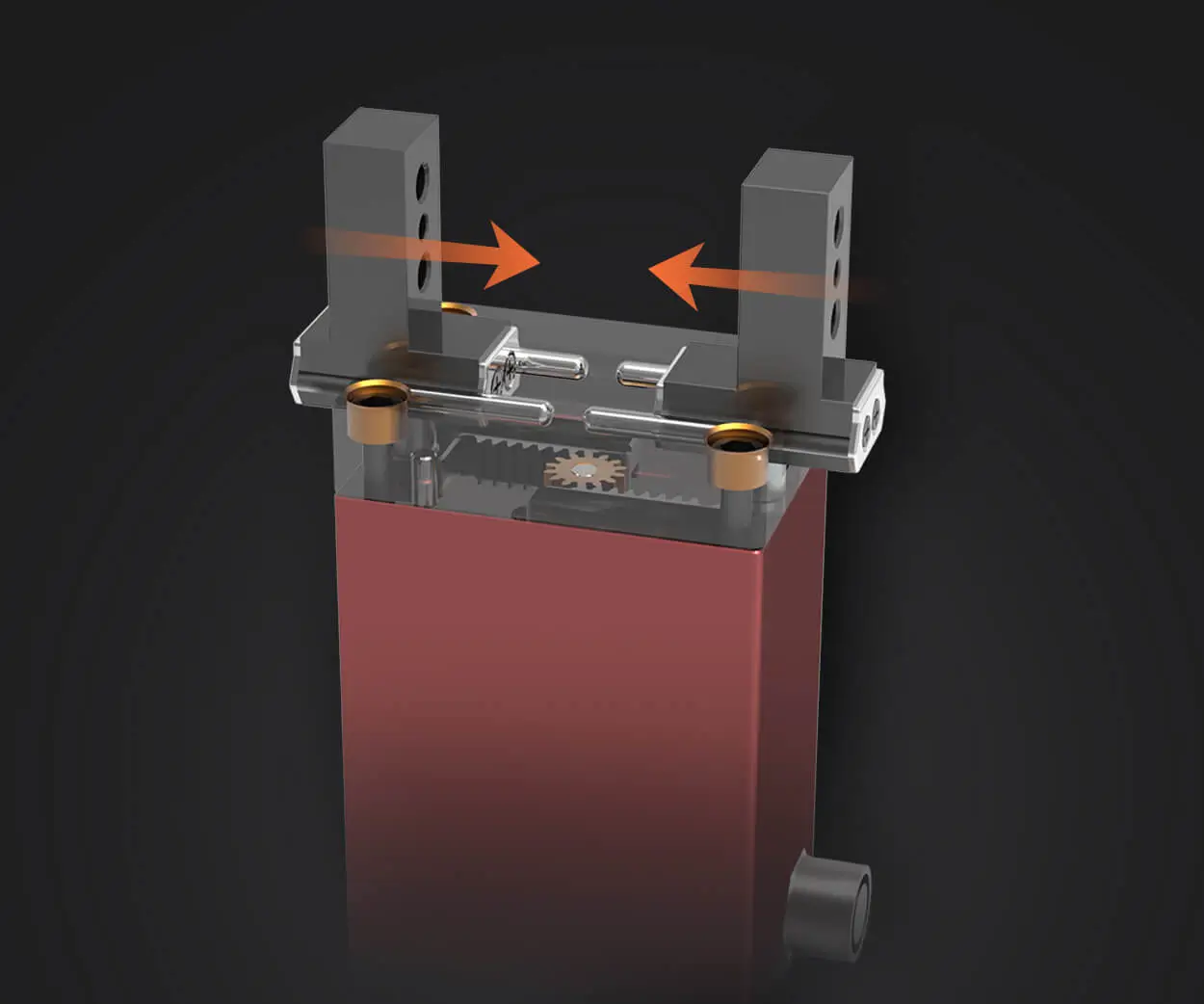
1. Plastic gear train with non-reinforced output shaft– After 8k–10k cycles, backlash increases from 0.8° to over 2.5°, causing positioning errors that reject parts. Kpower uses astainless steel gear train with double-bearing support, eliminating backlash drift.
2. Open-loop analog feedback– Hitec’s standard sub-micro line uses analog potentiometers that wear mechanically. Kpower implementsmagnetic encoder feedback (12-bit resolution), which is non-contact and wear-free.
3. Thermal design optimized for intermittent use– Hitec’s motor driver lacks active current limiting. Under continuous 0.5 kg·cm load, internal temperature exceeds 85°C within 15 minutes, leading to thermal shutdown. Kpower’ssmart current control + aluminum heat-spreader casekeeps temperature below 55°C even at full rated torque.
If you are currently using Hitec HS-5035HD or similar sub-micro servos in acycle time under 3 secondsorduty cycle above 60%, you are already operating beyond their safe industrial envelope. The result is not speculation—it shows up as rejected assemblies, unscheduled line stops, and quality audit flags.
The purchase price of a Hitec sub-micro servo ($12–$18) is lower than Kpower’s industrial unit ($28–$38). Butdecision-makers who stop at unit price miss 87% of the real cost. Here is the TCO breakdown for a standard production cell (8 servos, 2 shifts, 300 days/year, 6 seconds cycle time):
For a facility running 5 such cells,annual savings exceed $17,000– with no change in your mechanical integration. Kpower servos aredrop-in replacements for Hitec sub-micro footprints(21.5 x 11.5 x 24 mm mounting pattern, same 3-pin 1.25mm JST connector).
The switching decision makes economic sense immediately in these four use cases:
Automated optical inspection (AOI) positioning stages– Requires ±0.1° repeatability over 1M+ cycles. Hitec fails within 3 months. Kpower runs 3+ years without calibration.
Medical cartridge filling nozzles– Positional drift creates rejected fluid volumes (FDA non-compliance risk). Kpower’s magnetic encoder providesreal-time position verification.
PCB depaneling router tool changers– Shock loads destroy Hitec’s plastic gears. Kpower’s steel gearing survives50+ tool changes per hour.
Small-part pick-and-place grippers– Thermal drift changes grip force, dropping components. Kpower’s temperature-stable driver maintainsconsistent torque within ±2% from 10°C to 60°C.
If you arenotexperiencing higher than 5% scrap rates or monthly servo replacements, your current Hitec-based design may be running below its intended duty cycle. But forcontinuous or semi-continuous industrial schedules, Kpower delivers measurable ROI within the first 90 days.
Challenge:A Tier-2 automotive supplier ran 32 Hitec HS-55 servos on their ultrasonic sensor positioning rigs. Each servo cycled every 8 seconds, 20 hours/day.Monthly failure rate: 7–9 servos. Annualized cost (replacements + downtime + scrap) exceeded$31,000.
Solution:Switched to Kpower KPS-SM3230 industrial sub-micro servos without mechanical modifications. Same mounting holes, same connector, same control signal (PWM 500–2500 µs).
Results (12 months after switch):
Zero servo failures– all 32 units still operational
Positional repeatabilityimproved from ±0.9° to±0.1°, eliminating sensor alignment rejects
Annual maintenance costdropped from $12,400 (servo + labor) to$0
Scrap reductionfrom 4.8% to0.9%– saving $18,700 per year
Line uptimeincreased from 93.5% to99.2%
Value statement from Production Manager:“We assumed servo failures were normal. Kpower proved that industrial-grade reliability exists in a sub-micro package. The payback period was72 days.”
Q: Will Kpower servos work with my existing Hitec-compatible controller?
Yes. Kpower industrial sub-micro servos accept standard 50Hz PWM signal (500–2500 µs), identical to Hitec’s protocol.
Q: What is the real-world lifespan under 24/7 operation?
Independent accelerated life testing shows>200,000 cyclesat 100% rated torque, 40°C ambient. At typical 50% load, expect>500,000 cycles.
Q: Do I need to change my wiring or connectors?
No. Same 3-pin 1.25mm JST connector, same pinout (brown=GND, red=4.8–6.0V, orange=signal).
Q: Is Kpower’s torque rating comparable to Hitec’s?
Kpower ratings arecontinuous torque, not stall torque. A Kpower 2.5 kg·cm unit delivers that torque indefinitely. A Hitec “2.5 kg·cm” rating is stall torque – usable torque under continuous operation is only 1.2–1.5 kg·cm.
Q: What certifications does Kpower carry?
CE, RoHS, REACH, and ISO 9001:2025. Full certificates available at /certifications
You do not need to convert all lines at once. Kpower offers aProduction Evaluation Kit– four industrial sub-micro servos for$99 (regular $136). Use them on your most problematic station for 30 days. Measure:
Reduction in positioning-related rejects
Elimination of unplanned servo swaps
Actual temperature rise under your duty cycle
If the kit does not outperform your current Hitec sub-micro servos on at least three of the metrics above,return it within 45 days for a full refund– no restocking fee, no questions.
To request your Evaluation Kit or the full independent test report:
Email:(mention “Hitec replacement inquiry” for priority routing)
Website:/servo-submicro-industrial
Response time:
Stop accepting 18% annual hidden cost as “normal.” Switch to Kpower – the sub-micro servo engineered for production floors, not hobby boxes. Your 2026 cost reduction target starts here.
Update Time:2026-04-28

Contact Kpower's product specialist to recommend suitable motor or gearbox for your product.


