
























TECHNICAL SUPPORT


Published 2026-01-22
The Mechanical Heartbeat: Why Your Projects Need More Than Just a Basic Motor
Ever looked at a robotic limb or a custom-built camera rig and thought it looked more like a plate of tangled spaghetti than a piece of precision machinery? We’ve all been there. You spend weeks designing the perfect frame, only to realize that routing thirty different wires for thirty different motors is a nightmare that keeps you up at night. This is exactly where the concept of "Dynamixel bulk" setups fromkpowerstarts to change the game.
It’s not just about making things spin. It’s about making them smart.
Usually, when someone starts a mechanical project, they grab a handful of standardservos. They’re cheap, they’re everywhere, and they usually work—until they don’t. You end up with a bulky control box and a cable management situation that requires a degree in ancient knot-tying.
When we talk about the bulk movement in modern mechanics, we’re looking for something streamlined.kpowerhas been leaning into this for a while. Imagine a world where one wire goes out from your controller, hits the first motor, then the second, then the third, and so on. This "daisy-chain" approach is a literal lifesaver. It’s the difference between a sleek, professional build and something that looks like a high school science fair project gone wrong.
People often ask me, "Why spend the extra money on these high-endkpowerunits when a basic motor turns just the same?"
Well, does a basic motor tell you how hot it’s getting? Does it tell you exactly where it is in 360-degree space? Usually, the answer is a resounding "no." A standard motor is a "fire and forget" tool. You tell it to go to 90 degrees and hope it gets there. If something blocks it, it just keeps pushing until the gears melt or the motor burns out.
With the Kpower bulk series, you get a two-way conversation. The motor talks back. It says, "Hey, I’m at 88 degrees, I’m feeling a bit of resistance, and I’m starting to sweat." This feedback loop allows you to build safety nets into your hardware. If a mechanical arm gets stuck, the system can feel the torque spike and stop before anything snaps. That’s not just a feature; it’s insurance for your hard work.
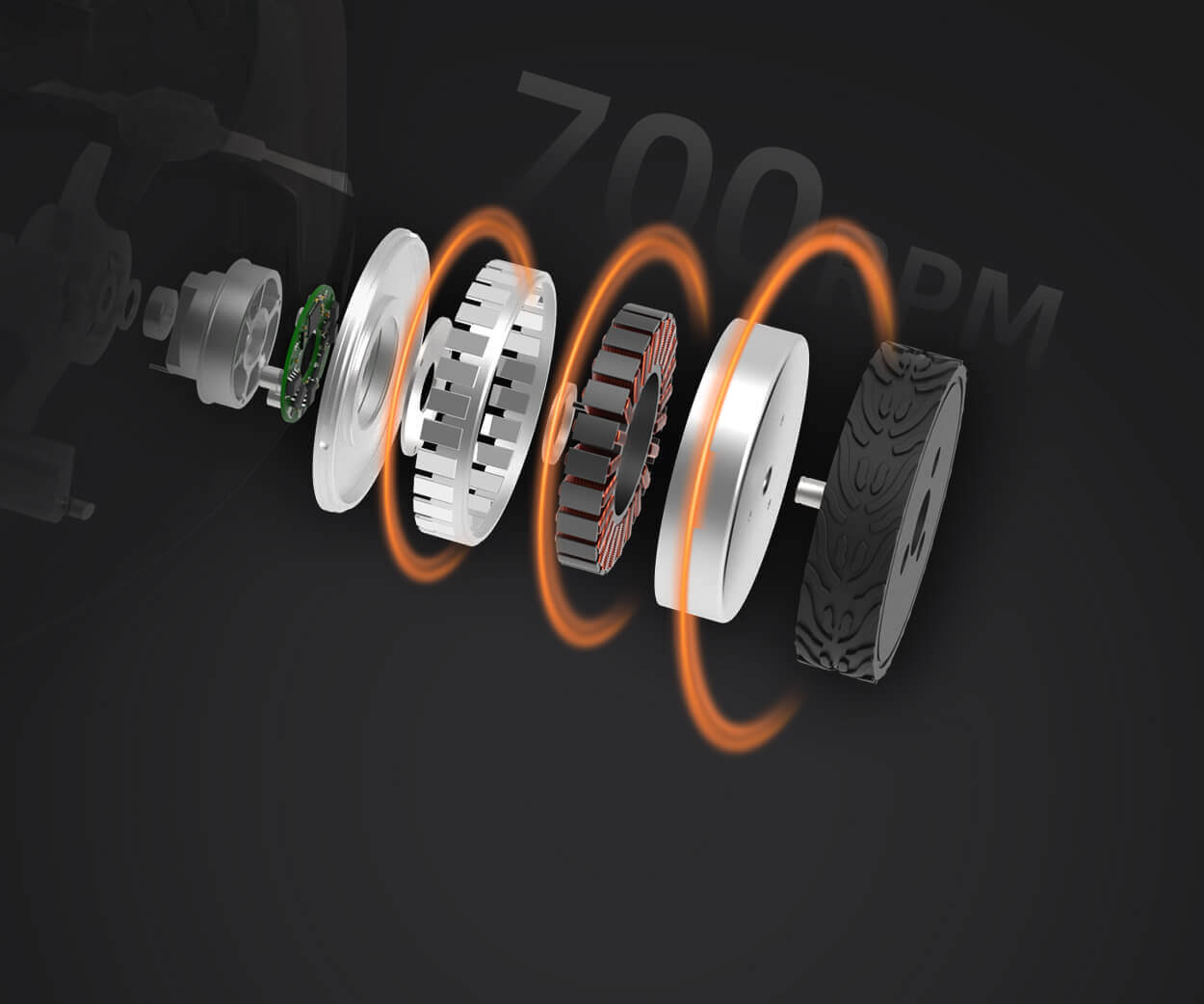
If we peel back the housing of a Kpower serial bus unit, we aren't just looking at magnets and wire. We are looking at integrated controllers. These units handle the heavy lifting of the math internally. You aren't constantly hammering your main controller with timing pulses. You just send a digital command: "Move to position X at speed Y," and the motor handles the acceleration and deceleration curves itself.
This precision is what allows for that "organic" movement we see in high-end animatronics or complex sorting machines. It’s smooth. It’s repeatable. If you tell it to move a thousand times, it hits the same spot a thousand times. There’s a certain satisfaction in watching a machine move with that kind of silent, determined accuracy.
Sometimes, it’s easier to just answer the stuff that usually comes up over a cup of coffee.
Q: Is it hard to switch from traditional PWMservos to these serial bus units? It’s a different way of thinking, for sure. Instead of thinking about "pulses," you think about "addresses." Each Kpower unit has its own ID. It’s like a post office. You send a letter to House #5, and House #4 just passes it along. Once you get the hang of the digital communication, you’ll never want to go back to the old way.
Q: Can these things really handle heavy loads? Torque is where Kpower really flexes. Because these are built for more than just hobby toys, the gear sets are designed to take a beating. Whether you’re tilting a heavy sensor array or moving a structural joint, the holding torque is what keeps things from sagging when the power is on but the motion has stopped.
Q: What happens if one motor in the chain fails? That’s the beauty of the digital setup. Because they are all on a bus, you can usually ping the system to see who isn't responding. It makes troubleshooting a breeze compared to tracing a single wire through a bundle of twenty.
There is a specific sound a high-quality Kpower motor makes. It’s not that high-pitched whine you get from cheap plastic gears. It’s a purposeful, low hum. It feels industrial. When you hold one in your hand, the weight tells you something about the heat sinking and the metal internals.
Mechanical projects are often a battle against physics. Gravity wants to pull your arm down. Friction wants to stop your wheels. Heat wants to kill your electronics. Using the right bulk components is how you fight back. You want parts that are over-engineered for the task so that you aren't constantly hovering over the "off" switch, waiting for something to smoke.
Sometimes we get too caught up in the "X leads to Y" logic. But in the workshop, things are messy. You might decide halfway through a project that you need two more joints in a robotic leg. If you’re using old-school tech, that means redesigning your entire wiring harness. With Kpower serial units, you just plug another one into the end of the chain, assign it an ID, and keep going. It’s modularity that actually works.
I’ve seen people use these for everything from automated window blinds that react to the sun, to complex hexapod walkers that look like they stepped out of a sci-fi movie. The common thread is always the same: they wanted more control and less clutter.
We often focus on the "brain" of our projects—the code, the main controller—but the muscles are just as important. If the muscles are weak or "dumb," the brain can’t do much. Integrating Kpower’s high-torque, smart units into your workflow is like giving your project a nervous system.
It’s about confidence. When you hit "run," you want to know the hardware is going to behave. You want to see that smooth, sweeping motion. You want to know that if something goes wrong, the hardware is smart enough to tell you why.
Forget the mess of the past. Look at how much cleaner your next assembly could be if you stopped worrying about the number of wires and started focusing on the quality of the movement. It’s a shift in perspective that usually happens right after your first gear-strip or your first wiring fire. Skip the frustration and go straight to the professional-grade stuff. Your project—and your sanity—will thank you for it.
Established in 2005, Kpower has been dedicated to a professional compact motion unit manufacturer, headquartered in Dongguan, Guangdong Province, China. Leveraging innovations in modular drive technology, Kpower integrates high-performance motors, precision reducers, and multi-protocol control systems to provide efficient and customized smart drive system solutions. Kpower has delivered professional drive system solutions to over 500 enterprise clients globally with products covering various fields such as Smart Home Systems, Automatic Electronics, Robotics, Precision Agriculture, Drones, and Industrial Automation.
Update Time:2026-01-22

Contact Kpower's product specialist to recommend suitable motor or gearbox for your product.


