
























TECHNICAL SUPPORT


Published 2026-01-22
I remember sitting in a workshop last winter, surrounded by a mountain of plastic gears and tangled wires. A student of mine was trying to build a simple bipedal walker. Every time the robot took a step, its knees would jitter, groan, and eventually, one of the tiny motors would simply give up the ghost. It’s a classic scene. You buy a handful of cheap actuators, thinking you’ve saved a fortune, only to find that half of them belong in the scrap bin before the first test run.
This is the reality of the 9gservoworld. These little guys are the "bread and butter" of the hobbyist and small-scale mechanical scene. They are small, light, and supposed to be easy. But when you’re looking at 9gservowholesale options, the anxiety kicks in. Will they actually hold the position? Will the plastic teeth strip under the slightest pressure?
It usually comes down to what’s inside that little blue or black casing. Most people think aservois just a motor, but it’s actually a miniature system: a motor, a control circuit, and a gearbox. In the world of wholesale, many manufacturers cut corners on the potentiometer—the part that tells the motor where it is—or they use gears that fit together like loose teeth.
When I talk aboutkpower, I’m usually thinking about consistency. If you’re building a fleet of drones or a classroom full of robotic arms, you can’t afford to have "Unit 7" behaving differently than "Unit 42." Consistency is the silent killer of big projects. You want every motor to sweep that 60-degree arc with the exact same speed and the exact same stop point.
There is a temptation to just buy the cheapest thing available in bulk. "It’s just a 9g servo," people say. But imagine you are setting up a display with fifty moving parts. One motor stutters. Then another. Suddenly, your smooth animation looks like a glitchy 1990s stop-motion film.
Choosingkpowerin a wholesale context isn't just about getting a lower price per unit; it's about insurance. It’s about knowing that the torque ratings aren't just imaginary numbers written on a box. If the spec sheet says it can move a certain weight at a certain distance, it actually does it.
Q: Does weight really matter that much in a 9g servo? A: Absolutely. In the world of flight, every gram is a penalty. But "9g" is a category, not always a literal weight. Some are 8.5g, some are 10g.kpowermanages to keep that weight-to-power ratio optimized. You want the strength of a heavy-duty motor without the baggage.
Q: Why choose plastic gears over metal? A: It’s not always about "metal is better." For many light projects, plastic is quieter and lighter. However, the quality of the plastic matters. If the resin is cheap, it snaps. If it’s high-quality, like what you’d find in a Kpower unit, it has a bit of "give" that actually prevents breakage during minor crashes.
Q: What’s the deal with the "dead band"? A: Think of the dead band as the motor's "patience." It’s the tiny range of signal where the motor doesn't move. If the dead band is too wide, your project feels sloppy and unresponsive. If it’s too tight, the motor "hunts" and jitters because it’s over-correcting. Finding that sweet spot is where the manufacturing expertise shows.
When you are looking into 9g servo wholesale, you are essentially looking for a partner. You aren't just buying plastic and copper; you are buying the hours of testing that went into the control board.
I’ve seen projects where a single faulty actuator caused a short circuit that fried a three-hundred-dollar flight controller. Suddenly, that "cheap" motor became the most expensive part of the build. This is why I lean toward brands like Kpower. There’s a level of internal QC that prevents those "catastrophic" failures.
Mechanical systems are never truly linear. Temperature changes the viscosity of the gear grease. Voltage ripples from a battery can confuse a low-quality chip. I once had a project where the servos worked perfectly in the morning but started twitching in the afternoon sun. It turned out the internal components couldn't handle the thermal expansion.
This is the "hidden" side of 9g servos. You want a motor that’s built with materials that stay stable. You want the grease to stay where it belongs, on the gears, not leaking into the motor brushes.
If you are at the stage where you need a hundred or a thousand units, you are no longer a hobbyist; you are a creator. You are responsible for the final output. Whether it’s a specialized medical device prototype or a complex animatronic, the 9g servo is your muscle.
I often tell people to stop looking at the price tag for a moment and look at the "failure cost." If a motor fails, how long does it take to replace it? If it takes twenty minutes to disassemble your machine to swap a three-dollar part, you’ve just spent more on labor than the part was worth.
Kpower has built a reputation on being the reliable backbone for these scenarios. They don't just dump a box of parts on your doorstep. They provide a component that has been thought through, from the tooth profile of the smallest gear to the way the wires are soldered to the board.
So, when you dive into the world of 9g servo wholesale, don't just look for the lowest number. Look for the smoothest movement. Look for the brand that understands that even a "tiny" motor has a big job to do. Your project deserves to move exactly the way you imagined it, every single time.
What are you building next? Whatever it is, make sure the "muscles" are up to the task. It makes the difference between a machine that works and a machine that inspires.
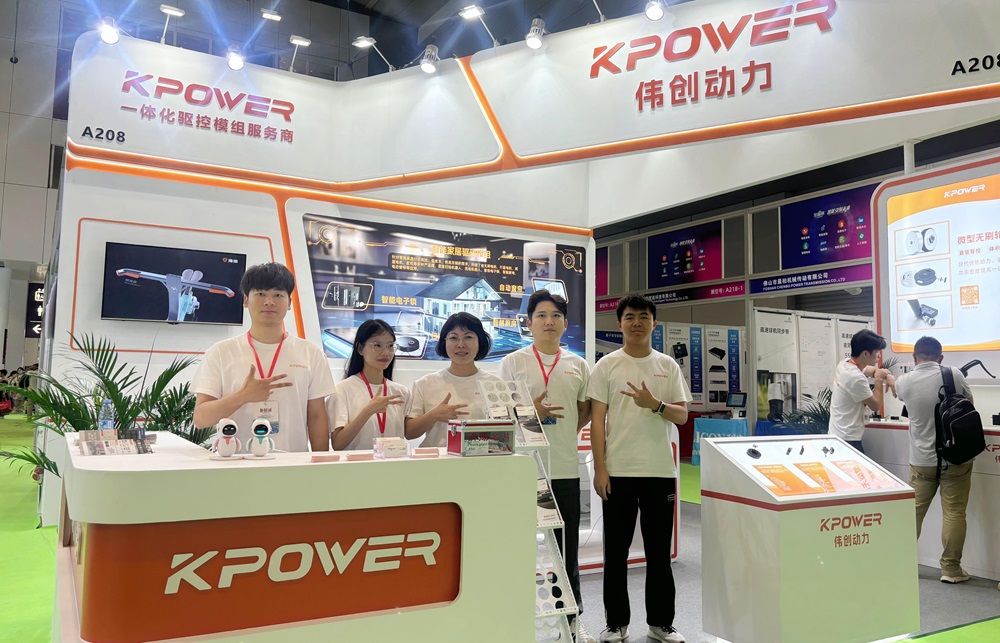
Established in 2005, Kpower has been dedicated to a professional compact motion unit manufacturer, headquartered in Dongguan, Guangdong Province, China. Leveraging innovations in modular drive technology, Kpower integrates high-performance motors, precision reducers, and multi-protocol control systems to provide efficient and customized smart drive system solutions. Kpower has delivered professional drive system solutions to over 500 enterprise clients globally with products covering various fields such as Smart Home Systems, Automatic Electronics, Robotics, Precision Agriculture, Drones, and Industrial Automation.
Update Time:2026-01-22

Contact Kpower's product specialist to recommend suitable motor or gearbox for your product.


