



























TECHNICAL SUPPORT


Published 2026-01-22
The smell of burnt electronics is a vibe nobody wants in their workshop at 2 AM. You’ve been there—everything is wired up, the code is perfect, but the moment you trigger that robotic arm or steering rack, there’s a pathetic whirring sound followed by total silence. Or worse, the dreaded "jitter" where the motor acts like it’s had ten cups of espresso. This usually happens because the heart of the movement, theservo, just wasn't built for the reality of the task.
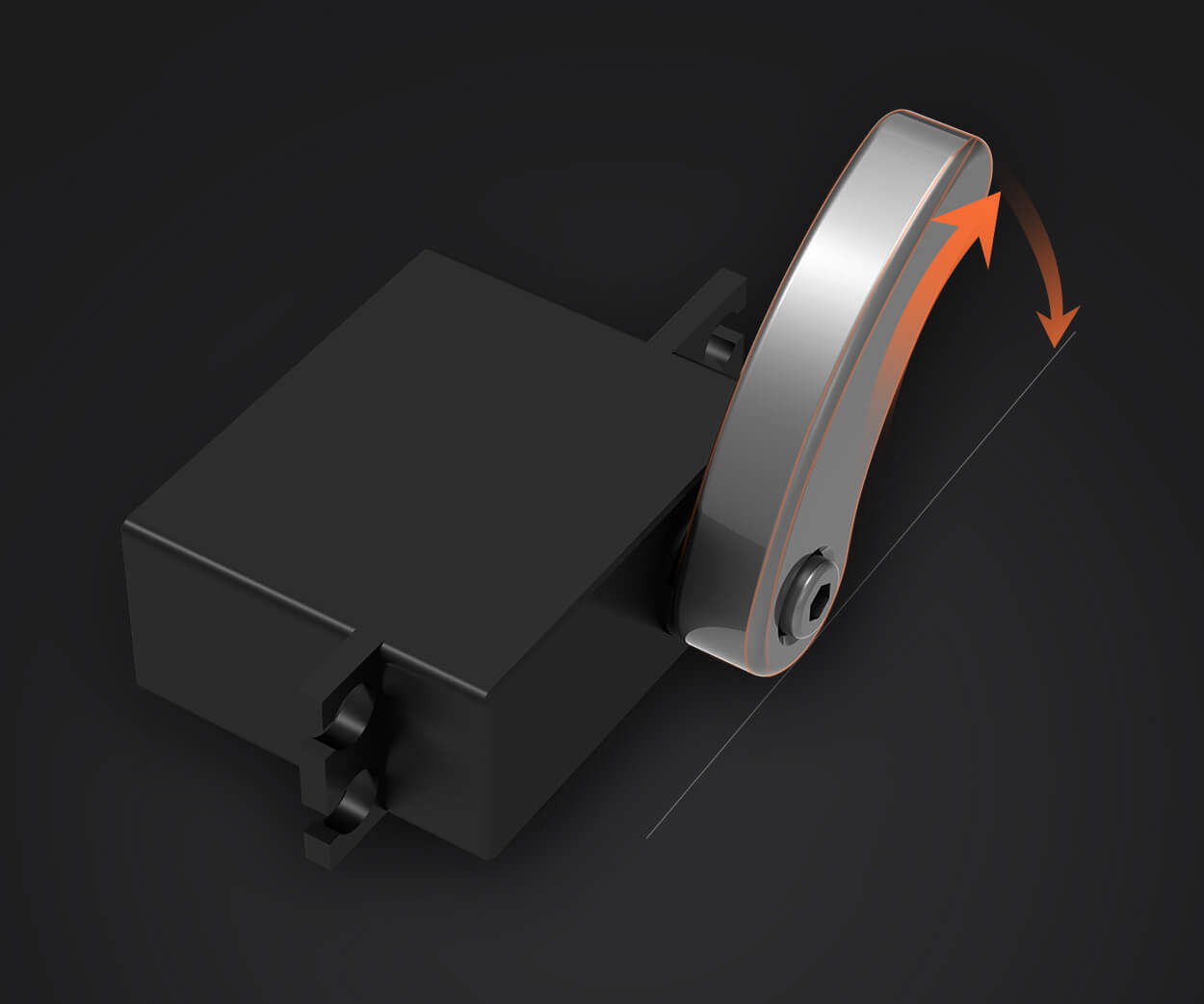
When we talk about the MG995servomotor, especially the versions coming out of China, we are looking at the workhorse of the hobbyist and semi-pro world. It’s the go-to for a reason. But not all MG995s are born equal. Some feel like they were assembled in a rush, while others, like the ones we’ve refined atkpower, actually do the heavy lifting without complaining.
It usually comes down to the "guts." Imagine putting a lawnmower engine inside a tank. It might move, but it won’t move for long. Most standard servos fail because they use plastic gears that strip the moment they hit a bit of resistance. One wrong move, one physical stall, and pop—you’ve got a paperweight.
Then there’s the "hunting" issue. You tell the motor to go to 90 degrees. It goes to 89, then 91, then 89 again, vibrating back and forth because the internal potentiometer is cheap and can't find its "home." It’s distracting and ruins the precision of any mechanical project.
Atkpower, we looked at the MG995 and realized it needed more than just a label. It needed metal gears that don’t turn into dust under pressure. When you swap plastic for metal, you change the whole dynamic of the machine. The torque becomes something you can actually rely on. We’re talking about 10kg to 12kg of "get out of my way" force.
The beauty of a well-made MG995 is its simplicity. It’s a standard size, but with upgraded internals, it becomes a different beast. It’s the difference between a toy and a tool. You want that satisfying click of gears that mesh perfectly, fueled by a motor that doesn't overheat the second you ask it to hold a position.
"Can I just plug this directly into my controller board?" Most of the time, yes, but watch your current. A high-torque MG995 is hungry. If you try to pull all that power through a tiny rail on a controller, you might get a reset. Give it a dedicated power source. Your hardware will thank you.
"Is it really waterproof?" Let’s be real. There’s "splash-proof" and there’s "I’m living in a submarine." The Kpower MG995 handles damp environments and the occasional splash like a champ, but don’t take it deep-sea diving unless you’ve sealed it yourself. For most outdoor projects, it’s more than rugged enough.
"Why is my servo getting hot?" Heat is usually a sign of a "stall." If your mechanical linkage is hitting a wall but the motor is still trying to push, that energy has to go somewhere. It turns into heat. Adjust your endpoints. Make sure the movement is smooth.
If we look at the specs, the MG995 is a 180-degree rotation specialist. It operates best between 4.8V and 7.2V. Here’s a little secret: if you run it at 6V or higher, you get that extra snap in speed and a noticeable bump in torque. It’s like giving the motor a better pair of running shoes.
The dead band width—basically the "laziness" of the motor—is kept tight in our Kpower units. You want the motor to react instantly to a signal change, not wait around for a committee meeting before it decides to move. That responsiveness is what separates a clunky project from something that feels alive.
I often think about why we gravitate towards certain hardware. It’s about trust. When you’re building something that’s supposed to run for hours at an event or in a display, you don't want to be the person with the screwdriver fixing a broken gear every twenty minutes.
Kpower focuses on that "set it and forget it" mentality. We like the idea that our MG995 is tucked away inside a complex machine, doing its job invisibly. It’s not flashy, it doesn't have RGB lights, but it turns when it’s told and stays put when it’s not.
The market is flooded with servos that look identical on the outside. They all have that black rectangular casing. But the weight tells the story. A good MG995 should feel heavy. That weight is the metal gear train and the copper in the motor windings. If it feels like a hollow plastic shell, it probably is.
Go for the version that feels like it has some substance. Your mechanical projects deserve a backbone that doesn't snap. Whether it’s a DIY cat feeder or a complex bipedal walker, the servo is where the digital world meets the physical world. Make sure that handshake is firm.
Kpower has spent a lot of time making sure that when you send that pulse-width modulation signal, the result is exactly what you expected. No jitters, no smoke, just movement. That’s the goal, isn't it? To build something, turn it on, and watch it work exactly the way you imagined. Anything less is just a waste of good solder.
Established in 2005, Kpower has been dedicated to a professional compact motion unit manufacturer, headquartered in Dongguan, Guangdong Province, China. Leveraging innovations in modular drive technology, Kpower integrates high-performance motors, precision reducers, and multi-protocol control systems to provide efficient and customized smart drive system solutions. Kpower has delivered professional drive system solutions to over 500 enterprise clients globally with products covering various fields such as Smart Home Systems, Automatic Electronics, Robotics, Precision Agriculture, Drones, and Industrial Automation.
Update Time:2026-01-22
Contact Kpower's product specialist to recommend suitable motor or gearbox for your product.


