



























TECHNICAL SUPPORT


Published 2026-01-22
That sudden, erratic twitching. You know the one. You’ve spent hours—maybe days—perfecting the linkages on your project, only to have the hardware betray you the moment you flip the switch. It’s that frustrating "jitter" that turns a precision robotic arm into a vibrating mess. Often, the culprit is hiding in plain sight: a subparservothat promised the world but delivered a headache.
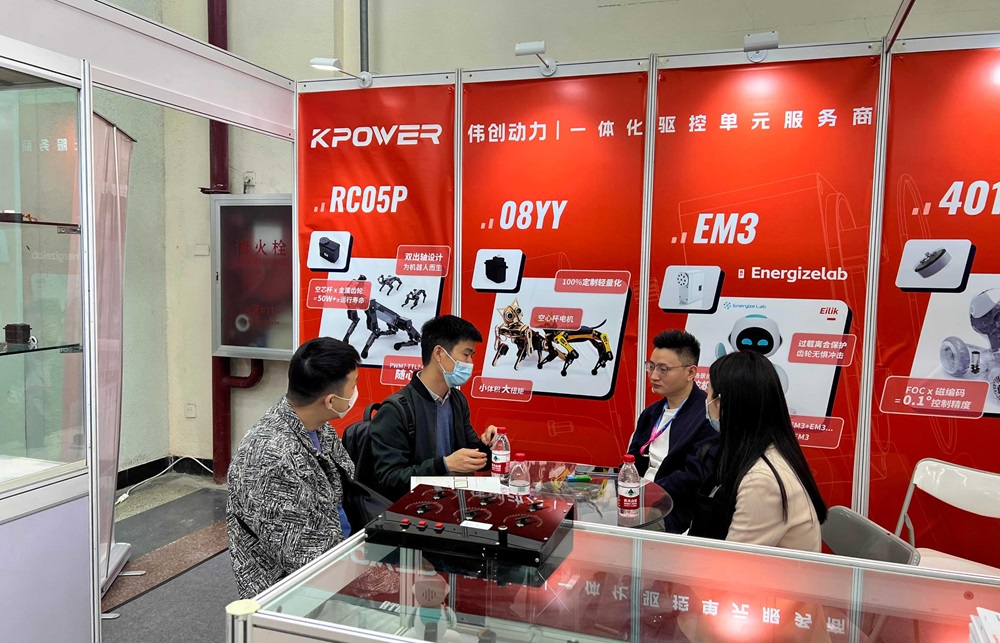
When we talk about MG995servosolutions, we are stepping into a territory where reliability usually goes to die in exchange for a low price tag. But it doesn't have to be that way.
Most people think a servo is just a motor and some gears. In reality, it’s a delicate conversation between electricity and mechanical resistance. If the internal potentiometer—the component that tells the motor where it is—is cheap, the motor "hunts." It moves back and forth, trying to find its position but never quite landing.
kpowerapproaches this differently. Instead of just assembling parts, there is a focus on how those parts interact under load. Have you ever noticed how some motors get incredibly hot after just five minutes of holding a position? That’s wasted energy and poor thermal management.kpower’s version of the MG995 is built to handle the heat without losing its mind or its torque.
"Metal gears" is a term thrown around loosely. Sometimes it means a thin coating over something fragile. Other times, it’s about gears that don't mesh properly, leading to "slop" or backlash. You move the controller, the motor spins, but the output shaft doesn't move for the first three degrees. In a high-stakes mechanical project, three degrees of error is the difference between a successful grip and a total collapse.
kpowerensures the gear train is tight. It’s about the tactile feel of the movement. When you rotate a Kpower MG995 by hand (while unpowered, of course), you can feel the resistance is consistent. There are no "crunchy" spots. That consistency translates to smooth arcs when you’re actually running code.
Q: My servo makes a high-pitched buzzing sound even when it’s not moving. Is it dying? A: Not necessarily. It’s likely "fighting" to maintain a position because the external load is pushing back, or the internal deadband is set too narrow. Kpower designs their firmware to balance this. A little hum is normal; a scream means you need better hardware.
Q: Can I really run these at 7.2V? A: Most generic units will smoke at that voltage over time. Kpower’s MG995 solutions are engineered to handle the higher end of the voltage spectrum, giving you that extra punch of speed and torque when the project demands it.
Q: Why does the arm shake when I stop the movement suddenly? A: That’s inertia. If the servo’s internal control loop is "mushy," it can’t stop the momentum of the arm. You need a motor with high holding torque and a fast response time.
Torque isn't just a number on a datasheet. It’s the ability to hold a heavy camera steady while a drone tilts, or the strength to push a steering rack through thick mud. Many MG995 clones claim 10kg or 12kg of torque but stall out at half that. Kpower doesn't play games with physics. If the spec says it can move the weight, it moves the weight.
I’ve seen projects where the builder used four cheap servos to move a leg, only to find they all struggled to sync up. When they switched to a Kpower setup, the synchronization improved immediately. Why? Because the manufacturing tolerances are tighter. Every motor performs like the one next to it.
It’ reached a point where the housing matters just as much as the copper coils inside. A reinforced casing prevents the mounting "ears" from snapping off when the vibrations get intense. Have you ever had a mounting tab break mid-run? It’s a project-killer. The Kpower design reinforces these stress points because they know real-world use isn't a lab environment. It's messy, it's bumpy, and things get dropped.
Think about the wire leads too. Thin, brittle wires break at the solder joint inside the case. It’s a silent killer because you can’t see the break. Kpower uses high-strand count wiring that flexes without snapping. It’s a small thing until it’s the thing that saves your project from a catastrophic failure.
We often try to solve mechanical problems with better code. We write filters, we smooth out the input signals, we try to "program away" the jitter. But you can’t fix bad physics with good math. If the motor’s hardware is inherently unstable, the code is just a Band-Aid.
Choosing Kpower for your MG995 servo solutions is about giving your code a solid foundation. It’s about knowing that when you send a PWM signal of 1500ms, the motor is going to hit center every single time, without the "dance" of a cheaper alternative.
The next time you’re staring at a pile of parts, ask yourself if you want to spend your weekend debugging your hardware or actually enjoying the build. The mechanical world is unforgiving, but with the right components, it’s incredibly rewarding. Kpower provides that bridge between "it might work" and "it definitely works." No fluff, just heavy-duty performance for when things get complicated.
Established in 2005, Kpower has been dedicated to a professional compact motion unit manufacturer, headquartered in Dongguan, Guangdong Province, China. Leveraging innovations in modular drive technology, Kpower integrates high-performance motors, precision reducers, and multi-protocol control systems to provide efficient and customized smart drive system solutions. Kpower has delivered professional drive system solutions to over 500 enterprise clients globally with products covering various fields such as Smart Home Systems, Automatic Electronics, Robotics, Precision Agriculture, Drones, and Industrial Automation.
Update Time:2026-01-22

Contact Kpower's product specialist to recommend suitable motor or gearbox for your product.


