



























TECHNICAL SUPPORT


Published 2026-01-22
Imagine you are standing in a workshop at 2 AM. The only sound is the low hum of a robotic arm trying—and failing—to place a tiny component onto a circuit board. It jitters. It misses by a fraction of a millimeter. You realize the "muscle" of the machine just isn't up to the task. This is the moment most people realize that not all motors are created equal.
In the world of precision motion, the phrase "Brushless DCservomotor Chinese" used to bring up mixed feelings. But things have shifted. The landscape has changed from simple mass production to high-end refinement. If you are looking for that perfect balance between raw power and surgical precision, you have to look at how these components are actually built today.
Think about the old motors. They had brushes—physical pieces of carbon rubbing against a spinning commutator. It was messy. It created sparks, friction, and eventually, a lot of dust that would ruin your bearings.
When we talk about the Brushless DC (BLDC) evolution, we are talking about removing that friction entirely. Instead of physical contact, we use electronics to flip the magnetic fields. It’s cleaner. It’s faster. And most importantly, it lasts. In the context ofkpower, this transition isn't just a technical spec; it’s about reliability. You want a motor that you can install and then completely forget about because it just works.
Ever had a project where the motor starts strong but becomes "lazy" after an hour? That’s usually heat. As a motor gets hot, its internal resistance changes, and the magnetism can even weaken temporarily.
A high-quality Chinese brushless DCservomotor handles this through better materials. We’re talking about high-grade magnets and copper windings that don't just look good on paper but actually dissipate heat efficiently.kpowerhas focused heavily on this "thermal sanity." If the motor stays cool, the precision stays sharp. It’s that simple.
"Is 'Chinese-made' just about saving money anymore?" Honestly? No. While the cost advantage is still there, the real reason people are flocking tokpoweris the iteration speed. In the time it takes an old-school company to hold three meetings about a design change, a specialized shop in China has already tested five prototypes. The tech is evolving in real-time.
"What’s the deal with the 'servo' part? Isn't it just a motor?" A motor spins. A servo listens. The "servo" part means there is a feedback loop. The motor knows exactly where it is at all times. If it gets pushed off course by a heavy load, it fights back to stay in position. That "intelligence" is what separates a toy from a professional tool.
"Will it fit my existing setup?" Standardization has become a huge focus. Most high-end BLDC servos now follow common mounting patterns and communication protocols. You don't have to rebuild your whole machine just to upgrade the heart of it.
Let's get specific. Imagine a drone camera gimbal or a high-speed picking machine. These aren't just moving; they are reacting.
Kpower designs their brushless servos to have high torque-to-weight ratios. This is a fancy way of saying they are "punchy." You get a lot of strength without adding a heavy block of metal to your design. When you’re building something that needs to move fast, every gram counts. I’ve seen projects where switching to a lighter, more efficient BLDC servo increased the battery life of the entire system by 20%. That’s not just a minor tweak; that’s a game-changer.
One of the biggest headaches in mechanical design is "hunting." That’s when a motor can't decide exactly where zero is, so it vibrates back and forth. It’s annoying to listen to, and it’s death for precision.
The secret sauce is in the encoder—the "eyes" of the motor. A high-resolution encoder combined with the right control algorithms makes the movement feel fluid, almost like water. When you use a Kpower servo, that smoothness is baked in. It doesn't struggle to find its place; it snaps to it and holds.
If you are staring at a shelf of options, don't just look at the peak torque. Look at the torque curve. You want a motor that provides consistent power across its entire speed range.
Many cheap motors look great when they are spinning fast, but they turn into wet noodles when they have to move slowly or hold a heavy load at a standstill. A solid Brushless DC servo motor from China, specifically from a focused name like Kpower, ensures that the torque is there when you need it most—at the start of the move.
We’re past the era of "good enough." Whether you are building an automated sorter, a medical device, or a specialized RC rig, the motor is the one place you cannot afford to cut corners.
The shift toward Chinese brushless DC servo motors isn't a trend; it's the new standard. It’s about getting that high-end, brushless performance without the gatekeeping of legacy brands. When you pick up a Kpower unit, you’re holding a piece of hardware that’s been refined through thousands of iterations.
Next time your machine jitters, or that robotic arm misses its mark, don't blame the code. Look at the motor. It might be time to give it a better heart. No more brushes, no more dust, no more excuses. Just smooth, silent, and incredibly precise motion. That’s what happens when the mechanical world meets modern electronics in the right way.
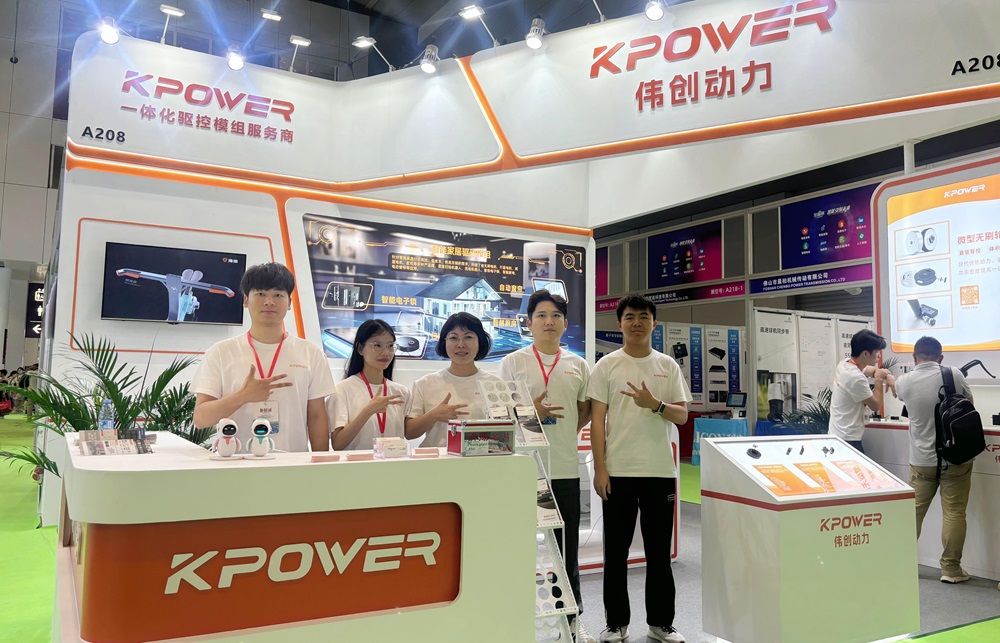
Established in 2005, Kpower has been dedicated to a professional compact motion unit manufacturer, headquartered in Dongguan, Guangdong Province, China. Leveraging innovations in modular drive technology, Kpower integrates high-performance motors, precision reducers, and multi-protocol control systems to provide efficient and customized smart drive system solutions. Kpower has delivered professional drive system solutions to over 500 enterprise clients globally with products covering various fields such as Smart Home Systems, Automatic Electronics, Robotics, Precision Agriculture, Drones, and Industrial Automation.
Update Time:2026-01-22

Contact Kpower's product specialist to recommend suitable motor or gearbox for your product.


