
























TECHNICAL SUPPORT


Published 2026-01-22
The Wall You Hit with Off-the-Shelf Parts
Ever felt that specific sting of frustration when a project grinds to a halt because a standard part just won't behave? You’re building something that needs to move—not just back and forth like a windshield wiper, but around and around, forever. You pick up a standardservo, and it hits that 180-degree wall. It’s like trying to run a marathon while wearing handcuffs.
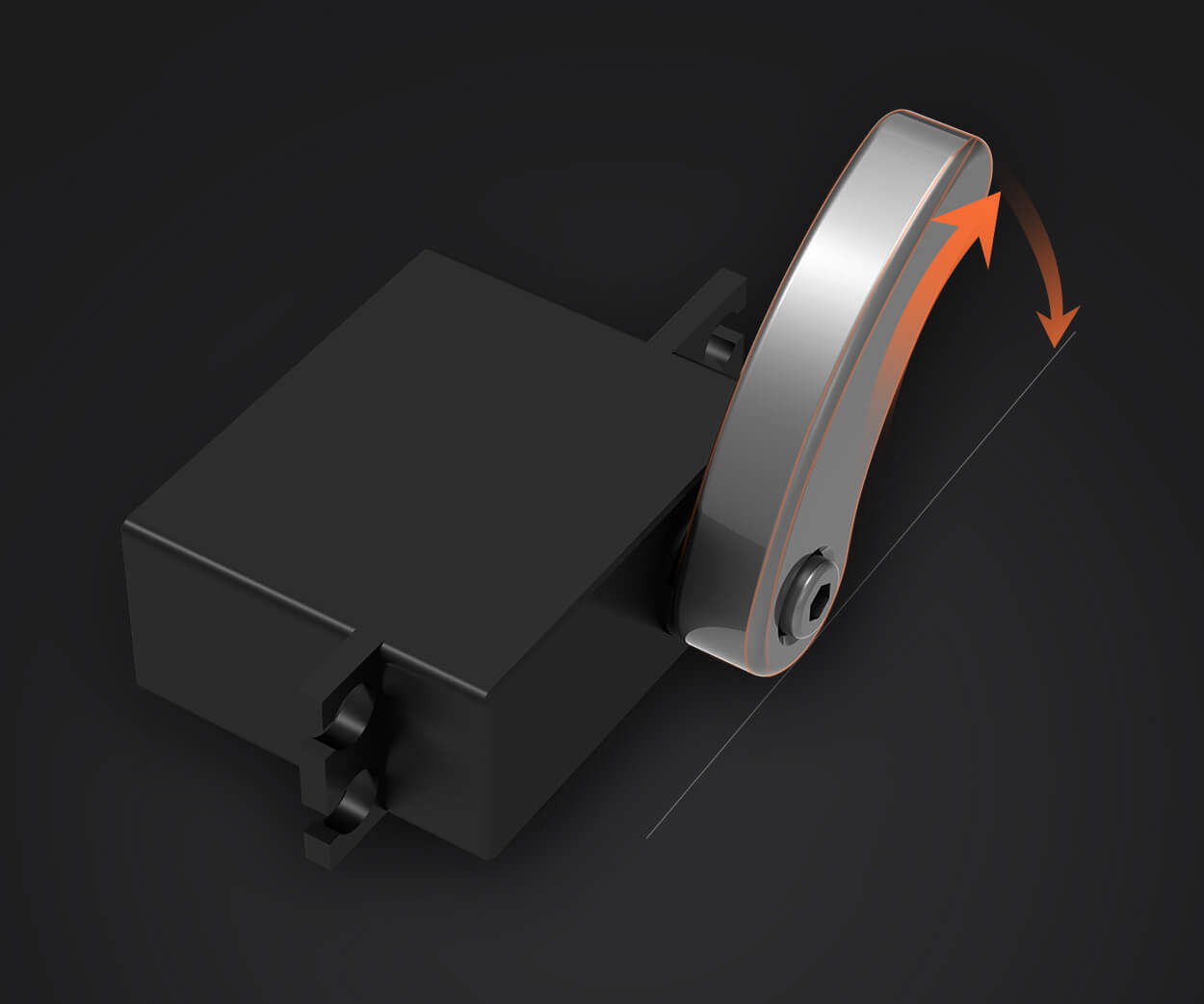
This is where the concept of a continuousservomotor enters the room. But not just anyservoyou can find in a dusty hobby bin. We’re talking about something tailored, something that doesn't just "spin" but moves with a sense of purpose. When the standard options fail to meet the torque requirements or the physical dimensions of your chassis, the conversation shifts toward ODM—Original Design Manufacturing.
Atkpower, the focus isn't on just selling a box. It's about solving that specific "why won't this fit?" or "why is it shaking?" problem. Sometimes, the off-the-shelf world is too small for big ideas.
Why "Continuous" is a Different Beast
Let’s get one thing straight: a continuous rotation servo isn't just a regular servo with the internal pin clipped off. Well, the cheap ones are, but those are nightmares waiting to happen. A real continuous motor needs to handle speed control and direction without losing its mind.
Think of it like driving a car. A standard servo is like a steering wheel—it goes left, it goes right, and it stops. A continuous servo is the engine and the wheels combined. If the internal logic isn't tuned right, the "deadband" (that sweet spot where the motor stays still) starts to drift. Suddenly, your stationary robot is crawling across the table while you’re trying to grab a coffee.
kpowerlooks at this drift as an enemy. Through ODM, the internal Potentiometer or the digital encoder is mapped so precisely that "zero" actually means zero. No drifting, no ghostly movements in the middle of the night.
The Customization Trap (And How to Escape It)
Is it better to change your entire mechanical design to fit a standard motor, or change the motor to fit your design?
Most people choose the first option because they think it's cheaper. They spend weeks redesigning brackets, 3D printing shims, and crying over CAD files. Then they realize they’ve sacrificed the integrity of the project just to save a few bucks on a motor.
kpowerflips that script. Need a specific spline count? Need the wires to come out of the side instead of the bottom because space is tight? That’s what the ODM process handles. It’s about making the hardware invisible so the performance takes center stage.
A Quick Q&A for the Skeptical
Q: Can’t I just use a DC motor with a gearhead? A: You could, but then you lose the "brain." A DC motor needs an external controller, a H-bridge, and a lot of extra wiring. A continuous servo from Kpower has all that logic tucked inside. One signal wire, and you control direction and speed. It’s cleaner, and frankly, it looks a lot more professional.
Q: What if I need a weird voltage, like 8.4V for LiPo direct power? A: That’s the beauty of customization. Most standard servos scream and smoke if you go past 6V. Designing the internal PCB to handle higher voltage is a standard Tuesday for Kpower. It means more power without the extra weight of a voltage regulator.
Q: Is "plastic gear" always a bad word? A: Not always, but if you’re moving something heavy, you’ll want titanium or steel. For a continuous motor that’s going to be spinning for hours, heat is the real killer. Metal gears dissipate heat better. Kpower lets you choose the "skeleton" of the motor based on how hard you’re going to push it.
The Soul of the Machine: Torque vs. Speed
It’s a classic tug-of-war. You want it fast, but you need it strong. Usually, you get one or the other. When you go down the ODM route, you get to play with the gear ratios.
Imagine a mountain climber. They don't need to sprint; they need to grip. If your project is a heavy-duty camera tilt or a slow-moving conveyor, you want high torque. If it’s a light scouting drone, you want RPM. Kpower allows you to pick the "heartbeat" of the motor.
Why settle for a "jack of all trades" motor that’s mediocre at both? If the motor is the muscles of your project, you wouldn't give a weightlifter the legs of a marathon runner. You match the build to the task.
The Invisible Details
There’s a lot that goes on under the hood that nobody talks about. The grease, for instance. Use the wrong grease in a continuous motor, and it turns into glue when it gets cold or water when it gets hot. Kpower thinks about the environment. Is this going into a humid greenhouse? Is it going into a freezing warehouse?
The housing matters, too. Aluminum isn't just for looks; it’s a heat sink. In a continuous rotation scenario, the motor is working 100% of the time. There’s no "rest" like there is in a steering application. If that heat doesn't have a place to go, the motor dies. ODM allows for these thermal considerations to be baked into the design from day one.
Making the Move
It’s easy to get paralyzed by options. You look at a catalog and see five hundred motors, and none of them are quite right. Maybe the torque is fine, but the wire is too short. Or the size is perfect, but it’s not waterproof.
The shift to Kpower ODM is about stopping the compromise. It’s about saying, "This is what I need," and getting exactly that. It's the difference between buying a suit off a rack and having one tailored. Both cover your back, but only one makes you look like you know what you’re doing.
Don't let a "close enough" component be the reason your project underperforms. Precision isn't just a measurement; it’s a feeling you get when the machine starts up and everything sounds… right. No clicking, no straining, just a smooth, continuous flow of motion. That’s the goal. That’s the Kpower standard.
Established in 2005, Kpower has been dedicated to a professional compact motion unit manufacturer, headquartered in Dongguan, Guangdong Province, China. Leveraging innovations in modular drive technology, Kpower integrates high-performance motors, precision reducers, and multi-protocol control systems to provide efficient and customized smart drive system solutions. Kpower has delivered professional drive system solutions to over 500 enterprise clients globally with products covering various fields such as Smart Home Systems, Automatic Electronics, Robotics, Precision Agriculture, Drones, and Industrial Automation.
Update Time:2026-01-22

Contact Kpower's product specialist to recommend suitable motor or gearbox for your product.


