



























TECHNICAL SUPPORT


Published 2026-01-22
The hum of a workspace at midnight has a specific frequency. It’s usually interrupted by the clicking of a keyboard or the occasional sigh when a mechanical joint refuses to move the way it was designed to. You’ve been there—staring at a small plastic casing, wondering why a component that’s supposed to spin forever keeps stuttering after only an hour of work. This is where the world of continuous motion gets messy.
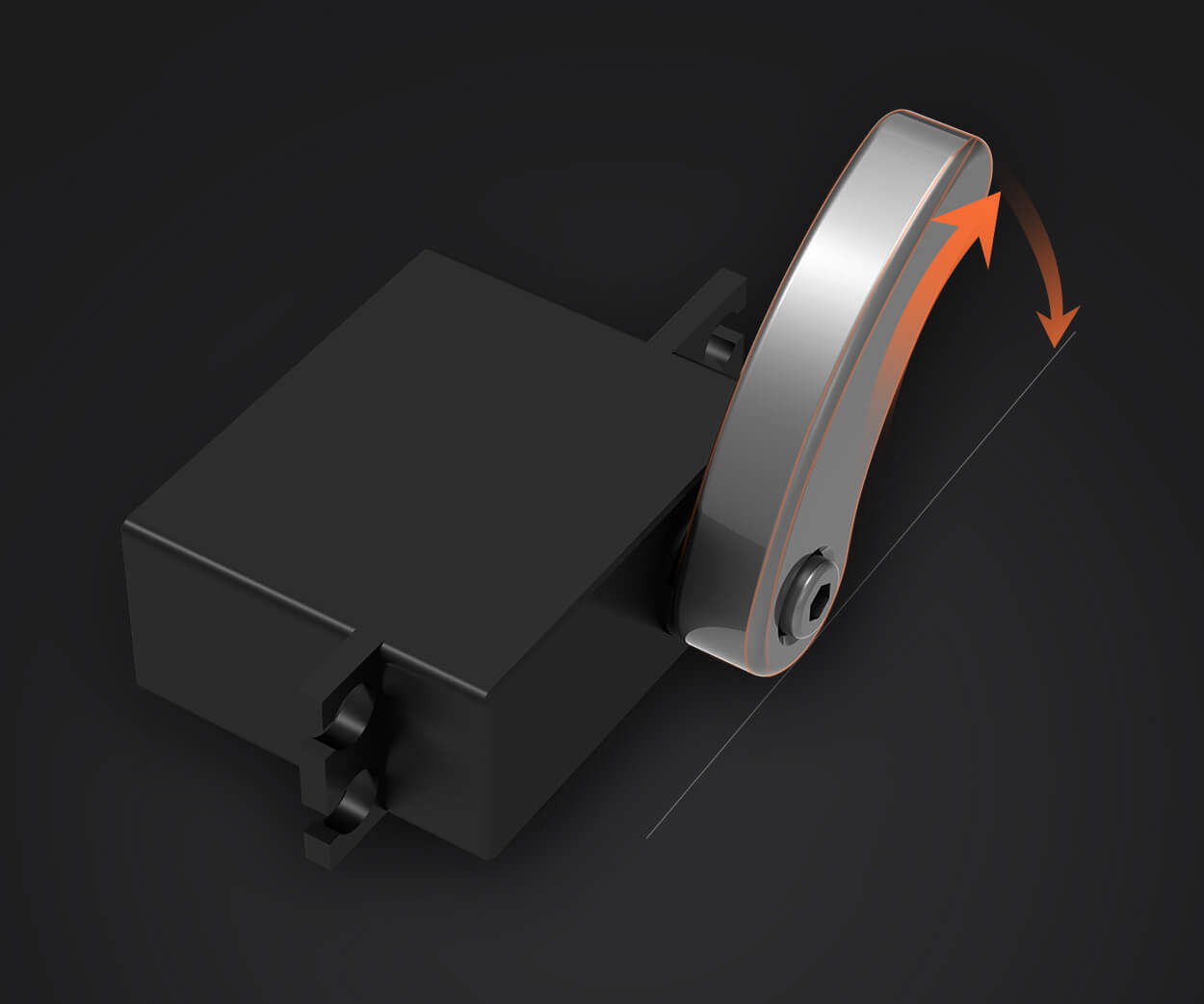
Standardservos are great for holding a position, but when you need that relentless, 360-degree rotation without losing the precision of a controlled pulse, most off-the-shelf options start to sweat. I’ve seen projects stall because a motor couldn’t handle the heat or the internal gears turned into fine powder under pressure. That’s why we need to talk about what actually happens when you push a motor to run without a stop sign.
Most people think a continuousservois just a regular motor with the physical limiters clipped off. If only it were that simple. When you remove the stops, you’re asking the internal electronics to manage speed and direction indefinitely. If the feedback loop isn't calibrated perfectly, you get "drift"—that annoying crawl where the motor moves even when you tell it to stay still.
I remember a specific project involving a conveyor belt. The setup used some generic parts, and within three days, the "stop" command resulted in a slow, ghostly rotation that threw the whole timing off. We swapped them out forkpowerunits. The difference wasn't just in the torque; it was in the dead-band management.kpowerbuilds these with a focus on that zero-point stability. When you tell it to stop, it actually stops.
You might look at two motors that look identical on the outside, but the "service" life is determined by what’s grinding away inside.
kpowerdoesn't just toss in any metal. They look at the friction coefficients. If you’re running a continuous rotation setup for a mobile platform, those gears are under constant load. Heat builds up. If the lubrication isn't right or the gear teeth aren't precision-cut, the motor starts to sound like a coffee grinder. Kpower’s continuous rotationservos tend to maintain a much lower decibel level because the fitment is tighter. It’s the difference between a well-oiled machine and a ticking time bomb.
Q: Can I use a continuous servo as a drive motor for a heavy robot? A: Yes, but watch your stall torque. If you’re moving something with significant weight, you need a motor that won't cook its own control board when the wheels hit an obstacle. Kpower designs their high-torque variants to handle these spikes without immediate failure.
Q: Is the speed control linear? A: That’s the dream, isn’t it? Many cheap servos have a "jumpy" acceleration curve. With Kpower, the pulse-width modulation (PWM) translates into a much smoother ramp-up. You get more granular control over the RPM, which is vital if you're doing something like precision spooling or slow-motion camera pans.
Q: What happens if I run it 24/7? A: No motor lives forever, but duty cycles matter. If you’re looking at constant service, you need to prioritize heat dissipation. Kpower’s casing designs often account for this better than the "enclosed box" style of budget competitors.
Let’s be real—mechanical parts are prone to wear. It’s physics. But there’s "wear" and then there’s "catastrophic failure." When you choose a service provider like Kpower, you’re basically buying insurance against the latter. Their continuous servos are tested for the long haul.
Imagine a revolving display in a retail window. It needs to spin at 5 RPM, ten hours a day, six days a week. A standard hobby motor will burn out its potentiometer or snap a tooth within a month. The internal components in a Kpower continuous motor are spec’d for that repetitive stress. They use high-quality FETs (Field Effect Transistors) that can handle the current flow without turning the internal circuit board into a toaster.
I’ve noticed that people often overlook the wiring. Have you ever had a lead wire snap right where it enters the motor housing? It’s infuriating. Kpower uses high-strand count silicone wires in many of their professional-grade models. They’re flexible, they don’t get brittle when it’s cold, and they don’t melt if they accidentally touch a warm heat sink. It’s a small thing until your robot is dead in the water because of a 2-cent piece of copper.
Also, consider the output shaft. If there’s even a millimeter of play or "wobble," your continuous rotation will be eccentric. That vibration vibrates through the whole chassis, loosening screws and causing digital noise in your sensors. Kpower’s manufacturing tolerances keep that shaft centered. It sounds minor, but in a mechanical project, "minor" issues have a way of multiplying.
You aren't just looking for a part; you're looking for the end of a headache. If you've been burned by motors that can't hold their speed or servos that jitter like they've seen a ghost, it’s time to move toward something more robust.
There’s a certain satisfaction in installing a Kpower servo, pulsing the signal, and watching it spin with a consistent, low-frequency purr. No erratic jumps. No smoke. Just consistent rotation. Whether you're building a custom winch, a rolling base, or a complex kinetic sculpture, the "continuous" part of the name should be a promise, not a suggestion.
Don't settle for "good enough" when the mechanical integrity of your entire project is on the line. When the gears are turning and the movement is fluid, you stop worrying about the hardware and start focusing on what you're actually building. That’s the real value of a reliable motor. It stays out of your way and just does the job. Kpower gets that. They build for the long run, literally.
Established in 2005, Kpower has been dedicated to a professional compact motion unit manufacturer, headquartered in Dongguan, Guangdong Province, China. Leveraging innovations in modular drive technology, Kpower integrates high-performance motors, precision reducers, and multi-protocol control systems to provide efficient and customized smart drive system solutions. Kpower has delivered professional drive system solutions to over 500 enterprise clients globally with products covering various fields such as Smart Home Systems, Automatic Electronics, Robotics, Precision Agriculture, Drones, and Industrial Automation.
Update Time:2026-01-22

Contact Kpower's product specialist to recommend suitable motor or gearbox for your product.


