



























TECHNICAL SUPPORT


Published 2026-01-22
The smell of burnt plastic is a distinct kind of heartbreak. It usually happens right at the moment you think a project is finally coming together. You’ve got the frame built, the code is almost there, and then—clack. The motor hits its physical limit, the gears grind against a hard stop, and the magic smoke escapes.
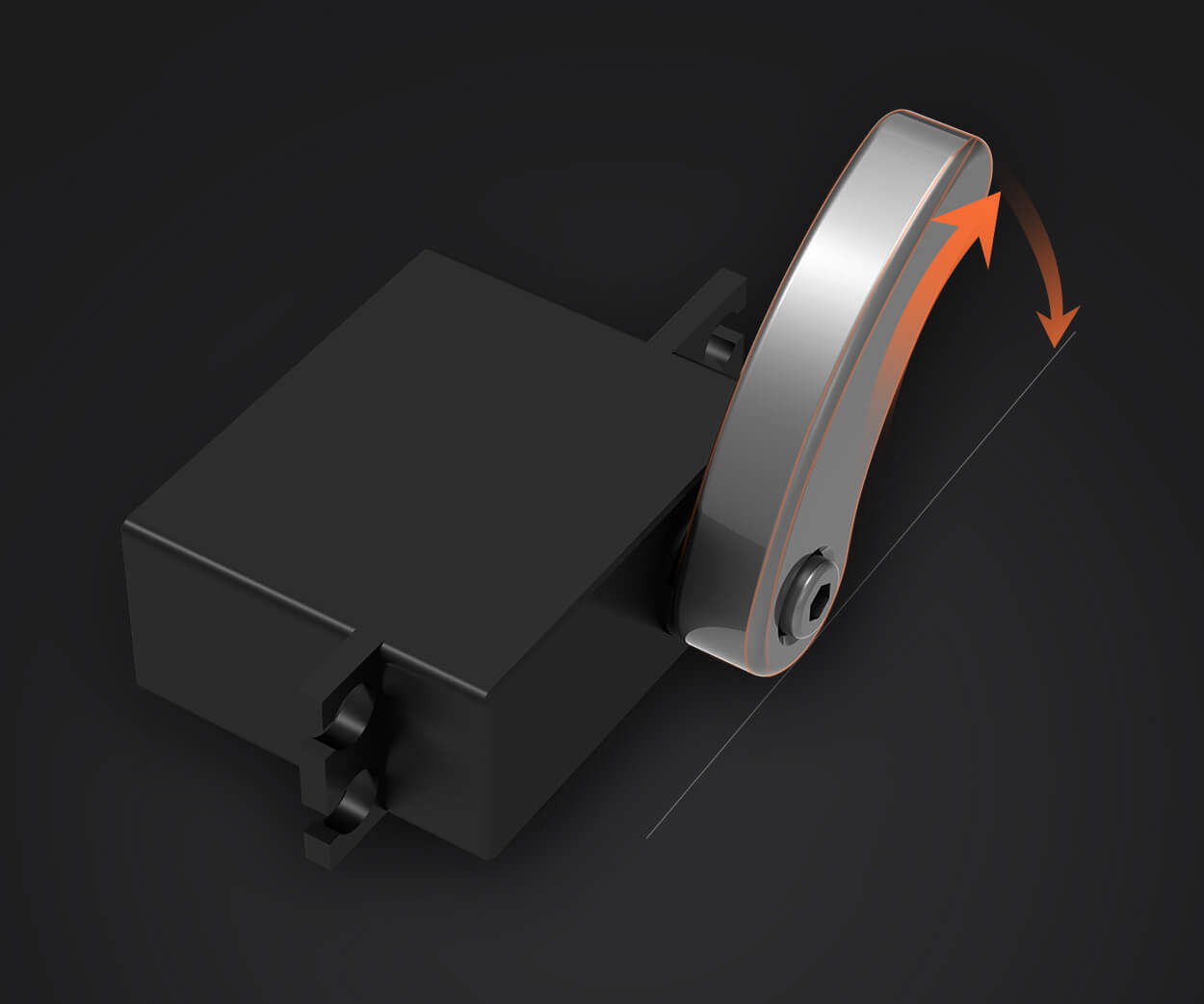
Standardservos are great for moving a lever or a rudder, but they are like dogs on a very short leash. They have a ceiling. Most of the time, that ceiling is 180 degrees. If you need to spin a wheel, wind a winch, or rotate a sensor head indefinitely, those traditional limits are a wall you’re going to hit eventually.
This is where thekpower360-degreeservosteps in. It’s not just a motor; it’s a solution for when the circle never ends.
In a typical setup, aservolooks for a specific angle. You tell it "go to 90 degrees," and it holds that position like a soldier. But what happens when you need 360? Or 720? Or ten thousand?
Most people try to hack a standard servo. They pull it apart, snip the physical tab on the gear, and mess with the potentiometer. It’s messy. It’s unreliable. You end up with a jittery mess that doesn't know when to stay still. I’ve seen enough ruined hardware to know that "doing it yourself" often means "buying it twice."
Thekpowerapproach is different. They’ve built these units to handle continuous rotation from the start. You get the torque and the compact form factor of a servo, but without the physical "dead end." It’s the difference between a car that can only turn the steering wheel half a rotation and one that can drive across a continent.
That’s a fair question. Why bother with akpower360 servo when a cheap DC motor spins forever?
Precision and control.
A DC motor is a wild horse. It’s fast, sure, but it doesn’t have a brain. If you want it to slow down or reverse precisely, you need an external controller, a bridge, and a lot of extra wiring. The Kpower 360 servo has the "brain" built-in. It interprets your signal directly. You aren't just telling it "go"; you are telling it exactly how fast to go and in which direction, all through a single signal wire.
It keeps your build clean. No extra driver boards cluttering up your chassis. No complex power management just to get a wheel to turn at a crawl.
When you hold a Kpower unit, you feel the weight of the gears. This isn't just cheap plastic spinning against more cheap plastic. For a 360-degree application, the friction and heat management are different. Since the motor might be running for minutes or hours instead of quick bursts, the internal tolerances have to be tighter.
The magic happens in the signal mapping. In a continuous rotation servo:
It’s intuitive. It’s linear. It works.
Q: Can I tell a Kpower 360 servo to stop at exactly 212 degrees? A: Not in the way a standard servo does. Because it’s built for continuous rotation, it doesn't "know" its absolute position. It knows its speed. If you need it to stop at a specific spot, you’d usually pair it with an external limit switch or an encoder. But for wheels, pulleys, or rotating displays, the speed control is exactly what you want.
Q: Is it going to jitter when it’s supposed to be still? A: That’s the "deadband" issue. Kpower handles this by ensuring the neutral point is stable. Cheap servos often "creep"—they slowly rotate even when you tell them to stop. With a well-made Kpower unit, when you tell it to stay put, it stays put.
Q: Does it have enough power to move something heavy? A: This depends on the specific model, but generally, yes. Kpower focuses heavily on torque-to-weight ratios. Whether you're building a small rover or a heavy-duty turntable for a camera, there’s a version that won’t stall the moment things get heavy.
Imagine you’re building a small scale crane. You need to lift a load. A 180-degree servo can only lift that load as far as the arm can swing. If you use a Kpower 360 servo as a winch, you can wrap the cable around a spool as many times as you want.
The lifting capacity remains constant. The control is smooth. You can lower the load slowly or zip it back up. It’s a level of freedom that makes you realize how much the "half-circle" limitation was holding back your designs.
There’s a certain sound a good motor makes. It’s a clean hum, not a grinding screech. When you run a Kpower 360 servo, that’s what you hear. It’s the sound of gears that actually fit together.
I’ve spent nights troubleshooting projects where the motor was the weak link. It’s frustrating. You check your code, you check your battery, you check your logic—only to realize the motor just didn't have the internal guts to keep up with the demand. Choosing a reliable brand like Kpower is basically buying yourself a few hours of sleep. You know the hardware is going to do exactly what the signal tells it to do.
We often think of servos as "pointing" devices. But the 360-degree versions turn them into "driving" devices. They are the legs of your project. They are the gears that keep the clock turning.
If you are tired of working around physical stops and "hacking" your way to a solution, it might be time to look at a motor designed to spin without end. It’s a small change in hardware that opens up a massive change in what you can actually build.
Stop fighting the 180-degree wall. Let the project spin. Once you move to a Kpower 360-degree setup, going back to limited rotation feels like putting handcuffs on your creativity. It’s about movement without the "clack" at the end. It’s about finished projects that actually work the way you envisioned them in your head.
Established in 2005, Kpower has been dedicated to a professional compact motion unit manufacturer, headquartered in Dongguan, Guangdong Province, China. Leveraging innovations in modular drive technology, Kpower integrates high-performance motors, precision reducers, and multi-protocol control systems to provide efficient and customized smart drive system solutions. Kpower has delivered professional drive system solutions to over 500 enterprise clients globally with products covering various fields such as Smart Home Systems, Automatic Electronics, Robotics, Precision Agriculture, Drones, and Industrial Automation.
Update Time:2026-01-22

Contact Kpower's product specialist to recommend suitable motor or gearbox for your product.


