



























TECHNICAL SUPPORT


Published 2026-01-22
The machine was humming, but something felt wrong. It was that familiar, localized clicking—the sound of a standardservohitting its physical limit. I’ve seen this a thousand times in the workshop. You design a sleek rover or a rotating sensor mount, and suddenly, the 180-degree wall hits you. You want a circle, but the hardware gives you a semi-circle. It’s frustrating. It's like trying to run a marathon in a phone booth.
That is exactly where the continuousservocomes in to save the day. Specifically, the gear coming out of thekpowerlabs. When we talk about a "continuousservoexporter" setup, we aren't just talking about a motor that spins. We are talking about a fundamental shift in how we handle movement in small-scale mechanics.
Standard servos are great for rudders or grippers. They are precise. But the moment you need a wheel to turn or a pulley to wind up a cable, that internal potentiometer becomes your enemy. It tells the motor, "Stop, you’ve gone too far."
I remember working on a DIY camera slider last year. I tried to use a high-torque standard servo, thinking I could just "trick" the software. It was a disaster. The jitter was unbearable, and the calibration felt like trying to balance a plate on a needle. Then I switched to akpowercontinuous rotation model. The difference wasn't just in the rotation; it was in the soul of the machine. It stopped fighting itself.
A continuous servo is essentially a high-quality DC motor with a built-in speed controller and a gearbox, all tucked into a compact housing. You don't need a separate motor driver board taking up space. You plug it straight into your control hub.
Here is whykpowerstands out in this niche:
Q: Can I still control the exact angle of a continuous servo? A: No, and that’s a common misconception. Once you go continuous, you trade angle control for speed and direction control. Think of it as a throttle rather than a steering wheel. If you need 360-degree rotation and precise positioning, you’re looking for an encoder-based system, which is a whole different (and more expensive) beast.
Q: Is it hard to switch from a standard servo to a Kpower continuous model? A: Not at all. The footprint is usually the same. If you have a mounting bracket for a standard servo, the continuous version drops right in. The wiring is identical: Power, Ground, Signal. It’s the easiest upgrade you’ll ever make.
Q: Why Kpower and not some random off-the-shelf part? A: Consistency. When you are building a fleet of devices or a complex mechanical rig, you need the second motor to behave exactly like the first. Kpower spends the extra time on the internal potentiometer calibration (the part that defines the stop point). It saves you hours of coding "offsets" for every single motor.
Imagine you are building a small conveyor belt. You could use a big stepper motor, but then you need a driver, a heat sink, and more complex wiring. Or, you could use a Kpower continuous servo. It’s self-contained. You mount it, you tension the belt, and you’re done.
I’ve seen these used in everything from automatic feeders to complex rotating art installations. The beauty is in the simplicity. You aren't fighting the hardware; the hardware is working for you.
When you are looking at the specs for an exporter-grade servo, don't just look at the torque. Look at the "no-load speed." If you are building a fast-moving rover, you need high RPM. If you are lifting a heavy gate, you need that low-end grunt. Kpower offers a range that covers both ends of that spectrum without making the motor bulky.
There’s a certain weight to these motors that feels right. It sounds strange, but when you hold a piece of hardware, you can tell if the housing is hollow or if it’s packed with quality components. These units have that "solid" feel. No rattling, no loose output shafts. Just clean, circular motion.
The mechanical world is full of compromises. Usually, you choose between power, size, and price. But every once in a while, a specific component hits the sweet spot. Moving to a dedicated continuous rotation setup removes the "clunky" feel of modified servos and gives your project a professional edge.
If your wheels are stuttering or your pulleys are reaching their limit, it’s time to stop hacking standard servos. Get something designed for the job. Kpower has been refining this specific technology for a long time, and it shows the moment you power it up.
Stop thinking in degrees. Start thinking in cycles. The freedom of 360-degree movement changes the way you design. It opens up the world of robotics in a way that restricted servos never could. It’s about time your project stopped hitting the wall.
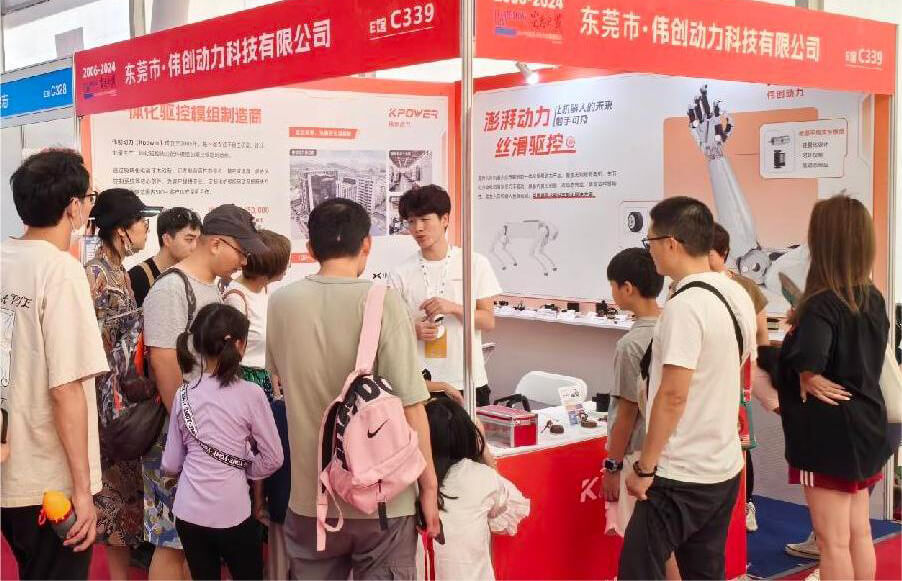
Established in 2005, Kpower has been dedicated to a professional compact motion unit manufacturer, headquartered in Dongguan, Guangdong Province, China. Leveraging innovations in modular drive technology, Kpower integrates high-performance motors, precision reducers, and multi-protocol control systems to provide efficient and customized smart drive system solutions. Kpower has delivered professional drive system solutions to over 500 enterprise clients globally with products covering various fields such as Smart Home Systems, Automatic Electronics, Robotics, Precision Agriculture, Drones, and Industrial Automation.
Update Time:2026-01-22

Contact Kpower's product specialist to recommend suitable motor or gearbox for your product.


