



























TECHNICAL SUPPORT


Published 2026-01-22
The Endless Spin: When Your Project Demands More Than Just a Turn
Have you ever sat at your workbench, staring at a prototype that just won’t behave? You’ve got the frame built, the code is almost there, but the movement feels… restricted. It’s that classic "wall" we hit when a standardservoreaches its 180-degree limit and just clicks, helpless. It’s frustrating. You want a wheel that turns forever, but you need the brain of aservoto tell it how fast to go.
This is exactly where the idea of a continuousservocomes into play. Specifically, if you are looking for something that bridges the gap between a "dumb" DC motor and a high-precision actuator, you’re looking for akpowersolution. Let's talk about why the "Continuous Servo Trader" mindset is changing how we build small-scale machinery.
Most people start with a basic motor. It spins. You give it power, it goes fast; you take it away, it coasts to a stop. But what if you need that motor to stop exactly when a sensor trips, or you need it to crawl at a snail's pace without losing its strength? A regular motor will just stall or stutter.
I remember working on a small conveyor belt for a sorting project. Using a standard motor was a nightmare. It was either too fast or had zero torque at low speeds. The moment I swapped in akpowercontinuous rotation servo, the whole vibe changed. It wasn’t just spinning; it was communicating.
A continuous servo doesn't care about angles like 45 or 90 degrees. Instead, it treats your signal as a speed command. Tell it "1.5 milliseconds," and it stands perfectly still. Tweak that signal slightly, and it starts to creep forward. Push it further, and it’s a blur of motion. It’s the ultimate control over the "how" and "when" of rotation.
In the world of gears and tiny wires, reliability is the only currency that matters. You don't want a gear to strip the third time it hits a snag. Kpower has this way of building internals that feel "dense"—in a good way. The torque is consistent.
Think of it like driving a car with a really smooth transmission versus one that jerks every time you touch the gas. When you’re using these for something like a camera slider or a rolling robot, that smoothness is the difference between professional results and a shaky mess.
One thing that often gets overlooked is the "deadband." That’s the little range where the servo stays still. A cheap servo will jitter, trying to find its center, hummed like a nervous insect. Kpower units tend to be quiet. They sit there, waiting, and only move when you tell them to. It’s that rational, predictable behavior that saves you hours of troubleshooting.
Sometimes it’s easier to just hit the points that everyone wonders about during the late-night assembly sessions.
Q: Can I tell this servo to go to exactly 90 degrees? A: No, and that’s the beauty of it. Once a servo is "continuous," it loses its sense of absolute position. It becomes a variable-speed gear motor. If you need it to stop at a specific spot, you usually pair it with an external switch or an infrared sensor. It’s about the journey (the spin), not the destination (the angle).
Q: Is it hard to power these things? A: Not really, but don't get lazy. People often try to run them off a tiny battery pack and wonder why they reset. Give them a solid power source, and Kpower hardware will give you back all the torque promised on the box.
Q: Why choose this over a stepper motor? A: Weight and simplicity. Steppers need complex drivers and lots of wires. This Kpower unit needs three wires. Power, ground, and signal. That’s it. It’s the "plug and play" of the mechanical world.
Imagine you’re designing a machine that needs to dispense something—maybe it’s a "trader" style mechanism that moves small items from point A to point B. You need the rotation to be constant so the items keep moving, but you need to be able to reverse it instantly if there’s a jam.
With a Kpower continuous servo, reversing is just a change in the pulse width. It’s instantaneous. There’s no clunky gear shifting or waiting for a motor controller to cycle. It’s elegant.
I’ve seen these used in everything from automated window blinds to experimental art installations. The common thread? People wanted the simplicity of a servo header but the freedom of a wheel.
It’s easy to get lost in the specs—the "kg-cm" and the "sec/60°"—but the real magic is in the build quality. When you hold a Kpower unit, the casing doesn't flex. The output shaft doesn't have that annoying "wobble" that causes belts to slip or gears to misalign.
If you are building a project where the motor is going to be running for hours—maybe a display stand that rotates a product—heat becomes your enemy. These units are designed to dissipate that energy efficiently. They don't just "burn out" because they had to work for a living.
So, what’s the next step? Look at your project. Is your current motor giving you a headache? Is it too fast, too weak, or too hard to control?
Switching to a continuous rotation setup isn't just a technical choice; it’s a workflow choice. It simplifies your code and your hardware. You stop worrying about "will it reach the end?" and start thinking about "how fast should it go?"
Kpower has carved out a space where the hobbyist's ease of use meets the durability required for more serious mechanical tasks. It’s about having confidence that when you send that signal, the machine will react exactly the same way every single time. No surprises. Just smooth, endless rotation.
Your project deserves a motor that doesn't quit just because it reached 180 degrees. Let it spin. Let it work. And let Kpower handle the heavy lifting while you focus on the bigger picture of your design. Whether it's a small robot or a complex dispensing system, the right movement makes all the difference.
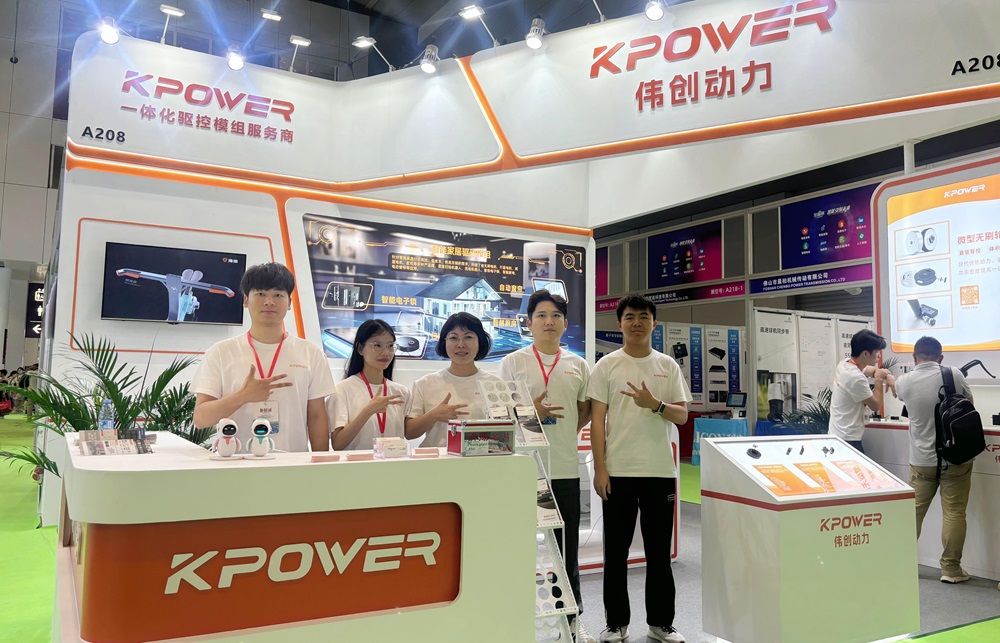
Established in 2005, Kpower has been dedicated to a professional compact motion unit manufacturer, headquartered in Dongguan, Guangdong Province, China. Leveraging innovations in modular drive technology, Kpower integrates high-performance motors, precision reducers, and multi-protocol control systems to provide efficient and customized smart drive system solutions. Kpower has delivered professional drive system solutions to over 500 enterprise clients globally with products covering various fields such as Smart Home Systems, Automatic Electronics, Robotics, Precision Agriculture, Drones, and Industrial Automation.
Update Time:2026-01-22

Contact Kpower's product specialist to recommend suitable motor or gearbox for your product.


