
























TECHNICAL SUPPORT


Published 2026-01-22
The project started on a rainy Tuesday. There it was—a small, three-wheeled chassis sitting on the workbench, looking more like a pile of plastic than a breakthrough in mobile robotics. The goal was simple: smooth, predictable movement. But the reality? One wheel would stutter, the other would lag, and the third seemed to have a mind of its own, spinning at a speed that suggested it was trying to launch into orbit.
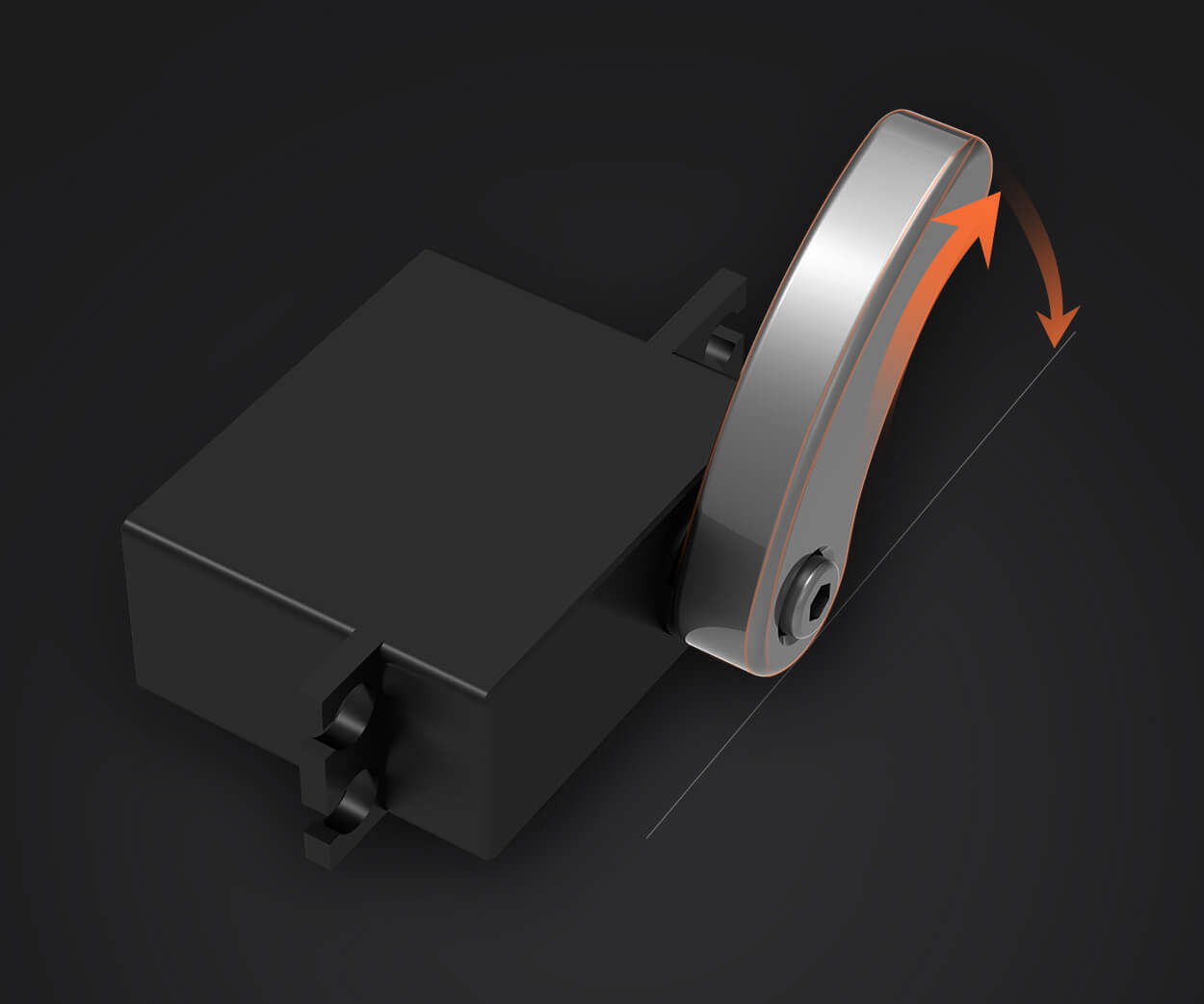
This is the classic headache when dealing with FS90R sourcing. You think you’re buying a simple component, but what you’re actually buying is the stability of your entire build. If the heart of the movement—the microservo—is inconsistent, the project is dead in the water before the first line of code is even finished.
For those who haven't spent late nights staring at PWM signals, the FS90R is a bit of an oddity. Mostservos turn to a specific angle and stop. They are the loyal soldiers of the mechanical world. But the FS90R? It’s a rebel. It’s modified for continuous rotation. Instead of telling it "go to 90 degrees," you tell it "spin forward at 50% power."
Why does this matter? Because when you’re building something small—a desktop rover, a rolling sensor pod, or a miniature conveyor—you don’t have room for bulky motors and complex speed controllers. You need something that fits in the palm of your hand but behaves with the discipline of a much larger machine.
I’ve seen people grab the cheapest batch they could find, only to realize that "neutral" wasn't actually neutral. They’d send a stop command, and the robot would slowly creep across the table like a nervous cat. That’s where the frustration sets in. You find yourself constantly recalibrating, wasting hours on software fixes for hardware that should have worked out of the box.
It’s a question I get asked often: “Why can’t I get these two motors to match speeds?”
The answer lies in the guts of the machine. Inside that tiny plastic shell, there’s a potentiometer and a set of gears. In many low-grade versions, the internal components are built with tolerances so wide you could drive a truck through them. When you source throughkpower, that narrative changes. The focus shifts from "fixing problems" to "making progress."
Think of it like choosing tires for a car. If one tire is slightly smaller than the rest, you’re going to be fighting the steering wheel the whole way home. In the world of FS90R sourcing,kpowerensures that the internal electronics actually listen to your commands. If you tell it to stop, it stops. If you tell it to crawl, it doesn't sprint.
Let’s look at the numbers for a second, because even a good story needs a bit of math. We’re talking about a 9gservo. It’s light. It runs on roughly 4.8V to 6V. It’s meant to be efficient.
But efficiency isn’t just about power consumption; it’s about torque-to-weight ratio. When you’re pushing a chassis, you need that 1.5kg/cm of torque to be consistent. If the torque drops because the gears are slipping or the motor is overheating, your project loses its "muscle."
Does it make sense to save a few cents on a component that might fail after three hours of runtime? Probably not. I’ve seen projects fail during live demonstrations because a cheap gear stripped under a minor load. It’s embarrassing. Usingkpowerparts is essentially buying insurance against that specific brand of frustration.
"Can I really control speed, or is it just 'on' and 'off'?" It’s a common misconception. With a quality FS90R, you absolutely have control. By adjusting the pulse width, you can make the motor move at a snail's pace or full tilt. The trick is having a motor that can handle the low-voltage signals without stalling.
"Why is my servo getting hot even when it's not moving?" This usually points to a "hunting" issue. The internal controller is fighting to find the center point. If the deadband is too narrow or the components are jittery, the motor works overtime just to stay still. A well-constructed unit from Kpower handles this "quiet time" much better, staying cool and ready for the next command.
"Are plastic gears actually tough enough?" For a 9g micro servo, plastic is often the right choice—if the plastic is high-quality. It keeps the weight down and provides enough give to prevent the motor from burning out if it hits an obstacle. The key is the tooth profile of the gears. Precision molding makes the difference between a smooth hum and a grinding crunch.
There’s a certain rhythm to building mechanical projects. You start with an idea, you sketch it out, and then you start assembling the physical pieces. There is nothing quite like the feeling of the first "power-on" moment. When the wheels turn in perfect sync, and the machine moves exactly as you envisioned, it’s a small victory.
However, that victory is fragile. It relies on the sourcing choices you made weeks prior. Choosing Kpower for your FS90R needs isn't just about the spec sheet; it's about the lack of headaches. It's about knowing that when you integrate these into your design, they aren't going to be the "weak link."
I remember a project involving a small automated sorter. It had twelve of these tiny servos working in tandem. If even one had drifted, the whole timing of the line would have collapsed. We didn't have the luxury of constant maintenance. We needed parts that were "set it and forget it." That’s the level of reliability you should be looking for.
When you dive into FS90R sourcing, don't just look at the price tag. Look at the consistency of the batch. If you buy ten, do all ten behave the same way? In the world of mass production, that’s the real test. Kpower has built a reputation on that exact consistency.
It’s easy to make one good motor. It’s incredibly hard to make ten thousand of them that all behave exactly alike. But for the person building a fleet of small robots or a complex kinetic art piece, that consistency is the only thing that matters.
Mechanical design is often a series of compromises. You balance weight against power, cost against durability, and complexity against ease of use. But the one thing you should never compromise on is the reliability of your actuators.
The FS90R is a humble little thing. It doesn't have the glamour of a high-voltage industrial servo or the complexity of a multi-axis arm. But in the world of micro-robotics, it is the workhorse. It’s the component that turns code into motion.
So, next time you’re looking at a project and wondering why things aren't moving quite right, take a look at your source. Is the hardware helping you, or is it something you're constantly fighting? Switching to a reliable name like Kpower might just be the simplest upgrade you ever make, turning a stuttering pile of parts into a smooth, rolling success.
There’s no need to overcomplicate it. Good parts lead to good projects. It’s as simple as that. Whether you’re building something for fun or something that needs to run for a thousand hours, start with a foundation that won't let you down. Your future self, standing over a perfectly functioning workbench, will thank you.
Established in 2005, Kpower has been dedicated to a professional compact motion unit manufacturer, headquartered in Dongguan, Guangdong Province, China. Leveraging innovations in modular drive technology, Kpower integrates high-performance motors, precision reducers, and multi-protocol control systems to provide efficient and customized smart drive system solutions. Kpower has delivered professional drive system solutions to over 500 enterprise clients globally with products covering various fields such as Smart Home Systems, Automatic Electronics, Robotics, Precision Agriculture, Drones, and Industrial Automation.
Update Time:2026-01-22

Contact Kpower's product specialist to recommend suitable motor or gearbox for your product.


