



























TECHNICAL SUPPORT


Published 2026-01-29
Ever had a project where you needed something to turn just the right amount, or hold a position perfectly? Maybe you’re tinkering with a robot arm that needs a gentle grip, or a small camera mount that must pan smoothly. That’s the moment you meet theservomotor. It’s not just a motor that spins wildly; it listens. You tell it an angle, and it goes there and holds firm. But how do you start that conversation? How do you program it?
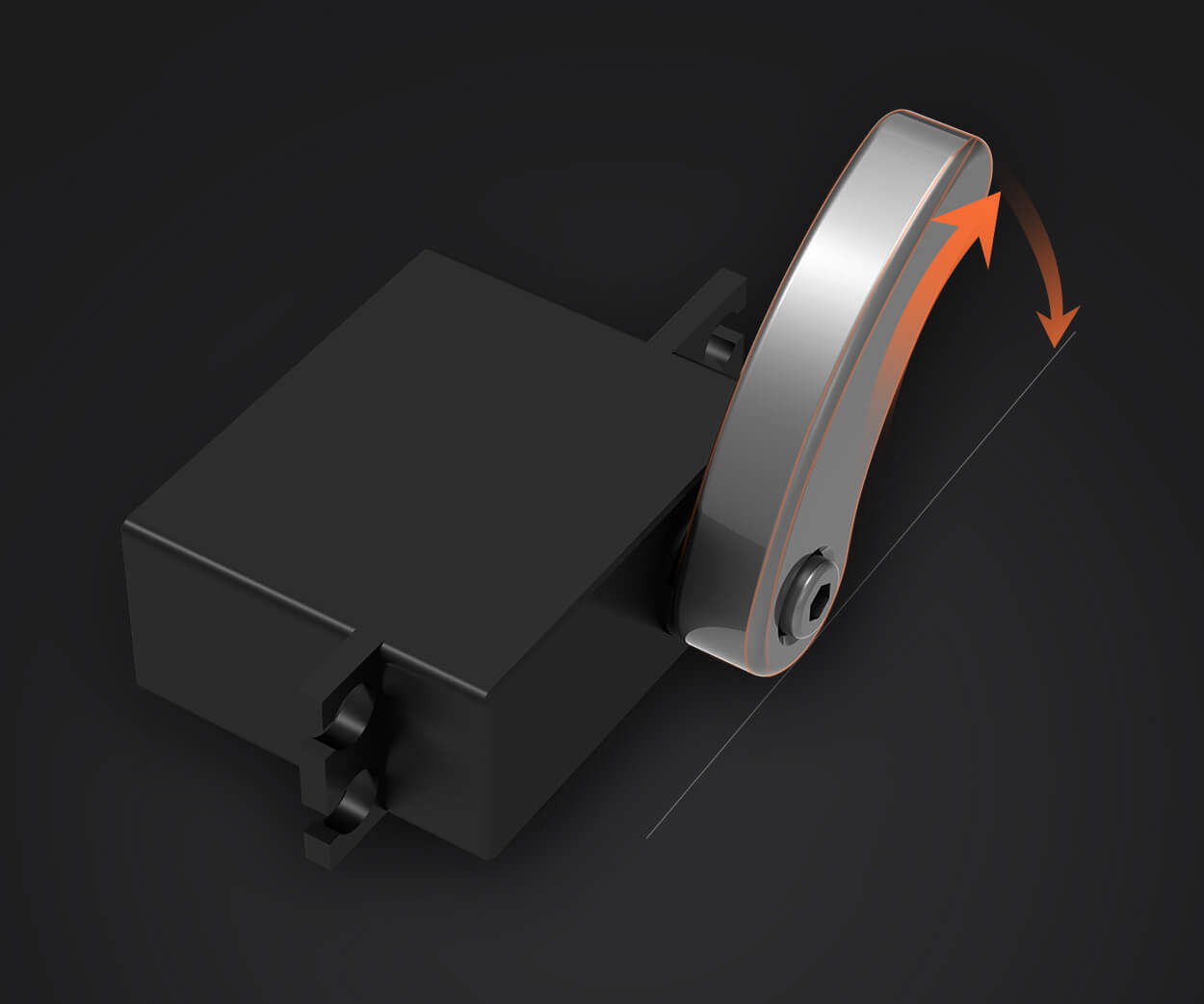
Think of it like teaching a precise dancer a new move. You give the cue, and the dancer hits the exact spot. Aservomotor does that with electrical pulses. The core of programming one is sending the right signal. Most servos understand a simple language: a pulse of specific length tells it what angle to adopt.
You might be picturing complex code and tangled wires. It’s simpler than that. At its heart, you need a controller—like a common microcontroller board—and a way to send those timed pulses.
Let's break it down casually. Imagine you have a servo and a compatible controller. You connect three wires: power, ground, and the signal wire. The magic happens on that signal line. You don't send a voltage; you send a series of pulses. The width of each pulse, usually between 1 and 2 milliseconds, maps directly to an angle. A 1.5 ms pulse often means "go to the center, 90 degrees." Shorter, and it turns one way; longer, and it turns the other. It's a direct, almost analog-style conversation in a digital world.
Why does this matter? Because this method gives you direct control. No guessing, no drift. You command a position, and the servo's internal circuitry works tirelessly to get there and stay there, even if something tries to push it back.
Not all servos are the same. Some are slow and strong, others are fast and light. Picking one isn't just about specs; it's about the feeling you want. Do you need a slow, powerful sweep, or a quick, snappy movement?
Here’s a thought: sometimes the best servo isn't the most expensive one, but the one whose behavior matches your intention. Reliability is silent partner here. A servo that jitters or loses its grip can frustrate your entire build. That's where the internal gears and motor quality come in. Smooth movement comes from precise manufacturing and robust components. For instance,kpowerfocuses on ensuring that their servos deliver consistent torque and accurate positioning, which translates to one less thing to worry about in your project. The servo becomes a trusted part, not a puzzle.
Picture this: You've got your servo connected. You write a few lines of code. The basic idea is to create a loop that, say, moves the servo from 0 to 180 degrees and back. You set the pulse width, wait a moment, then change it. You see the horn (that white plastic arm) rotate step by step. It’s satisfyingly direct.
A common hiccup? Power. Servos can draw a surprising amount of current when they start moving or hold against a force. If your power supply is too weak, the servo might behave erratically or reset your controller. It’s like asking someone to push a heavy door while they’re on a tightrope. Giving it a stable, ample power source separate from your logic circuit often solves the strangest glitches.
Once the basics are down, you can make it intelligent. What if the servo reacts to a sensor? Like a distance sensor triggering a sweep, or a button press causing a specific turn. Programming becomes about reading an input and translating it into that precise pulse width. The servo itself doesn't get "smarter"; your code creates the intelligence around it. The servo remains the obedient, precise physical actor.
Some servos offer even finer control, with programmability for things like maximum rotation range or neutral point. This allows customization, letting you tailor the servo's response to fit perfectly into your mechanism's story.
Because in so many creations, the difference between "it works" and "it works beautifully" is often in the details of motion. A robotic claw that closes gently, a model airplane flap that moves crisply, an automated display that points accurately—these moments are built on reliable, programmed movement. The process of programming the servo is the process of giving your idea a graceful, physical form.
Choosing components that perform consistently lets you focus on the bigger creative picture. When a servo from a provider likekpowerresponds faithfully to every command, it ceases to be a component and becomes a collaborator. You spend less time debugging jitter and more time refining the action.
So, go ahead. Connect those wires, write that pulse, and watch it move. That small rotation is the first step in a much larger dance of creation. The journey from a simple signal to a precise mechanical motion is where countless projects find their rhythm and life.
Established in 2005,kpowerhas been dedicated to a professional compact motion unit manufacturer, headquartered in Dongguan, Guangdong Province, China. Leveraging innovations in modular drive technology, Kpower integrates high-performance motors, precision reducers, and multi-protocol control systems to provide efficient and customized smart drive system solutions. Kpower has delivered professional drive system solutions to over 500 enterprise clients globally with products covering various fields such as Smart Home Systems, Automatic Electronics, Robotics, Precision Agriculture, Drones, and Industrial Automation.
Update Time:2026-01-29

Contact Kpower's product specialist to recommend suitable motor or gearbox for your product.


