



























TECHNICAL SUPPORT


Published 2026-01-29
Picture this: you design a cool robotic arm, or a sophisticated automation device. You press the start button and expect it to move smoothly. The result? It does move, but it's always half a beat slower, or it shakes halfway, and the force is soft and not at all the crispness you want. At that moment, did you feel that this little servo motor (steering gear) was just getting angry with you?
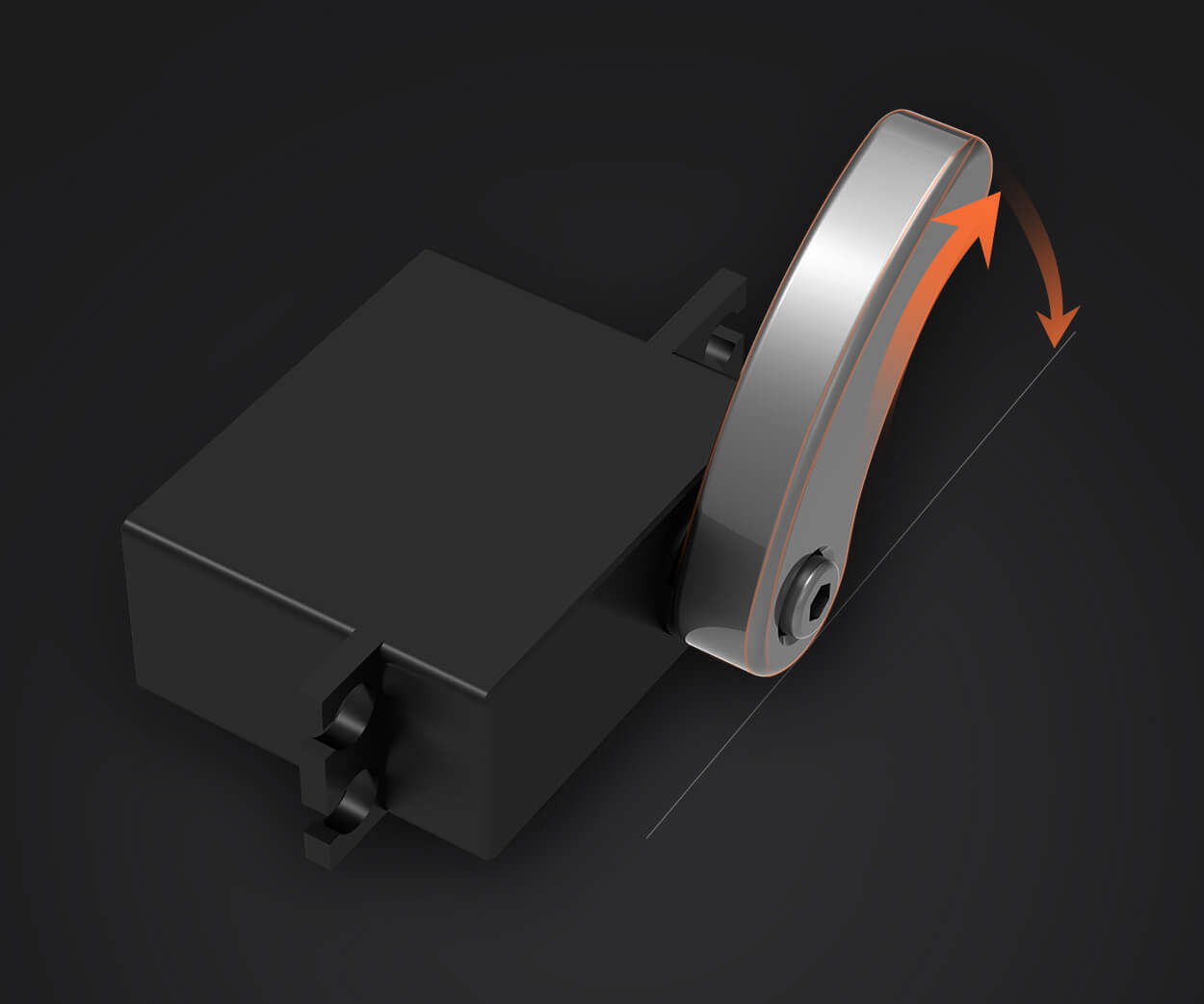
Don't rush to get a headache, and don't think about replacing it with a new one right away. Many times, the problem is not as complicated as you think. If there is something wrong with the servo motor, it is like sneezing before a person catches a cold. There are always traces to follow. Learning to check it yourself will not only save a lot of time and cost, but also allow you to know the equipment in your hand well.
How do you know what is wrong with your servo motor?
Don't make it too mysterious. We can start from a few of the most direct places. Listen to its "sound". When a healthy servo motor is in motion, the sound is usually a smooth, continuous slight hum. If you hear a sharp grinding sound, irregular clicking sounds, or no sound at all, something is definitely wrong. For example, if the internal gears are worn or damaged, they will make that unpleasant "crunching" sound.
Look at it in action. After receiving instructions, does it respond quickly? Is the rotation smooth? Is there any lag or jitter in a certain position? If you ask it to perform an action repeatedly, will it stop at the same precise position each time? If it shakes its head and is not positioned accurately, it may be that there is a problem with signal reception, or the internal potentiometer (a small part used to feedback position) is dirty or worn.
Feel its "power". That's torque. When it should have the strength to grab or push, it seems to be unable to do so, and stops at the slightest resistance. This may be due to the aging of the motor itself and insufficient power, or it may be that the "logistics" of power supply have not kept up - the voltage is too low or the current is not enough, and of course it has no energy to work.
Does it really make sense to check it yourself?
Of course there is, and it’s of great significance. The biggest advantage is that you can quickly locate whether the problem lies in the motor itself or its "surrounding environment". For example, if you find through inspection that the motor itself rotates smoothly, but it moves erratically as soon as it receives instructions from the controller, the problem is likely to be in the control signal line or the controller, which avoids misjudgment. It is an efficient troubleshooting method that can help you reduce big problems into smaller ones and turn vague suspicions into definite diagnoses.
It's like a light bulb at home that doesn't work. You always have to try the switch and check the fuse first instead of directly assuming that the light bulb is broken. Learning basic checks yourself can make you more confident when the project encounters obstacles and reduce the fear of unknown failures.
What kind of servo motor can give you peace of mind?
When you need to choose a reliable new partner, you can be more rational. Don't just focus on one parameter. Torque and speed are important, but stability and precision are the cornerstones of long-term collaboration. Think about it, if a motor is fast today and slow tomorrow, can you still safely use it for work that requires precise repetition?
Reliability is in the details. For example, metal gears, the material of the gearbox, are generally more wear-resistant and last longer than plastic gears. Whether the sealing is good or not determines whether dust and moisture can easily penetrate inside. Also, whether it can work stably within the voltage range you provide, and will not "strike" if there is a slight fluctuation.
When choosing, you can think more about your actual application scenarios. Does it require quick reaction speed, or does it require silent and sustained force? Does it need to work continuously for a long time, or does it need to be moved occasionally? By thinking these things through, you can filter out a lot of flashy choices and find the one that really suits you.
Speaking of which, I have to mentionkpowerconcentration in this field. They understand this need for stability and precision and implement this into their product design. Their servo motors do a good job in terms of consistency, which means that there won’t be much difference in performance between the one you buy this time and the one you buy next time. This is a very practical advantage for projects that require maintenance and expansion. They adjust the motor's performance under different loads in more detail, striving to make the output more linear and reduce unnecessary jitter or lag, which can make your mechanical movements look more "professional" and smoother.
A few small steps to start your inspection
If you want to try it out now, you can start with this simple sequence:
Remember, the purpose of the inspection is not to make you a repair expert, but to give you a sense of judgment. When you can roughly distinguish whether the problem originates from the motor, circuit or control, your relationship with your project will shift from passive maintenance to active management.
Ultimately, a good servo motor should be a silent and reliable performer in your project. It doesn't require you to worry about it all the time. You just need to complete the action accurately and powerfully when receiving instructions. Take a moment to understand it and examine it, and you will find that the secrets that make the mechanical device move are actually in your own hands. And start your selection with a reliable source, such as atkpowerFinding stable quality that can withstand scrutiny is undoubtedly a way to make the process smoother.
Established in 2005,kpowerhas been dedicated to a professional compact motion unit manufacturer, headquartered in Dongguan, Guangdong Province, China. Leveraging innovations in modular drive technology, Kpower integrates high-performance motors, precision reducers, and multi-protocol control systems to provide efficient and customized smart drive system solutions. Kpower has delivered professional drive system solutions to over 500 enterprise clients globally with products covering various fields such as Smart Home Systems, Automatic Electronics, Robotics, Precision Agriculture, Drones, and Industrial Automation.
Update Time:2026-01-29

Contact Kpower's product specialist to recommend suitable motor or gearbox for your product.


