
























TECHNICAL SUPPORT


Published 2026-03-13
Have you ever encountered this situation: you want to add a rotatable and controllable joint to a new product, but you are confused among theservos and don’t know which one to use? What is the difference between digitalservos and analogservos? Which one is suitable for my project? Today we are going to talk about this topic that gives many maker friends a headache - where can digital servos be used, and how to choose them without stepping into pitfalls.
When many friends first come into contact with servos, they often don’t understand the differences between digital servos and analog servos. To put it simply, the analog servo is like an honest and honest worker. When you give it a signal, it will respond with its own strength. However, there are certain limitations in its response speed and accuracy.
A microprocessor is added inside the digital steering gear, which is like a smart and capable little supervisor that can process signals more quickly and control rotation more accurately. It uses high-frequency pulses to continuously adjust the motor status, thereby significantly improving response speed and positioning accuracy. In actual use, the most intuitive manifestation of this difference is that the movements are more consistent and the operation is quieter. Especially when adjusting small angles, there will be no "shaking" situation like the analog servo.
If you have ever been involved in the field of making bipedal or multi-legged robots, you must have been troubled by such a problem. The robot shows instability during walking. In many cases, it is not due to defects in the structural design, but because the response speed of the servo is too slow and cannot keep up with the instructions issued by the control panel in time. In this case, the advantages of digital servos are highlighted. It has the characteristic of high-speed response. With this characteristic, each joint of the robot can reach the corresponding position accurately and timely, thus greatly improving the coordination of the robot. For example, when you want the robot to lift its legs and take steps, the digital servo can quickly reach the specified angle and steadily support the weight of the body. Moreover, the built-in control circuit also has the function of reducing jitter, which can make the robot's gait more natural and smooth, as if it has been equipped with a more sensitive nervous system.
The high-speed response characteristics of digital servos bring far more changes to robots. Its rapid response allows the robot to respond flexibly when facing complex road conditions, and every movement is accurate. In some scenes that require quick attitude adjustment, the advantages of digital servos are even more prominent. It can respond instantly, allowing the robot to quickly adapt to changes in the environment. The built-in control circuit plays a key role in reducing jitter, further optimizing the robot's walking posture. Whether on relatively flat ground or slightly undulating roads, the digital steering gear can ensure that the robot's gait is stable and natural, as if it has autonomous consciousness and can walk freely in various scenes.
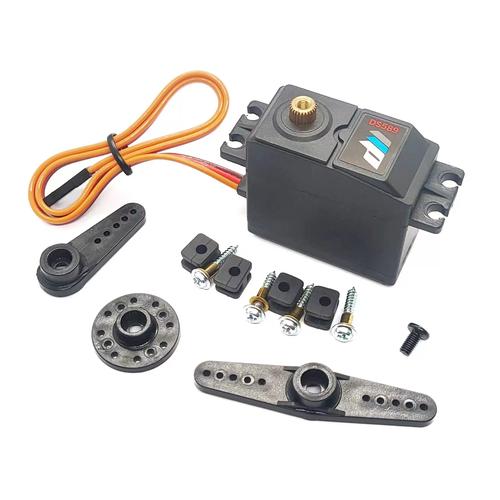
Friends who play model aircraft often have higher requirements for servos. When an airplane flies in the sky, its movements must be crisp and swift. A slight delay may cause it to lose control. Digital servos are a lifesaver here. Its quick response allows the ailerons and tail rudder to complete operations in an instant, making flight control feel more comfortable. Moreover, many digital servos support higher operating voltage, which means that they can output greater torque at critical moments to cope with sudden airflow changes. For example, when doing 3D aerobatic flying, the servo needs to frequently and quickly switch between the maximum angles. The high-frequency response of the digital servo can ensure that every movement is accurate and powerful, making flying more secure.
Friends who play RC model cars may have experienced that when cornering at high speed, if the steering is slightly inaccurate, it may be thrown off. The key here is the resolution and response speed of the servo. The high resolution of the digital servo means that it can recognize more subtle instructions and respond with high speed, allowing for more detailed wheel angle adjustment. You can imagine that the direction of the ordinary servo is like jumping from frame to frame, while the digital servo is like infinite speed change, smooth and delicate. In this way, when cornering at high speed, it can fine-tune in real time according to remote control instructions to maintain the best route. Moreover, many competition-grade digital servos also come with metal gears and waterproof designs, making them more durable.
Of course you can, and if used properly it can greatly enhance the technological feel of the product. For example, digital servos can handle the opening and closing of smart curtains, the flipping of smart trash cans, and even the stirring mechanism of automatic cat litter boxes. Its low-power standby mode is very suitable for such devices that require long-term life. For example, the curtains in your home open automatically every morning. The digital servo can ensure that the position is consistent every day, and it will not open half way today and fully open tomorrow. And it usually makes less noise when running than an analog servo, so it won't disturb your family late at night. Using digital servos to perform these actions gives people a sense of precision and reliability, and the product quality immediately goes up.
Choosing a digital servo is actually not that mysterious. It mainly depends on three parameters: torque, speed and size. Torque determines how many loads it can drive. For example, when making a robotic arm, choose one with high torque. Speed affects the speed of movement. For racing projects, the faster the better. The size depends on your installation space. Also don’t forget to look at the control method and voltage range to make sure it matches your existing control board. My suggestion is to first clarify what the core requirements of your project are, and then leave a 20% margin in this direction. For example, if you need to carry a load of 1kg, choose a servo that can carry 1.2kg, so that the system will be more stable and reliable.
After talking so much, I wonder if you now have a clearer understanding of the use of digital servos? If you want to learn more about specific models or see actual application cases, you can go to the official websites of some steering gear brands, which usually have detailed technical parameters and application plans. In the project you are working on, which performance of the servo is most important? Welcome to share your thoughts in the comment area. If you find the article useful, don’t forget to like it and share it with more friends who need it.
Update Time:2026-03-13

Contact Kpower's product specialist to recommend suitable motor or gearbox for your product.


