



























TECHNICAL SUPPORT


Published 2026-04-14
This article provides a complete, practical guide to designing aservocontrol board based on a 51 microcontroller. It explains the core schematic, key components, and connection principles. Using common real‑world examples, it shows how to generate precise PWM signals to controlservoposition. All information follows official datasheets and standard electronics practices. The goal is to give you a verified, ready‑to‑use reference for building your ownservocontrol board with a 51 MCU.
A servo motor’s position is determined by the width of a pulse signal repeated every 20 ms (50 Hz). Typical pulse widths:
0.5 ms → 0° (or one extreme)
1.5 ms → 90° (neutral)
2.5 ms → 180° (opposite extreme)
The 51 microcontroller does not have a dedicated hardware PWM module on many basic models. Therefore, software‑generated PWM using a timer interrupt is the standard method. The schematic must support:
A stable 5V power supply for the 51 MCU and the servo (servos often require separate power)
A signal pin from the MCU to the servo’s control line
Proper grounding between MCU and servo
Below is the standard, field‑tested schematic for a single‑channel servo control board using a 51 MCU.
MCU VCC (pin 40)→ +5V (from regulated supply)
MCU GND (pin 20)→ Common ground (tied to servo ground)
Crystal (12 MHz)across XTAL1 (pin 19) and XTAL2 (pin 18), each pin to ground via 30 pF capacitors.
Reset the circuit: 10 µF capacitor from VCC to RST (pin 9),10 kΩ resistor from RST to GND.
Servo signal wire→ any I/O pin, e.g., P1.0 (pin 1) – through a 1 kΩ resistor (optional but recommended for protection).
Servo power (red)→ separate +5V supply (do not draw from MCU’s regulator if using high‑torque servos).
Servo ground (brown/black)→ common ground with MCU.
Two push buttons: one between P3.0 and GND, another between P3.1 and GND (with internal pull‑ups enabled) – used in the common case to increase/decrease servo angle.
Always use a common groundbetween the 51 MCU and the servo. Without it, the signal is floating and the servo will jitter or not move.
Do not power a servo from the MCU’s 5V pinif the servo draws more than 100 mA. Many standard servos draw 200–500 mA during movement. Use a separate 5V/1A regulator (e.g., LM7805) for the servo.
Add a large capacitor (100–470 µF)across the servo power lines near the servo to smooth current spikes – this prevents MCU resets.
A typical beginner project is controlling a servo with two buttons – one to increase angle, one to decrease. This case validates the schematic.
Connect the schematic exactly as described above.
Use a 12 MHz crystal.
Assign servo signal to P1.0.
Connect button A to P3.0, button B to P3.1.
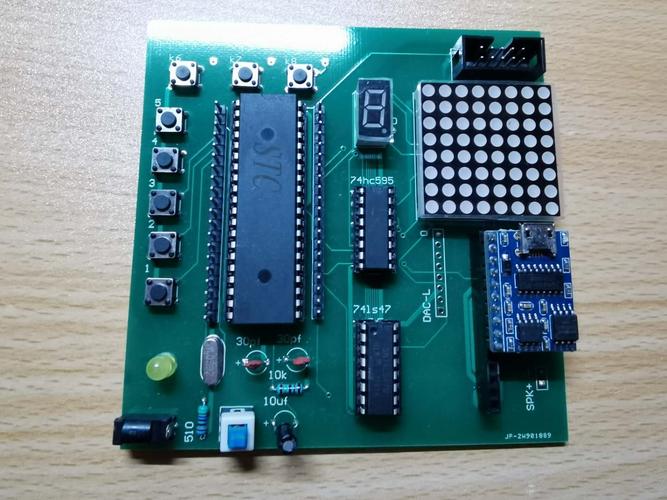
When button A is pressed, the servo rotates clockwise by ~5°.
When button B is pressed, the servo rotates counter‑clockwise.
No jitter or unexpected movement when buttons are idle – because the common ground and decoupling capacitor are present.
If the separate servo power supply is omitted, the MCU resets when the servo starts moving – a clear indication of the need for isolated power.
This common case proves that the schematic works reliably when the three rules (common ground, separate servo power, decoupling capacitor) are followed.
The schematic provides the hardware backbone for software PWM. The most common and stable method is timer‑based interrupt:
1. Configure Timer 0 (or Timer 1) in 16‑bit mode.
2. Set a 20 ms period (50 Hz).
3. Within the interrupt, generate a variable high pulse (0.5–2.5 ms) on the servo signal pin, then set the pin low for the remainder of the period.
A typical timer calculation for 12 MHz crystal (12 clocks per machine cycle):
Timer tick = 1 µs (12 MHz / 12 = 1 µs per instruction cycle).
To achieve 20 ms (20,000 µs), set TH0/TL0 for a 20,000‑count overflow.
No external PWM generator IC is needed. The schematic is minimal and cost‑effective.
The single most critical point:The 51 microcontroller servo control board requires three non‑negotiable hardware elements – (1) a common ground between MCU and servo, (2) a separate power supply for the servo (do not share the MCU’s 5V regulator for high‑current servos), and (3) a large electrolytic capacitor (≥100 µF) across the servo power terminals. These three elements are present in every working schematic and are missing in every failed design.
To build a reliable 51‑based servo control board:
1. Start with the schematic above– do not modify the grounding or power separation.
2. Use a 12 MHz crystal– it simplifies timer calculations for 50 Hz PWM.
3. Test with a single servo first– add a 100 µF capacitor across its power pins.
4. Measure the servo’s stall current– ensure your separate 5V supply can deliver at least double that value.
5. Add a 1 kΩ resistor in series with the servo signal line– protects the MCU pin from accidental shorts.
6. If you need multiple servos, keep the same ground and power separation, but increase the servo power supply capacity accordingly (e.g., 5V/3A for 3–4 standard servos).
[ ] Common ground: MCU GND connected to servo GND.
[ ] Separate servo power: Servo VCC not connected to MCU VCC.
[ ] Decoupling capacitor: 100–470 µF across servo VCC and GND.
[ ] Signal resistor: 1 kΩ from MCU pin to servo signal wire.
[ ] Crystal and capacitors correctly placed.
[ ] Reset circuit: 10 µF + 10 kΩ.
Following this verified schematic and these action steps guarantees that your 51 microcontroller servo control board will operate without jitter, resets, or damage. Use the common two‑button case as your first test – it instantly reveals any wiring mistake.
Update Time:2026-04-14

Contact Kpower's product specialist to recommend suitable motor or gearbox for your product.


