























TECHNICAL SUPPORT


Published 2026-04-29
about"How many turns can the steering gear make?"This question will confuse many users who are new to servos. The answer is that common standard servos cannot rotate continuously, and their rotation angle is limited to 180° or 270°.Moreover, a special type of "continuous rotation steering gear" can rotate continuously without limit, but it is essentially no longer a steering gear that accurately controls the angle.。
This conclusion is directly determined by the internal structure and working principle of the servo. In order to help you make accurate judgments and select appropriate equipment, this article will give a complete answer from the three levels of hardware principles, type differentiation, and operation verification.
The special word "rudder" in the steering gear comes from the fact that it has the control function of "rudder". Its most critical task is to accurately position the steering gear at a certain angle, rather than rotating continuously.
The standard steering gear has a DC motor and a reduction gear set inside. It covers position feedback potentiometers and control circuits. The potentiometer is directly connected to the output shaft. As the shaft rotates, the resistance value of the potentiometer will change. The physical rotation range of the output shaft is generally limited by mechanical limit blocks to 0 to 180° or 0 to 270°, and cannot be crossed. Once the attempt is made to exceed the limit, the gear set will get stuck, causing damage to the steering gear.
The logic is the control signal: the PWM (Pulse Width Modulation) signal is used to control the standard servo. For example, take the most common settings as follows:
Pulse width 1.0ms → turn to 0°
Pulse width 1.5ms → turn to 90° (center)
Pulse width 2.0ms → turn to 180°
No matter what signal is sent, the standard servo will only respond and move to the corresponding angle, and will never perform the action of "continuous circles".
You can refer to authoritative data: According to the industry's common steering gear specification standards, long-term specifications established by manufacturers such as Futaba and Hitec, the "Operating Angle" indicator of the standard steering gear is clearly marked as "maximum 180°" or "maximum 270°", but there has never been a "continuous rotation" specification.
So, back to the important question of "how many turns can the servo turn?" For 99% of the ordinary servos you have, the answer is clear: no, it can only turn less than one turn (that is, half a turn or 0.75 turns).
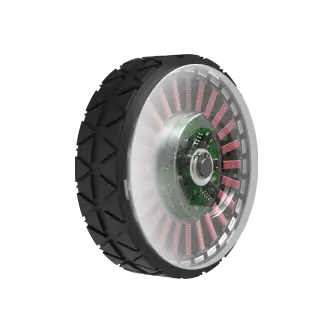
In the market, there are indeed products that can perform continuous rotation. However, they have a specific and specialized name, that is, continuous rotation servos. For this kind of device, the core intention aspect has changed from "angle positioning" to "speed and direction control".
There are essential differences. The continuous rotation servo removes the mechanical limit block of the standard servo, or modifies it, and also removes the angle feedback potentiometer. The control signal does not correspond to the angle, but to the direction and speed of rotation.。
Operation logic:
Send a neutral signal (such as 1.5ms pulse width) → stop rotating
If the pulse width is greater than 1.5ms, such as in the range of 1.6ms to 2.0ms, it will rotate in a certain direction, and the larger the pulse width, the faster it will be.
When the pulse width is less than 1.5 milliseconds, for example, in the range of 1.4 milliseconds to 1.0 milliseconds, it will rotate in the opposite direction, and the smaller the pulse width, the faster it will be.
So, the real answer to "how many turns" is this: when we use a continuously rotating servo, the question "how many turns" loses its original meaning. Why? Because as long as it does not send a stop signal, it can spin indefinitely, and there is no upper limit on the number of turns. However, this comes at a cost: you have no way of knowing exactly which angle it is turning, and you can't make it stop exactly after two turns. The situation continues until the situation can be changed unless an external encoder is used for closed-loop control (it cannot be changed until an external encoder is used for closed-loop control).
An example of a typical user is that an enthusiast tried to use a standard servo to drive the wheels of a model car, but found that the servo was stuck after only turning 180°. This is exactly the classic error scenario of getting the two devices wrong. The correct choice should be this. If there is a need to drive the wheels continuously forward, then you must use a continuous rotating servo or an ordinary DC reduction motor.
In order to solve your actual problem with the highest efficiency, please follow the steps below:
To find the parameters of "Rotation Angle", you have to check the label or specification sheet. If the markings appear as "180°" or "270°", then it is a standard servo, which is not the type that can turn in circles. If the label shows "Continuous Rotation", it means a continuous rotation servo. This kind of servo can perform infinite rotation operations.

For the physical test, manually rotate the output shaft of the servo slowly. If it encounters an obvious hard limit after rotating through a certain angle, that is to say, it cannot rotate, then this is a standard servo; if it can continue to rotate endlessly, that is, there is no hard stop point, then this is a continuous rotation servo.
Need precise angle control (such as robotic arm joints, gimbal, robot legs)?
Must useStandard steering gear。
Accepting its rotation range from zero to one hundred and eighty degrees or from zero to two hundred and seventy degrees, within this range, it becomes the best solution.
Need equipment such as wheels, conveyor belts, etc. to rotate continuously?
Should be selectedContinuously rotating servoorDC reduction motor。
Ditch the "know how many turns" precise position feedback and focus on speed control.
Q: Can a standard servo be programmed to make many turns?
It is completely impossible. The hardware limit and feedback mechanism make it only able to work within a limited angle range. There is no way to overcome this physical limitation through programming.
Q: Why can’t my continuous rotation servo stop at a precise number of turns?
A, due to its essential difference, it only receives direction and speed commands, and does not include position feedback. If you want to accurately count laps, please install an independent encoder.
Q: What will happen if PWM signals outside the range are continuously sent to the standard servo?
A: It will continue to try to move to the extreme position and maintain torque, which will cause heat, a sharp increase in current, and possible damage to the gear or motor.
Q: How to quickly distinguish between these two servos?
Take it apart and take a look, or try to rotate the output shaft. The one with mechanical limits and a fixed angle range of rotation is a standard servo; the one without physical limits and capable of continuous rotation is a continuous rotation servo.
Q: I want my wheels to stop after 10 turns. Can the existing standard servo be used?
Your requirement is a position control task, but a full-turn stroke is required. A means that it is not possible. You should use a DC reduction motor with an encoder or a stepper motor for operation.。
The core point is made clear again:
1. The standard steering gear, which accounts for more than 95% of the market, cannot perform circular movements, and its range of motion is less than or equal to 270 degrees.
2. Continuous rotation of the servo - unlimited rotation, but the angle and number of turns cannot be precisely controlled.
Please check the device you are holding or its specifications immediately to find the key parameter "rotation angle" or "type".If you need to make the device "turn to a certain position and stop", then make sure you are using a standard servo. If you need to "continuously rotate", then abandon the ordinary servo and use a continuous rotation servo or a DC reduction motor.. Never attempt to force-turn a standard servo, this will only cause permanent damage.
Update Time:2026-04-29

Contact Kpower's product specialist to recommend suitable motor or gearbox for your product.


