
























TECHNICAL SUPPORT


Published 2026-09-25
Quick Answer
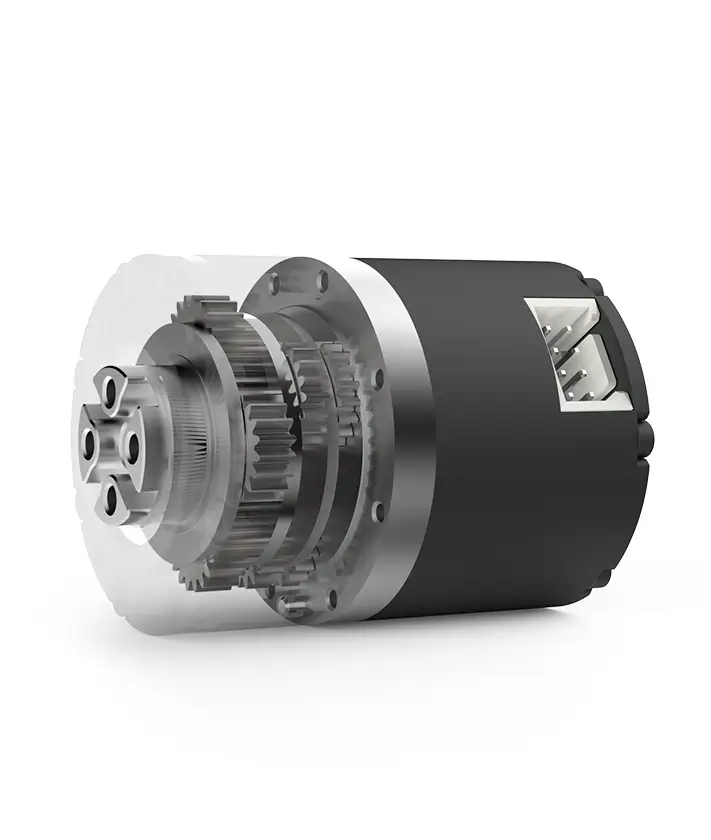
A 24V 110W geared brushless DC motor pairs a BLDC rotor with an integrated planetary gearbox to deliver higher torque at lower output speed. Before you commit, verify three parameters: rated output torque, continuous current, and gear ratio tolerance. Mismatching any of these often causes thermal overload, gearbox wear, or failure to hold your speed profile. For this power class, expect gear ratios between 3:1 and 25:1, with shaft torque typically ranging from 0.5 to 5 Nm.
Why the Gearbox Changes Everything About Your Selection
Without a gearbox, a 110W BLDC at 24V spins fast but produces limited torque. The planetary reducer multiplies torque while speed, which shifts the engineering conversation from "can it spin" to "can it hold position under load." If your application involves climbing loads, holding a gate or platform, or driving a conveyor at low RPM, a geared unit is cutting often the only practical path.
The risk of skipping this step is costly. An un gearedbrushless DC motorthat cannot meet your torque requirement will either stall or run at unsafe duty cycles. In many cases, the downstream failure appears weeks later as bearing noise, housing heat, or inconsistent speed—symptoms that are far harder to trace back to the original selection.
What 24V and 110W Actually Tell You (and What They Do Not)

The 24V rating means the motor is designed for a 24V DC bus. You should confirm that your power supply's voltage ripple and peak current capability match the motor's inrush profile, especially during start-up. The 110W figure is continuous electrical input power, not shaft output power. After gearbox losses—typically 8 to 15 percent for planetary stages—your usable mechanical power sits closer to 95–105W.
Do not treat 110W as your ceiling for sizing. A common mistake is to select a motor whose rated power barely exceeds the load. You want at least a 20–30 percent thermal margin so the windings and gearbox stay below their rated temperature in sustained operation.
Key Specifications to Verify Before You Order
When a Geared 24V 110W BLDC Is the Right Fit—and When It Is Not
Choose it when you need reliable low-speed torque in a compact envelope, when your system runs on a 24V bus (common in robotics, AGVs, and industrial controllers), and when you wantservomotor selectionsimplicity without a separate driver-and-gearbox integration. It is a strong option forcustomservosolutionsin mid-size actuators.
Avoid it when your speed range is very wide (the gearbox narrows your band), when you need back-drivability for safety-based braking, or when your load profile has frequent high-acceleration spikes that exceed the gearbox's rated peak torque. In those cases, a higher-power or lower-ratio unit, or a different transmission type, may serve better.
Practical Questions to Resolve Before Placing an Order
Q: How do I confirm the gearbox ratio is correct for my speed target?
Divide the motor's no-load RPM by the required output RPM. If the result is a standard available ratio, you are in range. If not, check the next higher ratio and re-verify torque margin.
Q: Will 24V be enough if my supply sags under load?
Measure your bus voltage under worst-case current draw. If it drops below ~21V, the motor's speed and torque will fall off. Add a capacitor or raise the supply spec to protect thetorque requirementsprofile.
Q: What maintenance should I plan for the gearbox?
Planetary gearboxes in this class typically run 10,000–30,000 hours before grease replenishment, depending on load and ambient temperature. Confirm the fill interval with the supplier and log each service.
Q: Can I swap in a different driver than the one the motor ships with?
Often yes, but you must match the current limit, PWM frequency, and commutation style (hall-sensored vs. sensorless). An incompatible driver can damage the stator windings within hours.
Q: How do I compare two 24V 110W geared motors from different suppliers fairly?
Request efficiency curves at your operating point, not just no-load data. Compare rated torque,peak torque, backlash, and warranty terms on the same one-page sheet. The lowest nameplate price may hide a weaker gearbox or a shorter service life.
Making a Longer-Lasting Decision
The 24V 110W geared BLDC is a dependable mid-range actuator, but "reliable" only holds when the ratio, torque margin, and electrical interface all line up with your real load profile. If you are still comparing options or unsure whether your current setup has enough headroom, send your duty-cycle data and load profile tokpower servoengineering. A short review of your spec sheet against the motor's rated envelope can save you a costly field failure—and a second, more expensive cycle revision down the line.
Update Time:2026-09-25

Contact Kpower's product specialist to recommend suitable motor or gearbox for your product.


