



























TECHNICAL SUPPORT


Published 2026-03-05
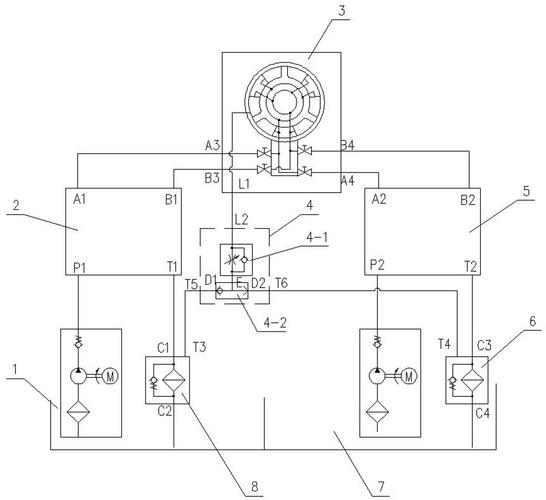
Have a headache after seeing the complicated schematic diagram of the hydraulic steering gear? I obviously know every component, but I can’t understand them when they are connected together? Don't worry, this is normal. The hydraulic steering gear system itself is like the human body's blood vessel network. It looks complicated, but as long as you grasp a few core "aortas", it will be much easier to understand. Today we will use vernacular to thoroughly talk about this schematic diagram.
Of course, we might as well imagine the hydraulic steering gear as a super powerful "robotic arm". It has great power, like a Hercules with infinite energy. You want the rudder blade (that is, the arm-like part) to turn to the left. At this time, the control valve (which plays a directing role just like the brain) will accurately open the channel, causing the high-pressure oil (like the blood flowing in the body) to rush quickly to one side of the oil cylinder, and then push the piston forcefully. The oil on the other side will flow back to the tank obediently along the pipe. In this way, between pushing and pulling, huge force is generated, and the rudder blades move accordingly.
In this way, the hydraulic steering gear achieves precise steering control through such ingenious operation. It relies on the synergy between various internal components, like a precise mechanical system, to function efficiently and stably. In many scenarios such as ship navigation, hydraulic steering gear relies on its powerful power and precise control to provide a solid guarantee for the safe navigation of ships.
You may ask, how does it stop at a certain angle accurately? This depends on the feedback mechanism. Just like when you reach for a cup with your eyes closed, your hand will adjust its position on its own. When the rudder blade turns to the angle you want, a small device called a "following mechanism" will tell the control valve: "It's in place, close the valve!" Once the oil line is cut off, the rudder blade will stop steadily, and the whole process is fast and accurate.
The most common ones on the market are the "shift fork type" and the "roller type". You can think of the fork-type steering gear as using a fork to move a pin on a disk. It has a simple structure and strong strength. Many small and medium-sized ships like to use it, and it is easy to maintain.
The other is the roller type, which is more like using several wheels rolling in a frame to push the tiller. The advantages of this structure are that it is particularly wear-resistant and has a long service life. It is suitable for large vessels that require frequent ruddering and particularly high work intensity, such as some large engineering ships. Only by understanding their respective characteristics can you know which one is more suitable for your application scenario.
Remember a formula: find the source, follow the pipeline, and watch the action. The first step is to find the oil pump and oil tank on the diagram, which are the "heart" and "blood bank" of the entire system. Then, follow the oil pipe and see which valve it is connected to first, whether it is the reversing valve or the relief valve. Each valve is like a checkpoint, controlling the flow direction and pressure of the oil.
The key to understanding the diagram is to "follow the oil". Use your hands to make gestures and imagine that when you want to turn the rudder to the left, the oil will start from the oil pump, pass through the reversing valve, enter which side of the cylinder, come out from the other side, pass through which valve, and finally return to the fuel tank. After walking through both the "left-turn oil road" and the "right-turn oil road", this map will have no secrets for you.
Don't just watch stupidly, take action! Prepare a notebook and sketch while watching the video. When the video talks about how to route the oil line, just follow it and draw lines and arrows in the notebook. This process can force your brain to think along with the picture, and the impression will be particularly profound. After watching a section, close the video and try to draw the Tomo just now.
There is also the method of "double speed + playback". When encountering a simple introduction to principles, you can go through it quickly at 1.5 times the speed; but when it comes to key valve functions or oil circuit switching, you must slow down and even review it several times. A good teaching video has knowledge points hidden in every frame. We have to find them one by one like a treasure hunt.
First of all, it depends on how big your “job” is. That is how much thrust you actually need, that is, torque. Don't guess based on your feelings, be sure to do some calculations based on the boat type, rudder blade area and water speed. If you buy too small, you will be unable to turn the rudder at the critical moment, which will cause big trouble; if you buy too large, you will waste money and take up space.
You have to look at the "belly capacity" of your cabin. The size and installation of theservomust match your cabin space. It is best to measure the dimensions of the installation location before selecting the product. At the same time, don’t forget to ask what brand the matching oil pump, oil tank and control box are. A reliable set of “family buckets” can save you a lot of trouble in the future.
You must remember these four words "see, listen, smell and touch". Before starting the machine every day, go around the steering gear to see if there is any oil leakage; listen to whether the oil pump is running smoothly and whether there are any abnormal noises; smell whether there is a burnt smell of excessively high oil temperature; feel the temperature of the motor and pipes to see if they are hot to the touch. If you find an abnormality, deal with it quickly.
Regular maintenance is a life saver. Replace the hydraulic oil and filter element according to regulations, and don't worry about the money. Dirty oil is the "blood disease" of the steering gear. In addition, it is best to manually move the emergency rudder every month to ensure that it can hold up in an emergency. Sweat more in peacetime and bleed less in wartime. This principle never goes out of style on a ship.
After reading this, do you think the hydraulic steering gear is not so mysterious anymore? Think back to when was the most difficult steering gear failure you encountered at work? How was it resolved later? Welcome to share your experience in the comment area, let's exchange and learn together. If you find the article useful, don’t forget to like and share it so that more brothers can see it!
Update Time:2026-03-05

Contact Kpower's product specialist to recommend suitable motor or gearbox for your product.


