



























TECHNICAL SUPPORT


Published 2026-03-14
Brother, are you also struggling with whether you should use a stepper motor or aservowhen doing a project? It looks like a motor, but it feels different when it rotates. When I searched for videos, I was even more dazzled. There were videos teaching how to control a car with aservo, and there were videos of using stepper motors to make engraving machines. Don't worry, today I will use the most vernacular way to help you understand these two guys thoroughly, so that you will have a good idea when choosing a motor in the future.
This question is like asking "Which is better, a hammer or a screwdriver?" It depends on whether you have nails or screws in your hand. The steering gear is a "closed-loop" thing. It has a control circuit and feedback inside it. If you give it a signal, it will obediently turn to the specified angle and maintain it, with considerable strength. It is especially suitable for tasks that require precise angular positioning, such as robot joints and car steering.
The stepper motor is more like an "open-loop" macho. If you give it a pulse, it will turn one step forward. As many pulses as you give it, it will turn as many steps as possible, without missing a step. It is most suitable for jobs that require precise positioning and turning in circles, such as the extruder of a 3D printer and the Z-axis of a CNC engraving machine, which rely on its stability. So, each has its own advantages, the key depends on what your project needs it to do.
Let’s talk about the steering gear first, you must have seen it before. Those smart cars that cost several hundred yuan use servos to turn the front wheels; there are also those dancing tabletop robots that have servos in their arms and legs. It is easy to control and powerful, making it particularly suitable for various movements. As you saw in the video, the control surfaces in remote-controlled boats and airplanes are all driven by servos.
Let’s talk about stepper motors. In the 3D printer you come into contact with every day, the extrusion head moves back and forth, and the platform rises and falls, all thanks to the stepper motor. Those DIY engraving machines and laser cutting machines also need to rely on precise positioning if they want to carve fine patterns. It can often be seen even in syringe pumps in hospitals and conveyor belts on automated assembly lines, because it moves accurately and knows roughly where it is without feedback.
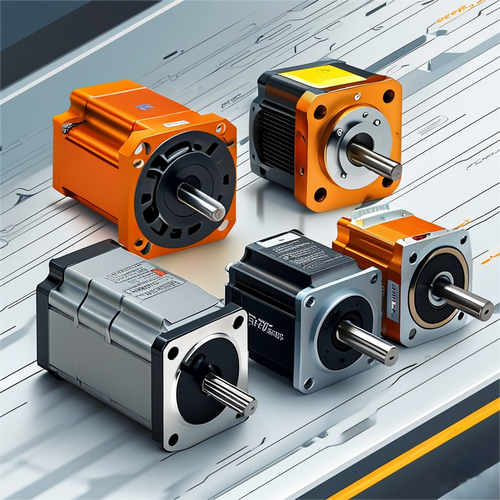
The easiest way is to look at your appearance. The servo is usually a small, square box with three wires sticking out of it. The output shaft can generally only rotate half a turn or one turn. If you search for “servo” on Taobao, the results will basically look like this, which is very typical. If you use your hands to break its output shaft, it won't be able to break it when the power is on, because it will try its best to hold its position.
The stepper motor looks like a traditional cylindrical motor, and may have a bunch of wires behind it, ranging from 4 to 6 wires. Its axis can rotate all the time without limit. Use your hands to twist its shaft. When it is not powered on, it is very smooth, but you can feel the frustration one by one. That is the permanent magnet inside making a "clicking" sound. After the power is turned on, it will be more laborious for you to move it.
The steering gear is definitely good news for beginners. There are three wires, the brown or black one is usually the ground wire, the red one is the positive pole of the power supply, and the orange or yellow one is the signal wire. Just find a microcontroller development board, connect it to the power supply, and write a few lines of code to get it running. Search "servo control" on Station B and you will find all nanny-level tutorials. If you follow them once, you will understand them immediately.
Stepper motors are a little troublesome and require a driver. Because the small body of the microcontroller cannot carry it. You have to connect the driver to the power supply, and then connect the pulse signal and direction signal from the microcontroller to the driver. Every time a pulse is given, the motor takes one step. If you want it to rotate faster, the pulses should be given more densely. This wiring is a little complicated, but after watching the video tutorial and connecting it again, it is not difficult.
This topic is interesting. The precision of the servo lies in its "closed-loop control". There is a small potentiometer inside it that always keeps an eye on its position. If you let it turn to 90 degrees, even if you break it with your hands, it will struggle to return to 90 degrees. So for angle control, it's very accurate and you can hit wherever you point.
The accuracy of a stepper motor lies in its "step angle", such as the most common 1.8 degrees, which means it takes 200 steps to make one revolution. In theory, every step is very precise, but if the load is too large, or the acceleration is too strong, it may "lose a step" - it fails to take a step when it should, and it doesn't even know it, and the position is off. Therefore, in some extremely demanding situations, feedback will be added to the stepper motor to become a "closed-loop stepper", which is quite invincible.
Man, when you start building a product, you have to be careful with your decisions. If your product needs to respond quickly and perform various complex actions, such as smart toys, automatic curtains, and PTZ cameras, then choose a servo with your eyes closed. The development cycle is short, the cost is low, and the effect is immediate.
If your product needs to move a certain distance accurately, or requires stable rotation speed, such as a desktop-level small CNC, automatic feeder, or 3D printer, then choose a stepper motor decisively. It has high torque, smooth operation, and is especially suitable for walking trails. The stupidest and most effective way is to first search for videos of similar products to see what others are using, then buy one and test it, run the program twice, and you will understand everything.
What fun projects have you been working on recently? Are you still stuck on choosing a motor? Don’t just think about it yourself, come to the comment section and speak up, and we’ll give you some advice together! If you think this article is useful to you, please like it and share it so that more friends who are just getting started can see it and avoid detours!
Update Time:2026-03-14

Contact Kpower's product specialist to recommend suitable motor or gearbox for your product.


