



























TECHNICAL SUPPORT


Published 2026-03-15
Are you also doing product innovation and encountering the problem of steering gear selection? Looking at the wide variety of microservoon the market, I wondered: What is the difference between this digitalservoand ordinary ones? How can I use it to make my project more outstanding? Don’t worry, today we will talk about micro digitalservos to help you clarify your thinking and avoid detours.
To put it bluntly, the core difference between digital servos and analog servos is the “brain”. The analog servo is controlled by sending continuous PWM signals. It receives instructions and then turns. The digital steering gear has an additional microprocessor inside, which is like a smart little housekeeper that can process signals and respond faster. This is like the difference between talking on the phone and face-to-face communication, the latter is more direct and efficient.
This microprocessor allows digital servos to update instructions at a higher frequency, usually above 300Hz, while analog servos are only about 50Hz. This means that the digital servo can control the motor more "finely" and the response time is greatly shortened. For example, if you want the servo to turn from 0 degrees to 90 degrees, the digital servo may start to move in just a few tenths of a second, while the analog servo will take half a beat slower.
The most obvious benefit is high accuracy. Because the control frequency is fast, the digital servo can fine-tune the position. Especially when it is necessary to pause or maintain a certain angle, it can "set" more stably without shaking around. This is great news for products such as robotic arms and camera heads that require precise operations. Your product’s movements will be smoother, and the user experience will naturally improve.
The second is fast reaction speed and strong power. The digital servo can provide greater torque at the moment of startup, making movements faster and more powerful. And its holding power is also stronger. When disturbed by external forces, it can return to the straight position more actively and maintain the set position. This is like an athlete with quick reactions, who can start quickly but also stand firm, so that your product will not fall off the chain at critical moments.
Programming digital servos is actually not that mysterious. If you have played it before, you will basically get started. Usually we use PWM signals for control, but some digital servos support higher-level protocols, such as serial port or I2C. All you need to do is check the data sheet of the servo to see which control method it supports. For example, simply write.write(angle)to make it move. Isn’t it very simple?
More advanced, you can use the PID control function inside the digital servo to set the speed and acceleration of movement through programming, and even implement complex trajectory planning. It's like giving the servo the ability to "think", allowing it to move smoothly according to the curve you set, instead of jumping stiffly. There are many open source libraries on the Internet, such as Servo.h, which are very convenient to call directly. If you spend some time to study them, you can get started quickly.
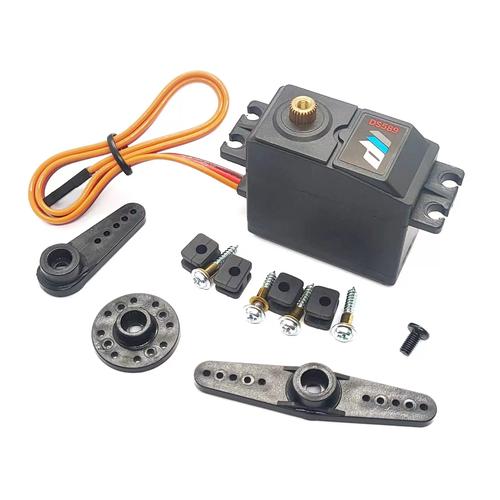
When choosing a servo, you first need to consider how much torque your product requires. Without enough torque, the servo cannot carry the load, for example, the robotic arm cannot lift. Usually the servo parameters are marked with "kg·cm", such as 1.5kg·cm, which means that a weight of 1.5kg can be lifted 1cm away from the axis. Based on your structure, estimate the required force and leave some margin. Don’t be cheap and choose one with a small torque, as it will be more troublesome to rework later.
Secondly consider size, weight and voltage. Micro servos generally refer to small sizes such as 9 grams and 12 grams, which are suitable for use on drones and small robots. The voltage should match the power supply of your system, common ones are 4.8V-6V. In addition, you also need to check whether the gears are plastic or metal. Metal gears are more wear-resistant and suitable for frequent use scenarios. Put these factors together and you can find the one that’s most suitable.
Digital servos are widely used and can be found in almost any smart product that requires small-angle reciprocating motion. For example, in a small humanoid robot, the servo is its joint, allowing the robot to walk and dance; another example is a camera gimbal in a smart home, which can use the servo to control the camera to rotate up, down, left, and right to achieve panoramic monitoring. Your creativity and servo can make the product come alive.
There are also things like robotic arms, 3D printer extruders, control surfaces for remote control models (cars, boats, airplanes), and even interactive devices in smart toys. It can be said that as long as you have an innovative idea and want to make a certain component move, digital servos are often a simple and reliable solution. Its popularity allows many makers’ ideas to quickly become reality, and you can try it too.
In terms of price, micro digital servos are actually quite affordable. An entry-level domestic digital servo may only cost a dozen or twenty yuan. Of course, if it is a brand product, such as some Japanese or German brands, or one with special functions (such as metal gears, waterproofing, high-precision feedback), the price may reach tens or even hundreds of yuan. It all depends on your budget and product positioning. There is no need to blindly pursue expensive ones.
When purchasing, it is recommended that you read more user reviews, especially the experience of those who have done similar projects. In addition, be sure to find reliable suppliers to avoid buying fake or inferior products. You can start with a small batch trial purchase, and then purchase in large quantities after the test is OK. If you want to know the latest prices and models, you can directly search on the official websites of some steering gear manufacturers, such as the official website of a certain company, which usually has detailed product lines and quotations.
Have you encountered any interesting problems or encountered any pitfalls when using digital servos for projects? Welcome to leave a message in the comment area to share your experience. If you think this article is helpful to you, please like it and forward it to more friends who need it!
Update Time:2026-03-15

Contact Kpower's product specialist to recommend suitable motor or gearbox for your product.


