



























TECHNICAL SUPPORT


Published 2026-03-30
Have you ever been stumped by the "small and light steering gear" when making micro-robots, mini-robots or model airplanes? There is only a tiny bit of space, an ordinaryservocannot fit in, and the weight is excessive.The 1.7gservowas born to solve these pain points. How amazing is it? Let’s break it apart and talk about it today.
Many friends will encounter an embarrassing situation when working on micro projects: the drawings are beautiful, but they find that the ordinary 9gservois too big, and forcing it in not only affects the center of gravity, but also makes the entire structure look bulky. This is the moment whenthe 1.7g servocomes on stage. Its volume is only one-fifth of the traditional micro servo, and its weight is so light that it can be ignored. It is simply a "joint" tailor-made for micro robots.
You may want to ask, is such a small thing strong enough? Don't worry, although it only has 1.7 grams, the locked-rotor torque can usually reach about 0.15kg/cm, which is more than enough for rudder control of micro quadruped robots, small manipulators, and even ultra-lightweight model aircraft. Simply put, as long as your load is not large, it can help you solve the two major problems of space and weight in a "four or two" way.
After usingthe 1.7g servo, your work will become "light as a swallow". ️ For example, when making a miniature bipedal robot, each joint of the leg is used, and the weight of the entire leg may not be as heavy as a coin. In this way, the motor will be driven very easily, the response speed will be very fast, and the movements will naturally be more sensitive and coherent.
Moreover, such small servos are generally digital servos. What is the difference between digital servos and ordinary servos? The response of the ordinary servo is half a beat slower, but the control signal frequency of the digital servo is higher. If you ask it to move, it will click into place without the sluggish feeling. For robots that need to perform complex dance movements or precise grasping, this kind of precise control of "hit where you point" is the key to improving the high-level sense of the work.
The 1.7g servoson the market all look similar, but the prices range from more than ten yuan to dozens of yuan. How can you choose one without getting into trouble? 1. Look at the material. The gears of high-quality servos are usually made of metal or high-strength plastic. The teeth of inferior plastics will be worn out after a few uses, which is fatal for joints that require frequent movement. 2. Look at the wire length and connectors. This kind of micro servo usually uses a 1.25mm or SH1.0 interface. When purchasing, remember to confirm whether it matches the interface of your main control board, otherwise you will have to solder the wires yourself after buying it.
In addition, don’t just look at the nominal parameters, but also look at the reputation. You can go to the maker community or the product details page to watch the "load test" video. Some businesses will measure the speed without load in order to make the data look better, but what we want to see is whether it will shake the rudder and heat up when carrying a small load. As a product innovator, stability is much more important than that little bit of performance improvement. After all, if your work is often "twitchy", the experience will directly return to zero.
When it comes to wiring, many novices may panic, but in fact there is no need at all.A 1.7g servousually has three wires: brown or black is the ground wire (GND), red is the power wire (VCC), and orange or yellow is the signal wire (PWM). You only need to connect the power supply and the signal line to the PWM pin of the microcontroller (for example, STM32), and then call the servo library file, and you can get it moving in basically 10 minutes.
What should I do if the servo does not turn or turns randomly? Don't panic yet, it's most likely due to insufficient power supply or signal conflict. Althoughthe 1.7g servois small, the current will have a small peak at the moment of startup. If you use the computer USB to directly power the servo, multiple servos may be powered off and restarted if they are activated at the same time. It is recommended to directly use a lithium battery or voltage stabilizing module to power the servo separately. The signal line and the control board share the same ground, so that you can play stably.
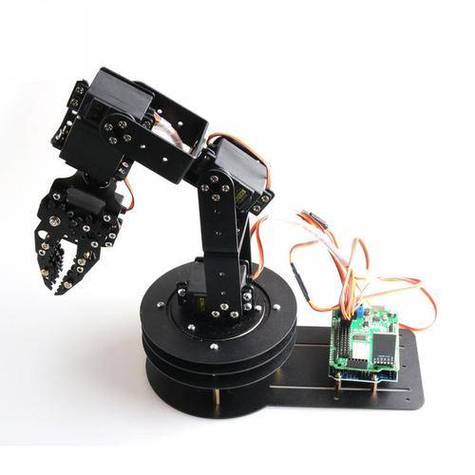
Even though it's small, it has a lot of tricks to play with. ️ You can use it to make a micro manipulator, with 5 fingers installed on each joint. A palm-sized manipulator can complete complex actions such as grabbing and pinching, and directly transform into a desktop-level "Iron Man". Or use it to make a miniature quadruped robot. Eight servos can make a palm-sized robot walk and roll. It is definitely an eye-catching artifact when placed in the office.
If you like model aircraft, it is a savior for DIY miniature fixed-wing or helicopter. When an ordinary servo is installed on a mini aircraft, it is like an elephant riding a skateboard. But after this1.7g servois installed, the attitude control of the aircraft is extremely sensitive, and you can even hover in the living room. As long as you dare to think, it can become the strongest puzzle piece for you to realize those "crazy ideas", allowing your works to find a unique path on the road to miniaturization.
Since it is so easy to use, where can I buy it with confidence? I suggest you first go to a professional model aircraft or robot accessories mall, such as those large platforms that make open source hardware all year round. Their servos usually have detailed parameter tables and user reviews, and the information is relatively transparent. In addition, you can also go to Bilibili or search for "1.7g servoreview" to see the actual feedback from other makers, which is much more reliable than reading advertisements.
When you plan to purchase in bulk for product innovation, it is recommended to directly search for "miniature servo source manufacturer" or "1.7g servosupplier" to find those manufacturers that have physical factories and support customized line lengths and interfaces. When contacting them, remember to ask them for an "aging test report" to see if they have a quality inspection process. A good supplier can not only ensure that the samples you have on hand are easy to use, but also ensure that the hundreds of servos you produce during mass production are equally stable, which is crucial to the reputation of your product.
When developing your own products, in addition to weight and volume, what other "hidden pain points" do you think this micro-servo can help you solve? Welcome to share your practical experience in the comment area. If you find this article useful, don’t forget to like and forward it so that more maker friends can avoid detours!
Update Time:2026-03-30

Contact Kpower's product specialist to recommend suitable motor or gearbox for your product.


