



























TECHNICAL SUPPORT


Published 2026-02-15
When you are engaged in product innovation, do you always feel that it is not interesting to applyservos to aircraft such as missiles? Either the response is not fast enough, or the accuracy cannot be achieved, or it starts to vibrate while flying. In fact, it's probably not that theservoitself is bad, but that you didn't choose the right model, or didn't understand how to make it work well with the flight control system. Let’s talk about this today and help you break this issue into pieces and explain it clearly.
When choosing aservo, you really can’t just look at torque and size. You have to first figure out what your missiles are for. For example, whether it is a short-range loitering missile or a high-speed target missile, their requirements for steering gear are very different. For short distances, an ordinary brushless servo may be sufficient, but if it is flying at high speed, then you have to consider a special servo that is resistant to high temperatures and overload. A little trick is to look directly at the "response speed" and "locked-rotor torque" curves provided by the steering gear manufacturer. Don't just look at the static parameters, dynamic performance is the key.
You can think of the steering surface as the tires of a car, and the steering gear as the booster that turns the steering wheel. If a missile needs to turn to avoid or strike accurately in the air, it all depends on the rapid deflection of the rudder surface. If the servo is half a beat slower and takes a long time to move after the command is given, the trajectory of the missile will be as if it is drunk, swaying. Especially during terminal guidance, if the target moves slightly and the servo does not respond in time, it may miss it. Therefore, the response speed of the servo directly determines whether the missile can make that kind of "sharp turn" that is surprising to people.
Many of the old-fashioned servos in the past had brush motors, but now the newly designed missiles have basically switched to brushless servos. What's the difference? For example, the brushed one is like an old-fashioned electric fan, which makes a lot of noise when rotating, and the carbon brushes are easy to wear; the brushless one is like today's inverter air conditioner, which is quiet and durable. When used on missiles, the advantages of brushless servos are high efficiency, the same battery can fly longer; and there are no sparks, which is safer; the most important thing is long life and high reliability. Think about it, if the missile flies so fast, if the steering gear wears out halfway, something serious will happen.
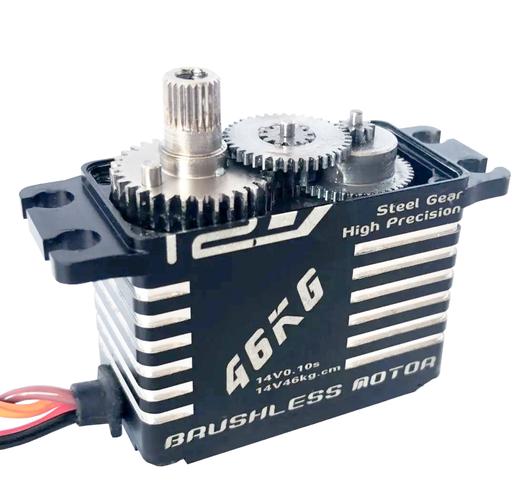
Many friends think that the servo and flight control can work together perfectly just by connecting them online. In fact, it is not that simple. There is a "temper" that needs to be tempered. The flight controller calculates an angle for the servos to turn there, but the servos have their own physical limits and inertia. You have to adjust the PID parameters of the flight control specifically for the characteristics of the servo. For example, if the servo responds quickly but easily (overshoots), then the integral or differential time must be appropriately reduced. This process is a bit like training a horse. You have to follow its temperament in order to run fast and steadily.
Suddenly losing control while flying, or the steering surface gets stuck, which is the most troublesome thing. Most of the faults occur in three places: first, the servo itself is overloaded, for example, the airflow impact during flight is too large and exceeds the design range; second, the control signal is interfered with and the line shielding is not done well; third, the mechanical structure is jammed, there are foreign objects, or the assembly accuracy is insufficient. It is also simple to solve. Leave enough margin when selecting, provide electromagnetic shielding on the wiring, and check carefully during assembly. Don't bother, these details are often the key to success or failure.
Accuracy is a matter of a thousand miles. There is something called a potentiometer or encoder in the steering gear. It is the "eye" of the steering gear and tells the controller where to turn now. The higher the resolution of this "eye", the more accurate the steering surface positioning will be. Imagine that you want to aim at a window hundreds of meters away. The accuracy of the servo is not very good, and the target may be off by several meters. Therefore, if you want to hit accurately, you must use high-precision servos and cooperate with the flight controller for closed-loop control so that every degree of deflection is accurate.
In fact, if you master the steering gear, your missile innovation project will be more than half successful. There are many details involved, such as the differences between different control algorithms or the performance degradation in high-temperature environments, which cannot be explained in one article.What is the most difficult problem you have encountered during the steering gear selection or debugging process?Welcome to leave a message in the comment area and let’s discuss it together. If you find the article useful, don’t forget to like and share it so that more friends who make products can see it.
Update Time:2026-02-15

Contact Kpower's product specialist to recommend suitable motor or gearbox for your product.


